Balachandran Shanoob, Zachariah Zita, Fischer Alfons, Mayweg David, Wimmer Markus A, Raabe Dierk, Herbig Michael
Department Microstructure Physics and Alloy Design Max-Planck-Institut für Eisenforschung GmbH Max-Planck-Straße 1 Düsseldorf 40237 Germany.
Department of Orthopedic Surgery Rush University Medical Center 1611 W. Harrison St. Chicago IL 60612 USA.
Adv Sci (Weinh). 2020 Jan 21;7(5):1903008. doi: 10.1002/advs.201903008. eCollection 2020 Mar.
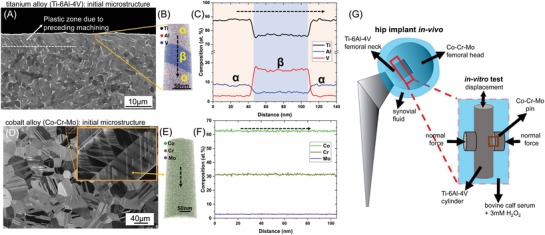
Millions worldwide suffer from arthritis of the hips, and total hip replacement is a clinically successful treatment for end-stage arthritis patients. Typical hip implants incorporate a cobalt alloy (Co-Cr-Mo) femoral head fixed on a titanium alloy (Ti-6Al-4V) femoral stem via a Morse taper junction. However, fretting and corrosion at this junction can cause release of wear particles and metal ions from the metallic implant, leading to local and systemic toxicity in patients. This study is a multiscale structural-chemical investigation, ranging from the micrometer down to the atomic scale, of the underlying mechanisms leading to metal ion release from such taper junctions. Correlative transmission electron microscopy and atom probe tomography reveals microstructural and compositional alterations in the subsurface of the titanium alloy subjected to in vitro gross-slip fretting against the cobalt alloy. Even though the cobalt alloy is comparatively more wear-resistant, changes in the titanium alloy promote tribocorrosion and subsequent degradation of the cobalt alloy. These observations regarding the concurrent occurrence of electrochemical and tribological phenomena are vital to further improve the design and performance of taper junctions in similar environments.
全球数以百万计的人患有髋关节关节炎,全髋关节置换术是终末期关节炎患者临床上成功的治疗方法。典型的髋关节植入物包括一个通过莫氏锥度连接固定在钛合金(Ti-6Al-4V)股骨柄上的钴合金(Co-Cr-Mo)股骨头。然而,该连接处的微动和腐蚀会导致金属植入物磨损颗粒和金属离子的释放,从而导致患者出现局部和全身毒性。本研究是一项从微米级到原子级的多尺度结构化学研究,旨在探究导致此类锥度连接金属离子释放的潜在机制。相关的透射电子显微镜和原子探针断层扫描揭示了在体外与钴合金发生大滑移微动时,钛合金亚表面的微观结构和成分变化。尽管钴合金相对更耐磨,但钛合金的变化会促进摩擦腐蚀以及随后钴合金的降解。这些关于电化学和摩擦学现象同时发生的观察结果对于进一步改善类似环境中锥度连接的设计和性能至关重要。