Wang Haiyong, Fu Linhai, Wei Desheng, Wang Bin, Zhang Chu, Zhu Ting, Ma Zhifeng, Li Zhupeng, Wu Yuanlin, Yu Guangmao
Department of Thoracic and Cardiovascular Surgery, Shaoxing People's Hospital (Shaoxing Hospital, Zhejiang University School of Medicine), Shaoxing, China.
Front Bioeng Biotechnol. 2020 Feb 20;8:75. doi: 10.3389/fbioe.2020.00075. eCollection 2020.
In the present study, we tried to describe the role of miR-29c-3p in esophageal carcinoma (EC) and the relationship of miR-29c-3p with CCNA2 as well as cell cycle, accordingly revealing the potential molecular mechanism across cell proliferation, migration and invasion.
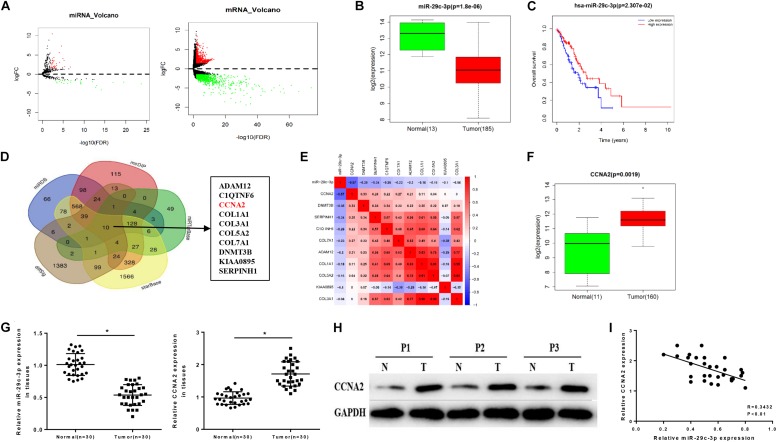
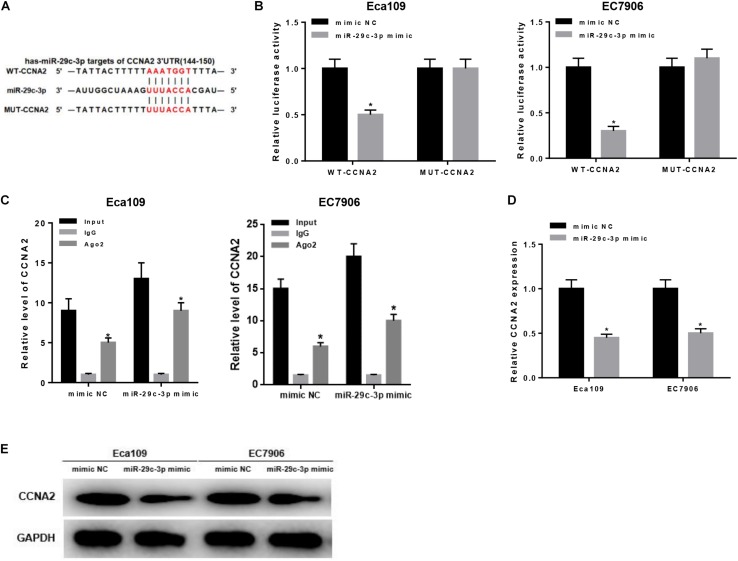
Expression profiles of EC miRNAs and matched clinical data were accessed from TCGA database for differential and survival analyses. Bioinformatics databases were employed to predict the downstream targets of the potential miRNA, and enrichment analysis was performed on the miRNA and corresponding target gene using GSEA software. qRT-PCR was conducted to detect the expression levels of miR-29c-3p and CCNA2 mRNA in EC tissues and cells, and Western blot was performed for the examination of CCNA2, CDK1 and p53 protein levels. Subsequently, cells were harvested for MTT, Transwell as well as flow cytometry assays to examine cell viability, migration, invasion and cell cycle. Dual-luciferase reporter gene assay and RIP were carried out to further investigate and verify the targeted relationship between miR-29c-3p and CCNA2.
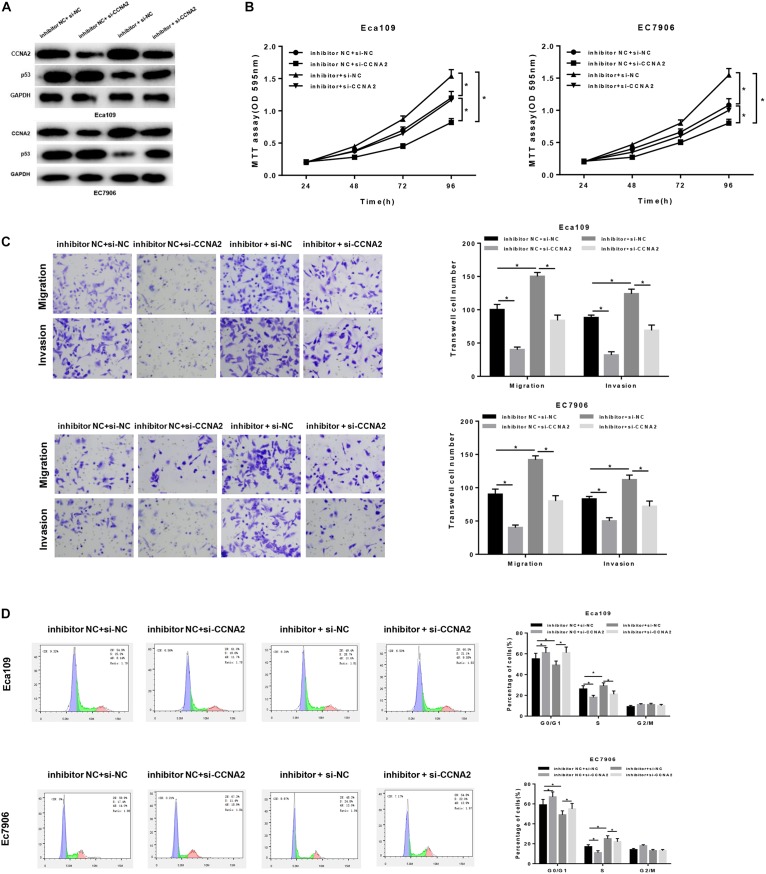
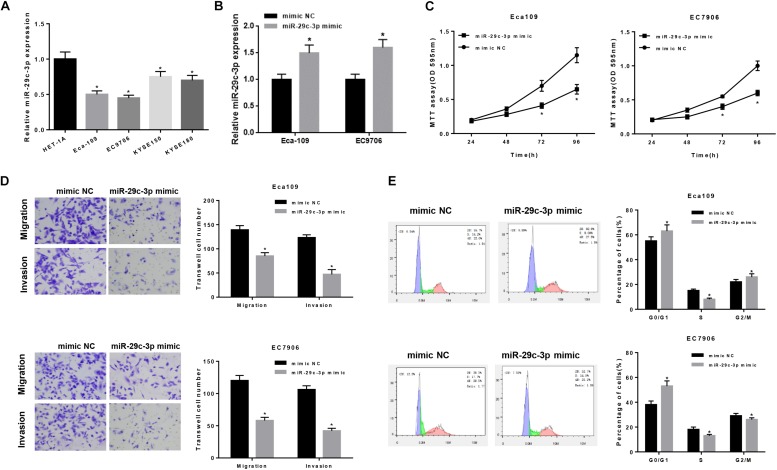
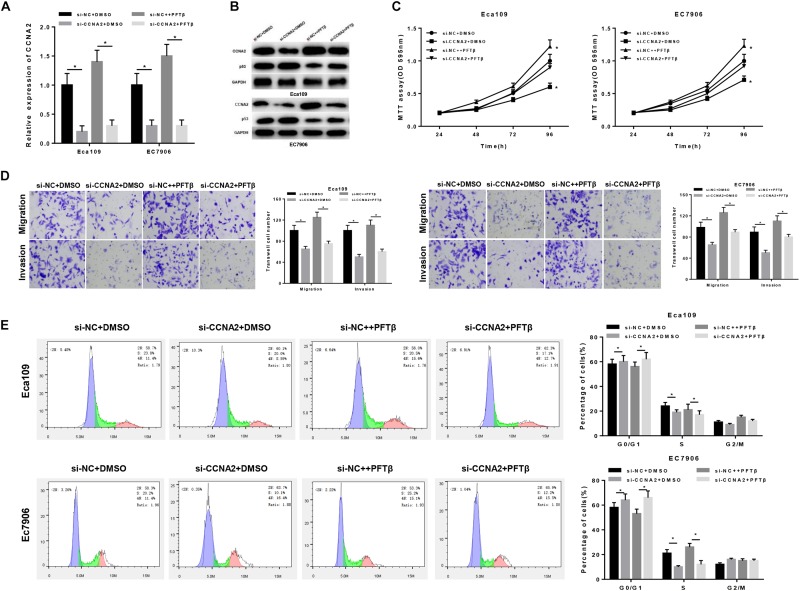
MiR-29c-3p was shown to be significantly down-regulated in EC tissues and able to predict poor prognosis. CCNA2 was found to be a downstream target of miR-29c-3p and mainly enriched in cell cycle and p53 signaling pathway, whereas miR-29c-3p was remarkably activated in cell cycle. MiR-29c-3p overexpression inhibited cell proliferation, migration and invasion, as well as arrested cells in G0/G1 phase. As suggested by dual-luciferase reporter gene assay and RIP, CCNA2 was under the regulation of miR-29c-3p, and the negative correlation between the two genes was verified. Silencing CCNA2 could suppress cell proliferation, migration and invasion, as well as activate p53 pathway, even was seen to reverse the inhibitory effect of PFTβ on p53. Besides, in the presence of low miR-29c-3p, CCNA2 was up-regulated while p53 was simultaneously inhibited, resulting in the promotion of cell migration, invasion and cell cycle arrest.
MiR-29c-3p plays a regulatory role in EC tumorigenesis and development. MiR-29c-3p can target CCNA2 to mediate p53 signaling pathway, finally attributing to the inhibition of cell proliferation, migration and invasion, and making cells arrest in G0/G1 phase.
在本研究中,我们试图描述miR-29c-3p在食管癌(EC)中的作用以及miR-29c-3p与CCNA2的关系及其与细胞周期的关系,从而揭示细胞增殖、迁移和侵袭过程中的潜在分子机制。
从TCGA数据库获取EC miRNA的表达谱及匹配的临床数据进行差异分析和生存分析。利用生物信息学数据库预测潜在miRNA的下游靶点,并使用GSEA软件对miRNA及其相应靶基因进行富集分析。采用qRT-PCR检测EC组织和细胞中miR-29c-3p和CCNA2 mRNA的表达水平,采用蛋白质免疫印迹法检测CCNA2、CDK1和p53蛋白水平。随后,收集细胞进行MTT、Transwell及流式细胞术检测,以检测细胞活力、迁移、侵袭和细胞周期。进行双荧光素酶报告基因检测和RIP实验,进一步研究和验证miR-29c-3p与CCNA2之间的靶向关系。
miR-29c-3p在EC组织中显著下调,且可预测预后不良。发现CCNA2是miR-29c-3p的下游靶点,主要富集于细胞周期和p53信号通路,而miR-29c-3p在细胞周期中显著激活。miR-29c-3p过表达抑制细胞增殖、迁移和侵袭,并使细胞停滞于G0/G1期。双荧光素酶报告基因检测和RIP实验表明,CCNA2受miR-29c-3p调控,验证了两个基因之间的负相关关系。沉默CCNA2可抑制细胞增殖、迁移和侵袭,并激活p53通路,甚至可逆转PFTβ对p53的抑制作用。此外,在miR-29c-3p低表达时,CCNA2上调而p53同时被抑制,导致细胞迁移、侵袭增加及细胞周期停滞。
miR-29c-3p在EC的发生发展中起调节作用。miR-29c-3p可靶向CCNA2介导p53信号通路,最终抑制细胞增殖、迁移和侵袭,并使细胞停滞于G0/G1期。