1The State Key Laboratory of Bioactive Substance and Function of Natural Medicines, Beijing, China.
2Key Laboratory of Drug Target Research and Drug Screen, Institute of Materia Medica, Chinese Academy of Medical Science and Peking Union Medical College, Beijing, 100050 China.
Clin Epigenetics. 2018 May 16;10:64. doi: 10.1186/s13148-018-0495-y. eCollection 2018.
miR-29c has been associated with the progression of many cancers. However, the function and mechanism of miR-29c have not been well investigated in breast cancers.
Real-time quantitative PCR was used to assess expression of miR-29c and DNMT3B mRNA. Western blot and immunochemistry were used to examine the expression of DNA methyltransferase 3B (DNMT3B) protein in breast cancer cells and tissues. The functional roles of miR-29c in breast cancer cells such as proliferation, migration, invasion, colony formation, and 3D growth were evaluated using MTT, transwell chambers, soft agar, and 3D Matrigel culture, respectively. In addition, the luciferase reporter assay was used to check if miR-29c binds the 3'UTR of DNMT3B. The effects of miR-29c on the DNMT3B/TIMP3/STAT1/FOXO1 pathway were also examined using Western blot and methyl-specific qPCR. The specific inhibitor of STAT1, fludarabine, was used to further check the mechanism of miR-29c function in breast cancer cells. Studies on cell functions were carried out in DNMT3B siRNA cell lines.
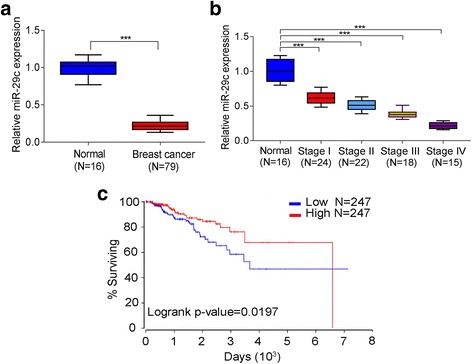
The expression of miR-29c was decreased with the progression of breast cancers and was closely associated with an overall survival rate of patients. Overexpression of miR-29c inhibited the proliferation, migration, invasion, colony formation, and growth in 3D Matrigel while knockdown of miR-29c promoted these processes in breast cancer cells. In addition, miR-29c was found to bind 3'UTR of DNMT3B and inhibits the expression of DNMT3B, which was elevated in breast cancers. Moreover, the protein level of TIMP3 was reduced whereas methylation of TIMP3 was increased in miR-29c knockdown cells compared to control. On the contrary, the protein level of TIMP3 was increased whereas methylation of TIMP3 was reduced in miR-29c-overexpressing cells compared to control. Knockdown of DNMT3B reduced the proliferation, migration, and invasion of breast cancer cell lines. Finally, our results showed that miR-29c exerted its function in breast cancers by regulating the TIMP3/STAT1/FOXO1 pathway.
The results suggest that miR-29c plays a significant role in suppressing the progression of breast cancers and that miR-29c may be used as a biomarker of breast cancers.
miR-29c 与许多癌症的进展有关。然而,miR-29c 在乳腺癌中的功能和机制尚未得到充分研究。
实时定量 PCR 用于评估 miR-29c 和 DNMT3B mRNA 的表达。Western blot 和免疫组化用于检测乳腺癌细胞和组织中 DNA 甲基转移酶 3B(DNMT3B)蛋白的表达。使用 MTT、Transwell 室、软琼脂和 3D Matrigel 培养分别评估 miR-29c 在乳腺癌细胞中的增殖、迁移、侵袭、集落形成和 3D 生长等功能作用。此外,还使用荧光素酶报告基因检测来检查 miR-29c 是否与 DNMT3B 的 3'UTR 结合。还使用 Western blot 和甲基特异性 qPCR 检查 miR-29c 对 DNMT3B/TIMP3/STAT1/FOXO1 通路的影响。使用 STAT1 的特异性抑制剂氟达拉滨进一步检查 miR-29c 在乳腺癌细胞中的功能机制。在 DNMT3B siRNA 细胞系中进行细胞功能研究。
miR-29c 的表达随着乳腺癌的进展而降低,与患者的总生存率密切相关。miR-29c 的过表达抑制了乳腺癌细胞的增殖、迁移、侵袭、集落形成和 3D Matrigel 中的生长,而 miR-29c 的敲低则促进了这些过程。此外,发现 miR-29c 结合了 DNMT3B 的 3'UTR 并抑制了其表达,而 DNMT3B 在乳腺癌中升高。此外,与对照相比,miR-29c 敲低细胞中的 TIMP3 蛋白水平降低,而 TIMP3 的甲基化增加。相反,与对照相比,miR-29c 过表达细胞中的 TIMP3 蛋白水平增加,而 TIMP3 的甲基化减少。DNMT3B 的敲低减少了乳腺癌细胞系的增殖、迁移和侵袭。最后,我们的结果表明,miR-29c 通过调节 TIMP3/STAT1/FOXO1 通路在乳腺癌中发挥作用。
研究结果表明,miR-29c 在抑制乳腺癌的进展中发挥重要作用,miR-29c 可作为乳腺癌的标志物。