Tianjin Medical University Cancer Institute and Hospital, National Clinical Research Center for Cancer, Tianjin, China.
Key Laboratory of Cancer Prevention and Therapy, Tianjin, China.
Thorac Cancer. 2020 May;11(5):1139-1148. doi: 10.1111/1759-7714.13354. Epub 2020 Mar 10.
Vascular endothelial growth factor C (VEGFC), an activator of lymphangiogenesis, is newly identified as an immunomodulator which can regulate the immune system so that tumor cells more easily escape immune surveillance. Evidence has shown programmed cell death-ligand 1 (PD-L1) can also suppress the immune response. Nevertheless, the clinical significance of co-expression of VEGFC and PD-L1 for predicting outcomes in patients with lung adenocarcinoma has not yet been determined.
A total of 114 patients with lung adenocarcinoma who underwent surgeries at Tianjin Medical University Cancer Institute and Hospital between December 2011 and September 2016 were retrospectively reviewed. Tissue specimens were collected for immunohistochemistry of VEGFC and PD-L1 which were analyzed with an H-score system.
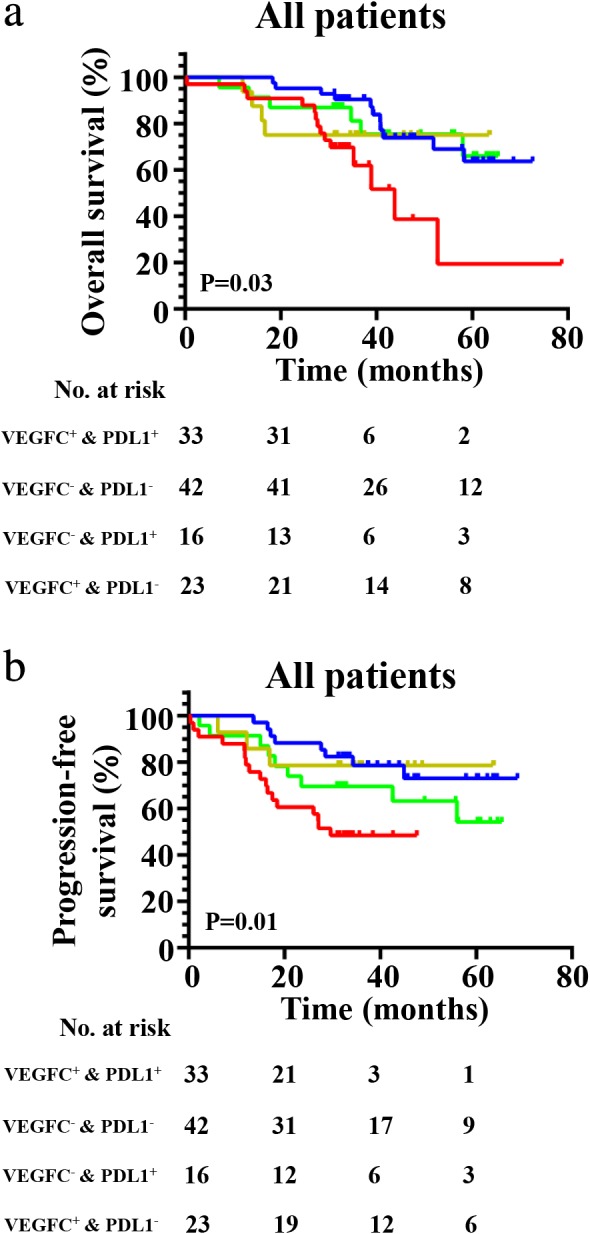
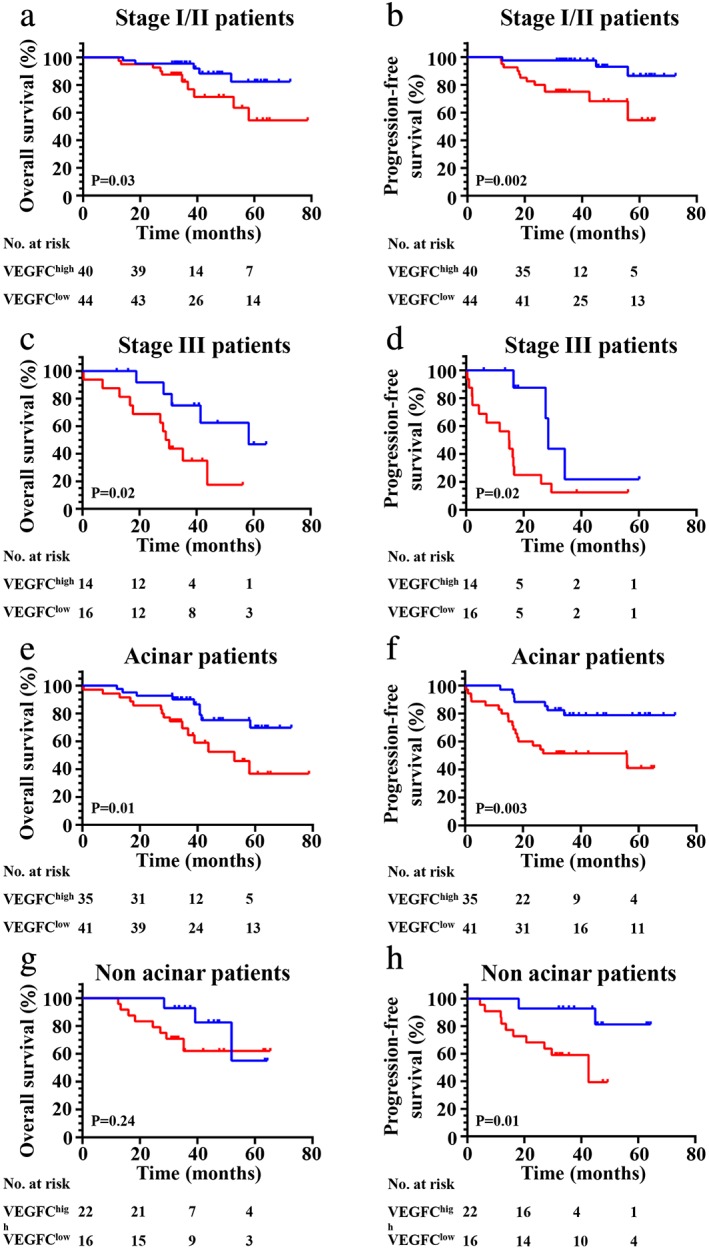
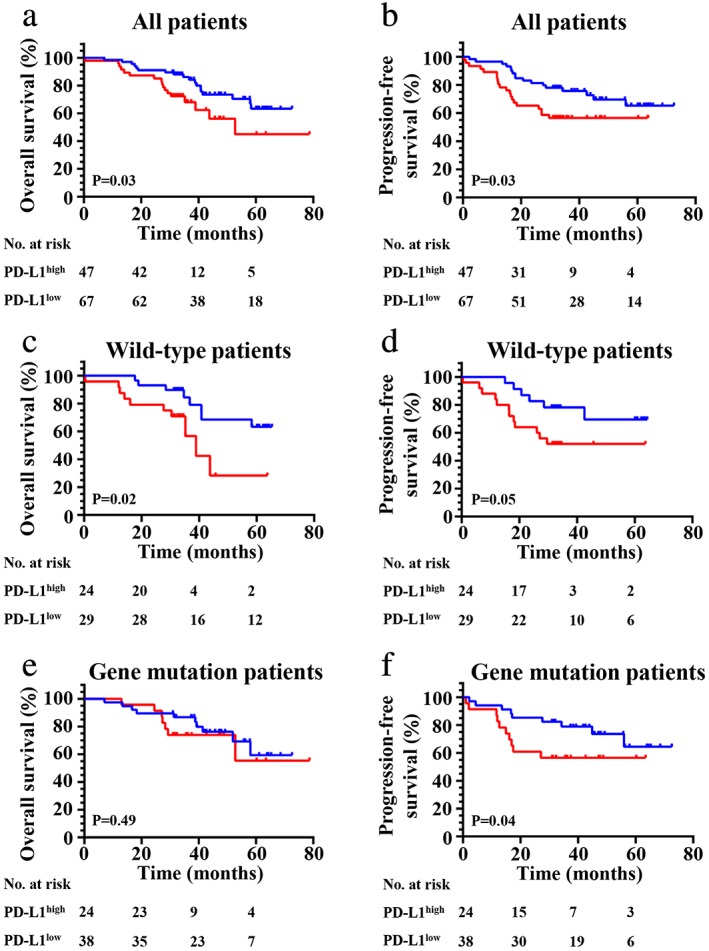
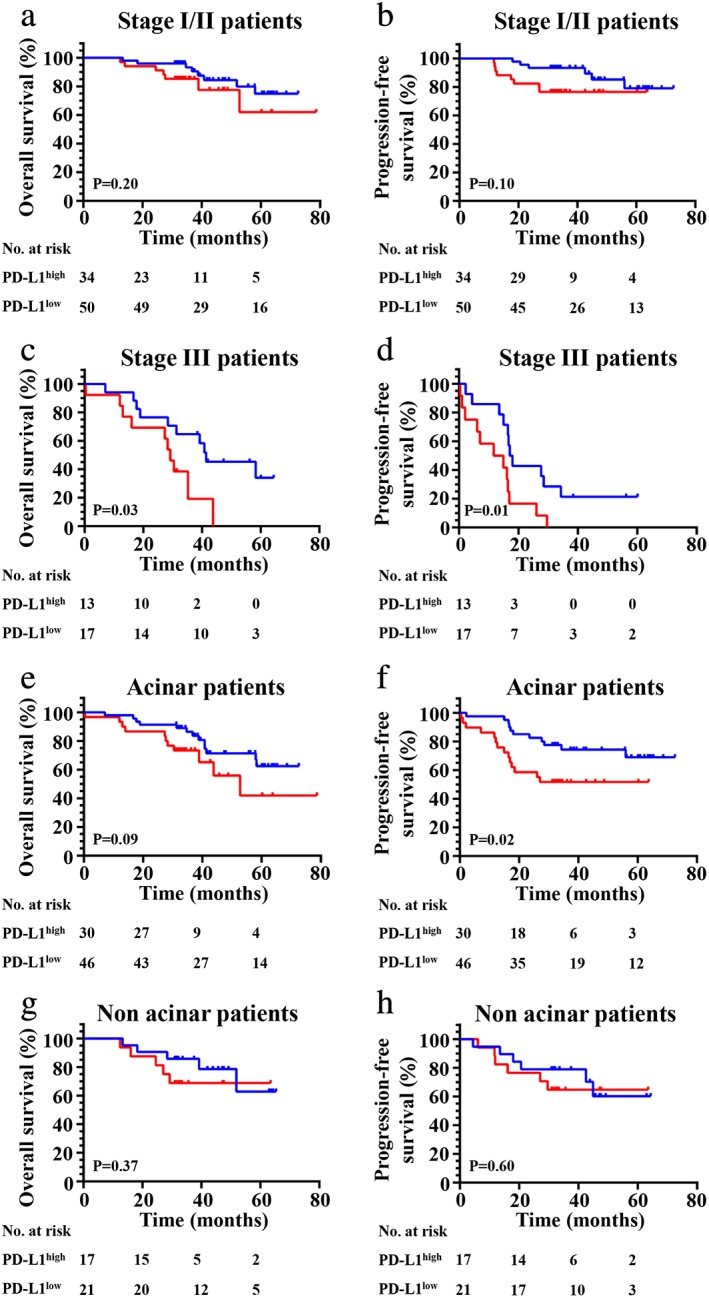
In this study, 57 (50.0%) and 47 (41.2%) patients were classified as VEGFC high expression and PD-L1 high expression. Co-expression was observed in 33 (28.9%) patients. In addition, a positive correlation was found between VEGFC and PD-L1 (P = 0.0398, r = 0.1937). In a univariate analysis, both progression-free survival (PFS) and overall survival (OS) were significantly worse in the VEGFC high expression group and the PD-L1 high expression group, respectively. Furthermore, VEGFC/PD-L1 co-expression showed a worse OS (P = 0.03) and PFS survival (P = 0.01) than the other groups.
Taken together, these results indicate that VEGFC/PD-L1 co-expression can forecast both poor OS and PFS in patients with resected lung adenocarcinoma. Co-expression of VEGFC and PD-L1 may serve as a significant prognostic factor for patients with lung adenocarcinoma.
VEGFC/PD-L1 co-expression forecasts poor survival in patients with resected lung adenocarcinoma. VEGFC/PD-L1 co-expression may be used as a prognostic indicator and provide the theoretical possibility to screen the optimal population with a combination of anti-VEGFC and anti-PD-L1 therapy in the clinical treatment.
血管内皮生长因子 C(VEGFC)是淋巴管生成的激活剂,最近被鉴定为一种免疫调节剂,可调节免疫系统,使肿瘤细胞更容易逃避免疫监视。已有证据表明程序性细胞死亡配体 1(PD-L1)也可以抑制免疫反应。然而,血管内皮生长因子 C(VEGFC)和 PD-L1 共表达对预测肺腺癌患者预后的临床意义尚未确定。
回顾性分析 2011 年 12 月至 2016 年 9 月在天津医科大学肿瘤医院接受手术治疗的 114 例肺腺癌患者。采用免疫组织化学法检测 VEGFC 和 PD-L1 的表达,并用 H 评分系统进行分析。
本研究中,57 例(50.0%)和 47 例(41.2%)患者被归类为 VEGFC 高表达和 PD-L1 高表达。33 例(28.9%)患者出现共表达。此外,还发现 VEGFC 与 PD-L1 之间存在正相关(P=0.0398,r=0.1937)。单因素分析显示,VEGFC 高表达组和 PD-L1 高表达组患者的无进展生存期(PFS)和总生存期(OS)均显著降低。此外,与其他组相比,VEGFC/PD-L1 共表达组的 OS(P=0.03)和 PFS 生存(P=0.01)更差。
综上所述,这些结果表明,VEGFC/PD-L1 共表达可预测肺腺癌患者的不良 OS 和 PFS。VEGFC/PD-L1 共表达可能是肺腺癌患者的一个重要预后因素。
VEGFC/PD-L1 共表达预测肺腺癌患者预后不良。VEGFC/PD-L1 共表达可作为一种预后指标,并为临床治疗中联合抗 VEGFC 和抗 PD-L1 治疗筛选最佳人群提供理论可能性。