Department of Psychiatry, University of Pittsburgh School of Medicine, Pittsburgh, PA, United States.
School of Systems and Enterprises, Stevens Institute of Technology, Hoboken, NJ, United States.
JMIR Mhealth Uhealth. 2020 Mar 10;8(3):e16240. doi: 10.2196/16240.
Mobile assessment of the effects of acute marijuana on cognitive functioning in the natural environment would provide an ecologically valid measure of the impacts of marijuana use on daily functioning.
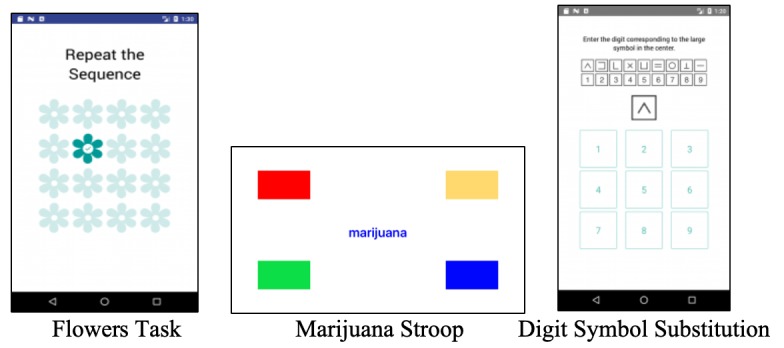
This study aimed to examine the association of reported acute subjective marijuana high (rated 0-10) with performance on 3 mobile cognitive tasks measuring visuospatial working memory (Flowers task), attentional bias to marijuana-related cues (marijuana Stroop), and information processing and psychomotor speed (digit symbol substitution task [DSST]). The effect of distraction as a moderator of the association between the rating of subjective marijuana high and task performance (ie, reaction time and number of correct responses) was explored.
Young adults (aged 18-25 years; 37/60, 62% female) who reported marijuana use at least twice per week were recruited through advertisements and a participant registry in Pittsburgh, Pennsylvania. Phone surveys and mobile cognitive tasks were delivered 3 times per day and were self-initiated when starting marijuana use. Completion of phone surveys triggered the delivery of cognitive tasks. Participants completed up to 30 days of daily data collection. Multilevel models examined associations between ratings of subjective marijuana high (rated 0-10) and performance on each cognitive task (reaction time and number of correct responses) and tested the number of distractions (rated 0-4) during the mobile task session as a moderator of the association between ratings of subjective marijuana high and task performance.
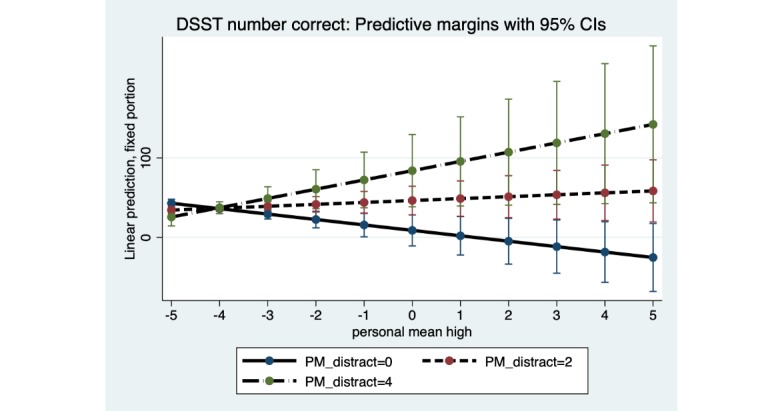
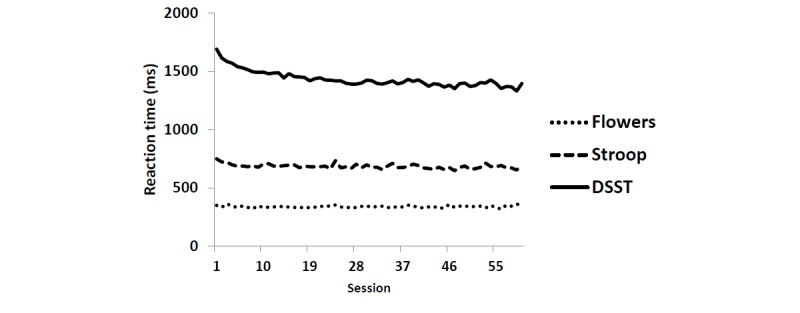
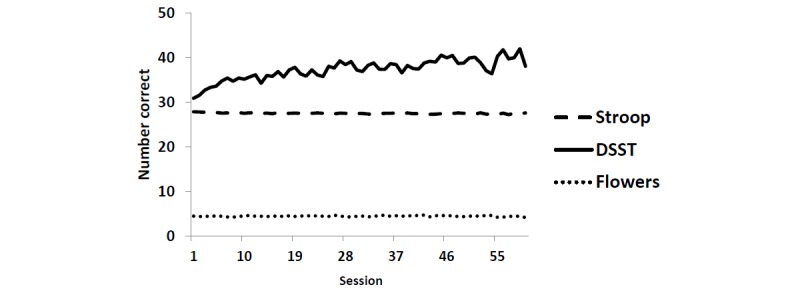
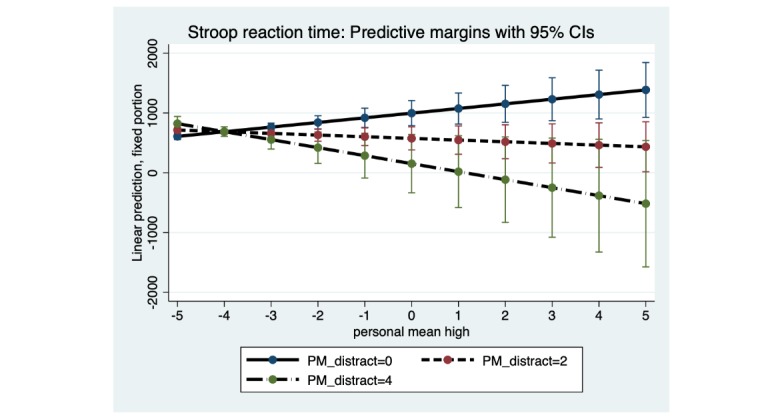
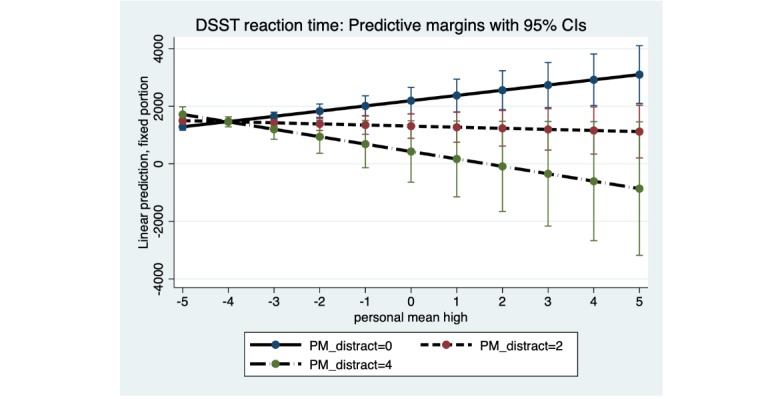
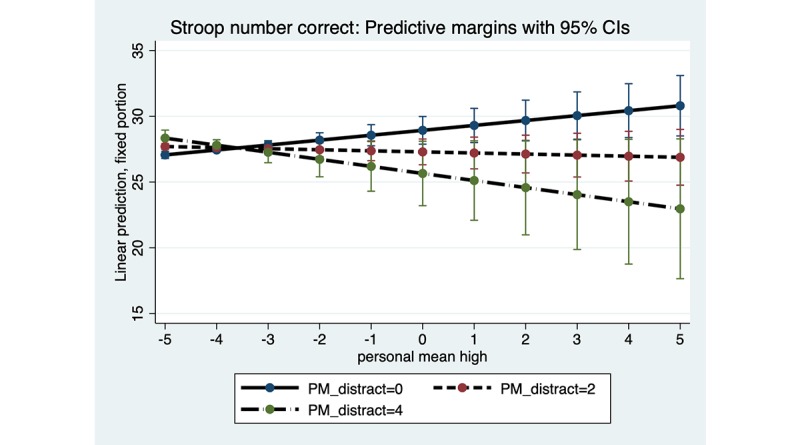
Participants provided 2703 data points, representing 451 reports (451/2703, 16.7%) of marijuana use. Consistent with slight impairing effects of acute marijuana use, an increase in the average rating of subjective marijuana high was associated with slower average reaction time on all 3 tasks-Flowers (B=2.29; SE 0.86; P=.008), marijuana Stroop (B=2.74; SE 1.09; P=.01), and DSST (B=3.08; SE 1.41; P=.03)-and with fewer correct responses for Flowers (B=-0.03; SE 0.01; P=.01) and DSST (B=-0.18; SE 0.07; P=.01), but not marijuana Stroop (P=.45). Results for distraction as a moderator were statistically significant only for certain cognitive tasks and outcomes. Specifically, as hypothesized, a person's average number of reported distractions moderated the association of the average rating of subjective marijuana high (over and above a session's rating) with the reaction time for marijuana Stroop (B=-52.93; SE 19.38; P=.006) and DSST (B=-109.72; SE 42.50; P=.01) and the number of correct responses for marijuana Stroop (B=-0.22; SE 0.10; P=.02) and DSST (B=4.62; SE 1.81; P=.01).
Young adults' performance on mobile cognitive tasks in the natural environment was associated with ratings of acute subjective marijuana high, consistent with slight decreases in cognitive functioning. Monitoring cognitive functioning in real time in the natural environment holds promise for providing immediate feedback to guide personal decision making.
在自然环境中移动评估急性大麻对认知功能的影响将提供对大麻使用对日常功能影响的生态有效衡量。
本研究旨在研究报告的急性主观大麻高(评分 0-10)与 3 项移动认知任务(Flowers 任务,测量视空间工作记忆;对大麻相关线索的注意力偏差;信息处理和心理运动速度)的表现之间的关联。探索分心作为主观大麻高评分与任务表现(即反应时间和正确反应数)之间关联的调节剂的作用。
通过广告和宾夕法尼亚州匹兹堡的参与者登记册招募每周至少使用大麻两次的年轻成年人(18-25 岁;37/60,62%女性)。电话调查和移动认知任务每天提供 3 次,并在开始使用大麻时自行启动。完成电话调查会触发认知任务的交付。参与者完成了长达 30 天的日常数据收集。多水平模型检验了主观大麻高评分(评分 0-10)与每项认知任务(反应时间和正确反应数)之间的关联,并测试了移动任务期间的注意力分散次数(评分 0-4)作为主观大麻高评分与任务表现之间关联的调节剂。
参与者提供了 2703 个数据点,代表了 451 次大麻使用报告(451/2703,16.7%)。与急性大麻使用的轻微损害作用一致,主观大麻高评分的平均增加与所有 3 项任务的平均反应时间较慢有关-花(B=2.29;SE 0.86;P=.008)、大麻 Stroop(B=2.74;SE 1.09;P=.01)和 DSST(B=3.08;SE 1.41;P=.03)-并且对于花(B=-0.03;SE 0.01;P=.01)和 DSST(B=-0.18;SE 0.07;P=.01)的正确反应数减少,但大麻 Stroop 则不然(P=.45)。作为调节剂的分心结果仅在某些认知任务和结果中具有统计学意义。具体来说,正如假设的那样,一个人报告的平均分心次数调节了主观大麻高评分(超过会议评分)与大麻 Stroop 的反应时间之间的关联(B=-52.93;SE 19.38;P=.006)和 DSST(B=-109.72;SE 42.50;P=.01)以及大麻 Stroop 的正确反应数(B=-0.22;SE 0.10;P=.02)和 DSST(B=4.62;SE 1.81;P=.01)。
年轻人在自然环境中进行的移动认知任务的表现与急性主观大麻高评分相关,与认知功能的轻微下降一致。实时监测自然环境中的认知功能有望为指导个人决策提供即时反馈。