Meyer Nicholas, Faulkner Sophie M, McCutcheon Robert A, Pillinger Toby, Dijk Derk-Jan, MacCabe James H
Department of Psychosis Studies, Institute of Psychiatry, Psychology and Neuroscience, King's College London, London, UK.
South London and Maudsley NHS Foundation Trust, London, UK.
Schizophr Bull. 2020 Sep 21;46(5):1126-1143. doi: 10.1093/schbul/sbaa024.
Sleep and circadian rhythm disturbances in schizophrenia are common, but incompletely characterized. We aimed to describe and compare the magnitude and heterogeneity of sleep-circadian alterations in remitted schizophrenia and compare them with those in interepisode bipolar disorder.
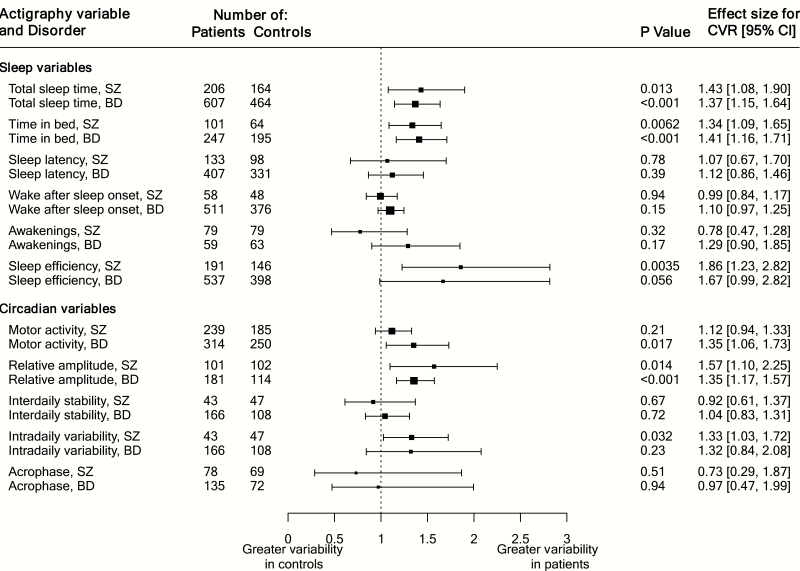
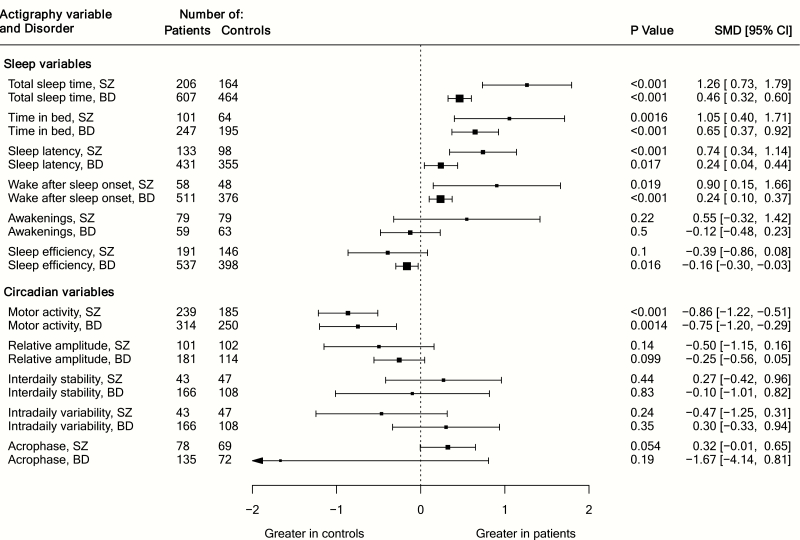
EMBASE, Medline, and PsycINFO were searched for case-control studies reporting actigraphic parameters in remitted schizophrenia or bipolar disorder. Standardized and absolute mean differences between patients and controls were quantified using Hedges' g, and patient-control differences in variability were quantified using the mean-scaled coefficient of variation ratio (CVR). A wald-type test compared effect sizes between disorders.
Thirty studies reporting on 967 patients and 803 controls were included. Compared with controls, both schizophrenia and bipolar groups had significantly longer total sleep time (mean difference [minutes] [95% confidence interval {CI}] = 99.9 [66.8, 133.1] and 31.1 [19.3, 42.9], respectively), time in bed (mean difference = 77.8 [13.7, 142.0] and 50.3 [20.3, 80.3]), but also greater sleep latency (16.5 [6.1, 27.0] and 2.6 [0.5, 4.6]) and reduced motor activity (standardized mean difference [95% CI] = -0.86 [-1.22, -0.51] and -0.75 [-1.20, -0.29]). Effect sizes were significantly greater in schizophrenia compared with the bipolar disorder group for total sleep time, sleep latency, and wake after sleep onset. CVR was significantly elevated in both diagnoses for total sleep time, time in bed, and relative amplitude.
In both disorders, longer overall sleep duration, but also disturbed initiation, continuity, and reduced motor activity were found. Common, modifiable factors may be associated with these sleep-circadian phenotypes and advocate for further development of transdiagnostic interventions that target them.
精神分裂症患者的睡眠和昼夜节律紊乱很常见,但特征尚未完全明确。我们旨在描述和比较缓解期精神分裂症患者睡眠 - 昼夜节律改变的程度和异质性,并将其与发作间期双相情感障碍患者的情况进行比较。
检索EMBASE、Medline和PsycINFO数据库,查找报告缓解期精神分裂症或双相情感障碍患者活动记录仪参数的病例对照研究。使用Hedges' g对患者与对照组之间的标准化和绝对平均差异进行量化,使用平均缩放变异系数比(CVR)对患者与对照组在变异性方面的差异进行量化。采用wald型检验比较不同疾病之间的效应大小。
纳入了30项研究,共涉及967例患者和803名对照。与对照组相比,精神分裂症组和双相情感障碍组的总睡眠时间均显著更长(平均差异[分钟][95%置信区间{CI}]分别为99.9[66.8, 133.1]和第31.1[19.3, 42.9]),卧床时间(平均差异分别为77.8[13.7, 142.0]和50.3[20.3, 80.3]),但睡眠潜伏期也更长(分别为16.5[6.1, 27.0]和2.6[0.5, 4.6]),且运动活动减少(标准化平均差异[95%CI]分别为 - 0.86[-1.22, -0.51]和 - 0.75[-第1.20, -0.29])。在总睡眠时间、睡眠潜伏期和睡眠开始后觉醒方面,精神分裂症组的效应大小显著大于双相情感障碍组。在总睡眠时间、卧床时间和相对振幅方面,两种诊断的CVR均显著升高。
在这两种疾病中,均发现总体睡眠时间延长,但睡眠起始、连续性受到干扰,且运动活动减少。常见的、可改变的因素可能与这些睡眠 - 昼夜节律表型相关,这为进一步开发针对这些因素的跨诊断干预措施提供了依据。