Occupational Therapy Unit, Clalit Health Services, Tiberias, Israel.
Sociology and Anthropology Department, Max Stern Yezreel Valley College, Yezreel Valley, Israel.
PLoS One. 2020 Mar 10;15(3):e0229982. doi: 10.1371/journal.pone.0229982. eCollection 2020.
Hand injuries (HI) are common and may limit participation in work. The objective of this study is to examine the effect of ethnicity and other prognostic variables on return-to-work (RTW) among male manual workers after acute HI.
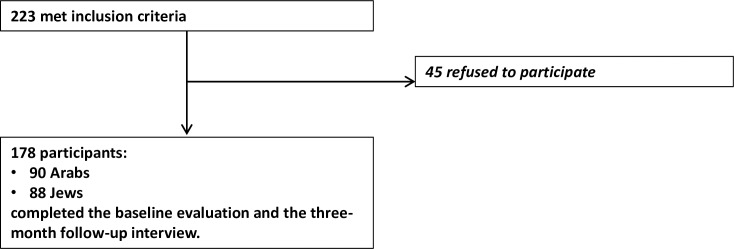
A cohort of 178 subjects (90 Arabs, 88 Jews) aged 22 to 65 was studied. Trained bilingual occupational therapists evaluated and interviewed the subjects, using structured validated questionnaires for evaluating personal and environmental factors, body function and structure, and activity limitation and participation restrictions. Employment status 3 months post injury was assessed by a telephone interview. To establish a predictive model for RTW, ethnicity and certain variables of the four domains mentioned above were analyzed using logistic regression analysis.
A significant difference in the rate of RTW between Jews and Arabs was found (45.5% for Jews, 28.9% for Arabs, p = 0.03) three months post HI. In the univariate regression analysis, ethnicity was associated with RTW (OR = 2.05; CI: 1.10-3.81) for Jews vs. Arabs. Using a multivariate analysis, only legal counseling, educational attainment, and the severity of disability were significantly associated with RTW.
RTW three months post HI among manual workers is directly related to variables such as education and legal counseling and only indirectly related to ethnicity. Patients with a lower level of education and those who were engaged in legal counseling need special attention and close guidance in the process of RTW.
手部损伤(HI)较为常见,可能会限制其参与工作。本研究旨在探讨种族和其他预后变量对急性 HI 后男性体力劳动者重返工作岗位(RTW)的影响。
研究了一个由 178 名年龄在 22 至 65 岁之间的男性组成的队列,其中包括 90 名阿拉伯人和 88 名犹太人。经过培训的双语职业治疗师使用评估个人和环境因素、身体功能和结构、活动受限和参与受限的结构化验证问卷对研究对象进行评估和访谈。通过电话访谈评估受伤后 3 个月的就业状况。为了建立 RTW 的预测模型,使用逻辑回归分析分析了上述四个领域的种族和某些变量。
发现犹太人的 RTW 率与阿拉伯人有显著差异(犹太人的 RTW 率为 45.5%,阿拉伯人为 28.9%,p=0.03)。在单变量回归分析中,种族与 RTW 相关(OR=2.05;CI:1.10-3.81),犹太人高于阿拉伯人。在多变量分析中,只有法律咨询、教育程度和残疾严重程度与 RTW 显著相关。
体力劳动者 HI 后三个月的 RTW 与教育和法律咨询等变量直接相关,而与种族仅间接相关。教育程度较低的患者和接受法律咨询的患者在 RTW 过程中需要特别关注和密切指导。