Kaissis Georgios A, Ziegelmayer Sebastian, Lohöfer Fabian K, Harder Felix N, Jungmann Friederike, Sasse Daniel, Muckenhuber Alexander, Yen Hsi-Yu, Steiger Katja, Siveke Jens, Friess Helmut, Schmid Roland, Weichert Wilko, Makowski Marcus R, Braren Rickmer F
Technical University of Munich, School of Medicine, Department of Diagnostic and Interventional Radiology, 81675 Munich, Germany.
Imperial College of Science, Technology and Medicine, Faculty of Engineering, Department of Computing, SW7 2AZ London, UK.
J Clin Med. 2020 Mar 7;9(3):724. doi: 10.3390/jcm9030724.
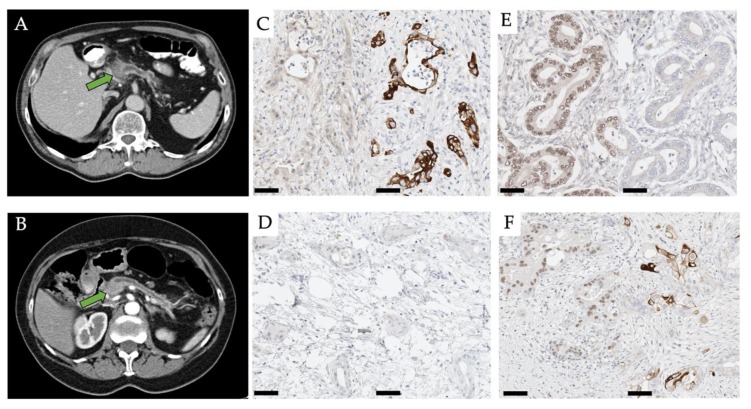
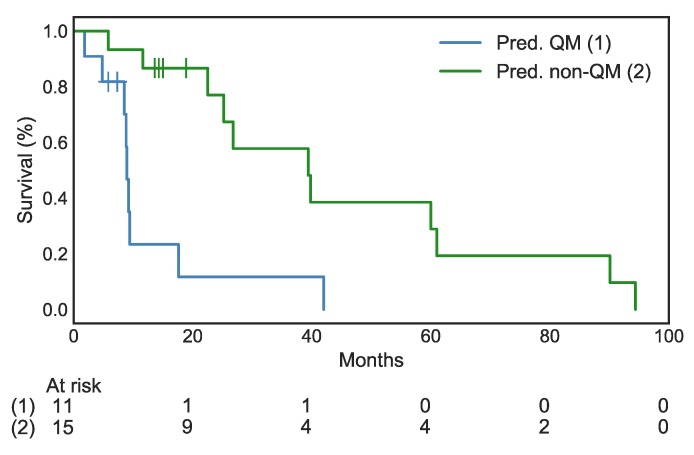
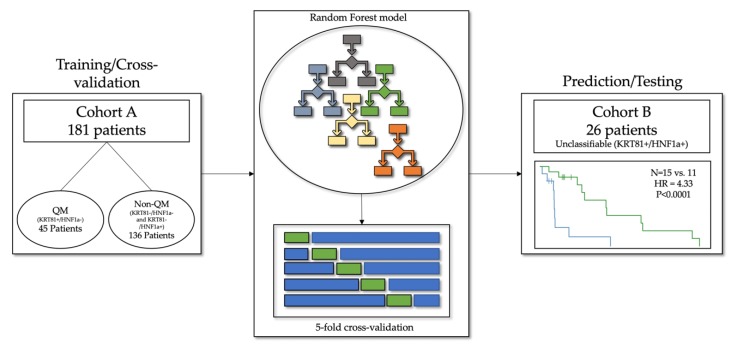
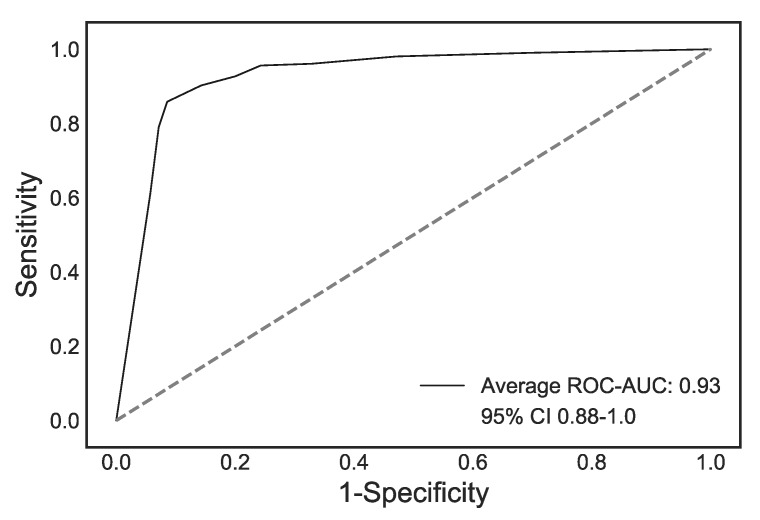
To bridge the translational gap between recent discoveries of distinct molecular phenotypes of pancreatic cancer and tangible improvements in patient outcome, there is an urgent need to develop strategies and tools informing and improving the clinical decision process. Radiomics and machine learning approaches can offer non-invasive whole tumor analytics for clinical imaging data-based classification. The retrospective study assessed baseline computed tomography (CT) from 207 patients with proven pancreatic ductal adenocarcinoma (PDAC). Following expert level manual annotation, Pyradiomics was used for the extraction of 1474 radiomic features. The molecular tumor subtype was defined by immunohistochemical staining for KRT81 and HNF1a as quasi-mesenchymal (QM) vs. non-quasi-mesenchymal (non-QM). A Random Forest machine learning algorithm was developed to predict the molecular subtype from the radiomic features. The algorithm was then applied to an independent cohort of histopathologically unclassifiable tumors with distinct clinical outcomes. The classification algorithm achieved a sensitivity, specificity and ROC-AUC (area under the receiver operating characteristic curve) of 0.84 ± 0.05, 0.92 ± 0.01 and 0.93 ± 0.01, respectively. The median overall survival for predicted QM and non-QM tumors was 16.1 and 20.9 months, respectively, log-rank-test = 0.02, harzard ratio (HR) 1.59. The application of the algorithm to histopathologically unclassifiable tumors revealed two groups with significantly different survival (8.9 and 39.8 months, log-rank-test < 0.001, HR 4.33). The machine learning-based analysis of preoperative (CT) imaging allows the prediction of molecular PDAC subtypes highly relevant for patient survival, allowing advanced pre-operative patient stratification for precision medicine applications.
为了弥合胰腺癌不同分子表型的最新发现与患者预后切实改善之间的转化差距,迫切需要开发能够为临床决策过程提供信息并加以改进的策略和工具。放射组学和机器学习方法可为基于临床影像数据的分类提供非侵入性的全肿瘤分析。这项回顾性研究评估了207例经证实的胰腺导管腺癌(PDAC)患者的基线计算机断层扫描(CT)。在进行专家级手动标注后,使用Pyradiomics提取了1474个放射组学特征。通过对KRT81和HNF1a进行免疫组织化学染色,将分子肿瘤亚型定义为准间充质(QM)与非准间充质(非QM)。开发了一种随机森林机器学习算法,用于从放射组学特征预测分子亚型。然后将该算法应用于具有不同临床结局的组织病理学无法分类的肿瘤独立队列。该分类算法的敏感性、特异性和ROC-AUC(受试者操作特征曲线下面积)分别为0.84±0.05、0.92±0.01和0.93±0.01。预测的QM和非QM肿瘤的中位总生存期分别为16.1个月和20.9个月,对数秩检验=0.02,危险比(HR)为1.59。将该算法应用于组织病理学无法分类的肿瘤,发现两组患者的生存期有显著差异(8.9个月和39.8个月,对数秩检验<0.001,HR为4.33)。基于机器学习的术前(CT)影像分析能够预测与患者生存高度相关的分子PDAC亚型,从而实现术前患者的高级分层,以应用于精准医学。