Gosford District Hospital, Central Coast Local Health District, Gosford, NSW, 2250, Australia.
J Orthop Surg Res. 2020 Mar 10;15(1):100. doi: 10.1186/s13018-020-01619-4.
Periprosthetic fractures are increasingly encountered in hip arthroplasty. The Vancouver classification system is widely used. Little knowledge exists regarding the association of the Vancouver classification with either cemented or uncemented stems. The aim was to analyse a series of fractures and determine associations.
A series of consecutive patients over 8 years was identified including only post-operative fractures of primary hip arthroplasties. Baseline and radiographic characteristics were recorded including the type of stem fixation (cemented or uncemented) and Vancouver classification. Statistical analysis was performed to determine the association of the Vancouver classification between cemented and uncemented stems.
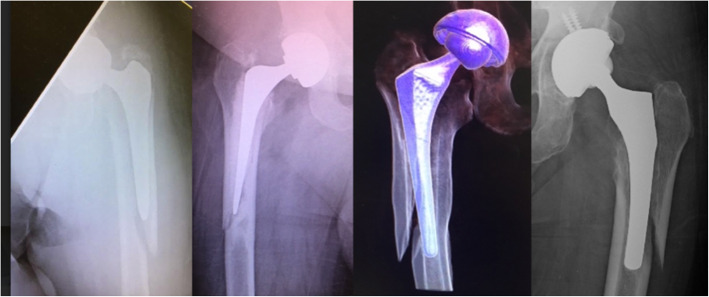
A total of 172 patients were identified (84 cemented stems, 88 uncemented stems). There were 30 Vancouver A fractures (12 cemented vs.18 uncemented, p > 0.05), 125 Vancouver B fractures (63 cemented vs. 62 uncemented, p > 0.05) and 17 Vancouver C fractures (9 cemented vs. 8 uncemented, p > 0.05). The Vancouver B2 fracture occurred most frequently (N = 95; 44 cemented vs. 51 uncemented, p > 0.05) and consists of four distinct fracture patterns: the previously described comminuted 'burst', clamshell and spiral patterns and the newly observed 'reverse' clamshell. The burst and spiral fracture patterns are significantly associated with cemented stems, and the clamshell pattern is significantly associated with uncemented stems.
Vancouver A, B and C fractures occur equally in cemented and uncemented stems. Awareness of four distinct Vancouver B2 fracture patterns, including the newly observed reverse clamshell, will aid surgeons in predicting stem instability.
在髋关节置换术中,越来越多地遇到假体周围骨折。温哥华分类系统被广泛应用。关于温哥华分类系统与骨水泥固定或非骨水泥固定柄之间的关系,我们知之甚少。目的是分析一系列骨折并确定相关性。
确定了 8 年来连续的一系列患者,仅包括初次髋关节置换术后的术后骨折。记录了基线和影像学特征,包括柄固定类型(骨水泥固定或非骨水泥固定)和温哥华分类。进行了统计分析以确定温哥华分类系统在骨水泥固定和非骨水泥固定柄之间的相关性。
共确定了 172 名患者(84 个骨水泥固定柄,88 个非骨水泥固定柄)。有 30 个温哥华 A 型骨折(12 个骨水泥固定 vs. 18 个非骨水泥固定,p > 0.05),125 个温哥华 B 型骨折(63 个骨水泥固定 vs. 62 个非骨水泥固定,p > 0.05)和 17 个温哥华 C 型骨折(9 个骨水泥固定 vs. 8 个非骨水泥固定,p > 0.05)。温哥华 B2 型骨折最常见(N = 95;44 个骨水泥固定 vs. 51 个非骨水泥固定,p > 0.05),由四个不同的骨折模式组成:以前描述的粉碎性“爆裂”、蛤壳和螺旋模式,以及新观察到的“反向”蛤壳模式。爆裂和螺旋骨折模式与骨水泥固定柄显著相关,蛤壳模式与非骨水泥固定柄显著相关。
骨水泥固定和非骨水泥固定柄中发生温哥华 A、B 和 C 型骨折的频率相同。认识到四个不同的温哥华 B2 型骨折模式,包括新观察到的反向蛤壳,将有助于外科医生预测柄的不稳定性。