Department of Physics and Astronomy, University of California, Irvine, Irvine, California, USA.
Department of Biomedical Engineering, University of California, Irvine, Irvine, California, USA.
mBio. 2020 Mar 10;11(2):e02730-18. doi: 10.1128/mBio.02730-18.
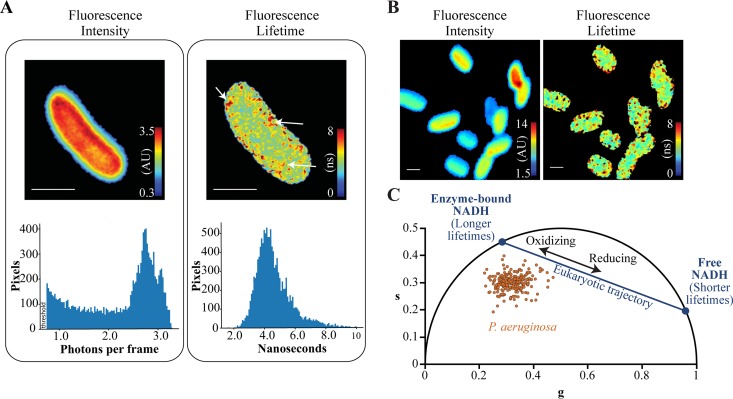
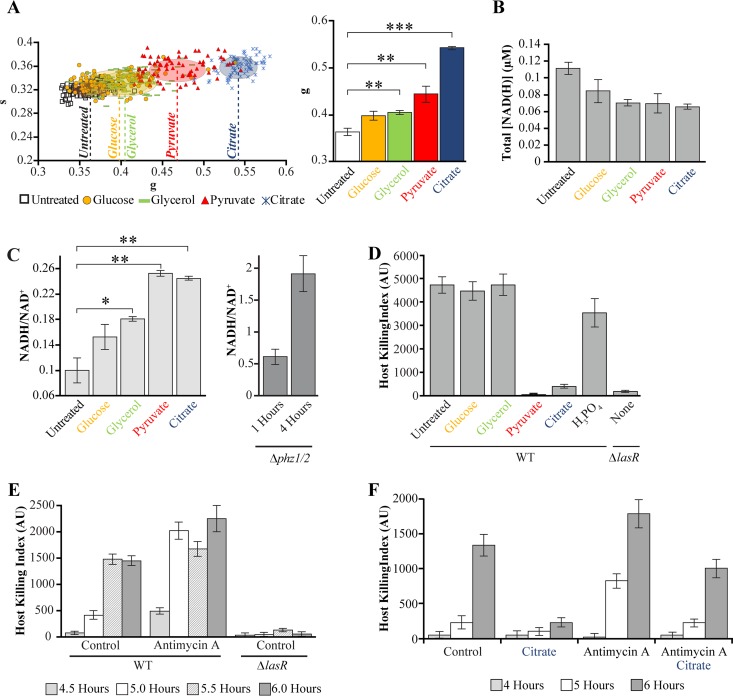
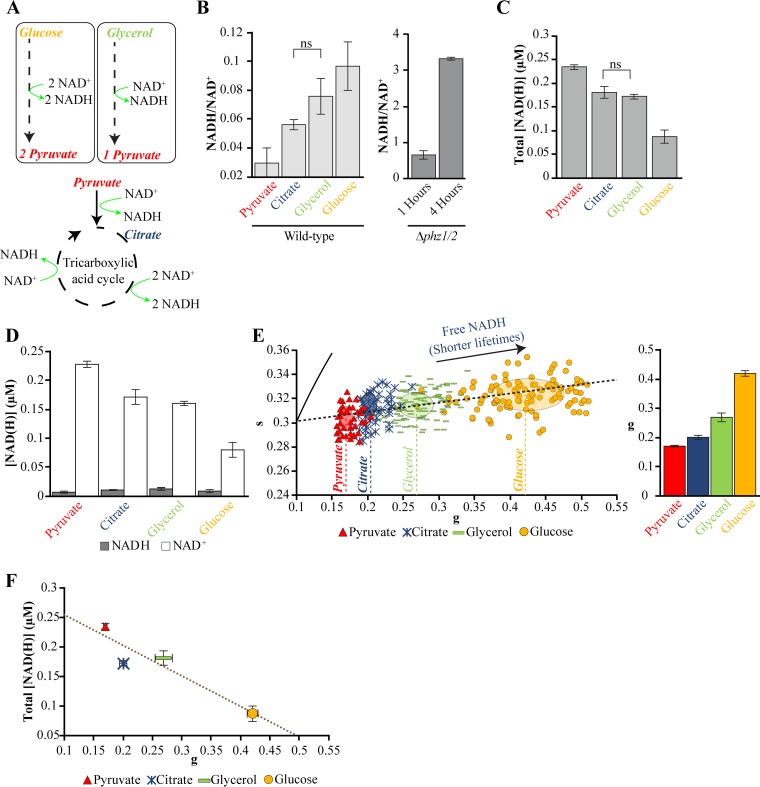
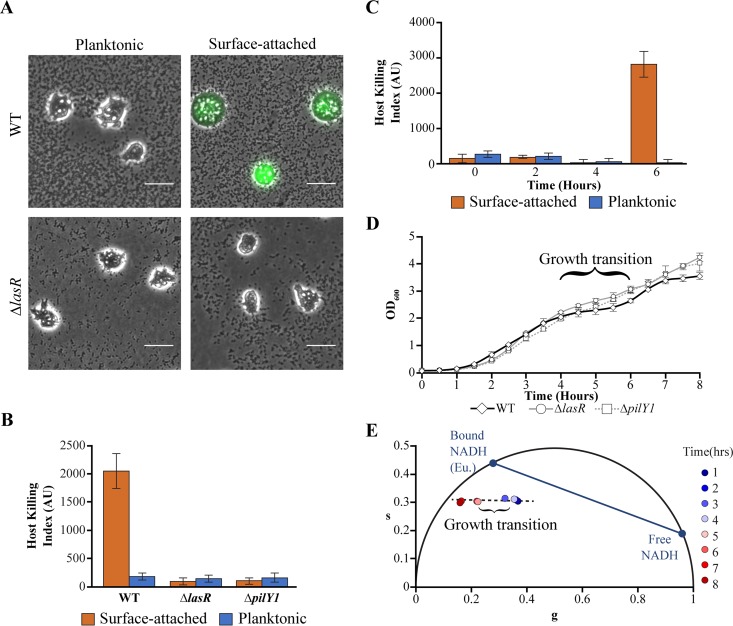
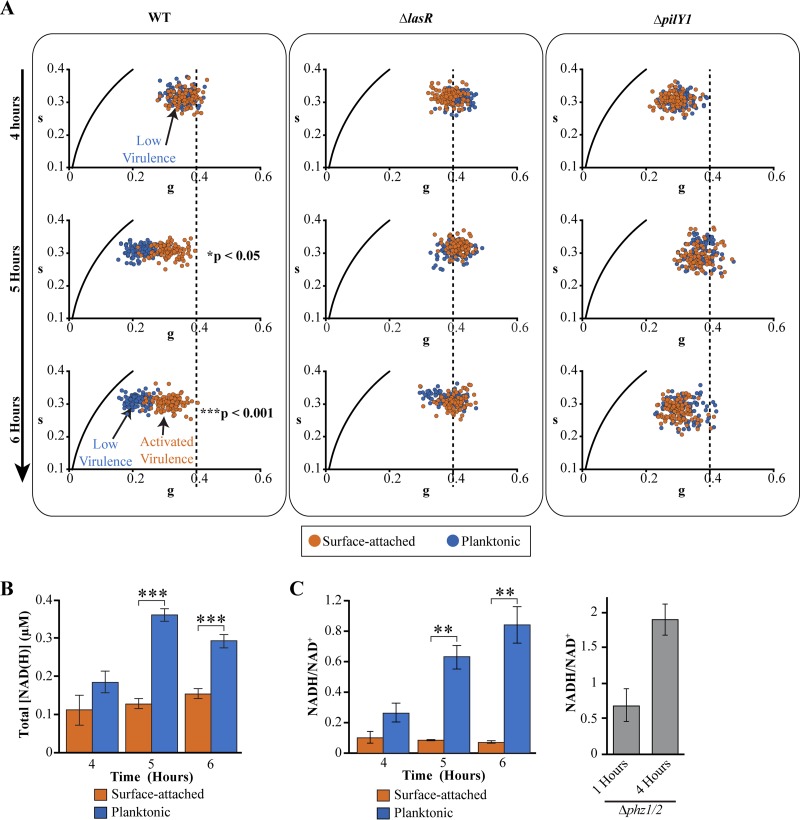
The availability of energy has significant impact on cell physiology. However, the role of cellular metabolism in bacterial pathogenesis is not understood. We investigated the dynamics of central metabolism during virulence induction by surface sensing and quorum sensing in early-stage biofilms of the multidrug-resistant bacterium We established a metabolic profile for using fluorescence lifetime imaging microscopy (FLIM), which reports the activity of NADH in live cells. We identified a critical growth transition period during which virulence is activated. We performed FLIM measurements and direct measurements of NADH and NAD concentrations during this period. Here, planktonic (low-virulence) and surface-attached (virulence-activated) populations diverged into distinct metabolic states, with the surface-attached population exhibiting FLIM lifetimes that were associated with lower levels of enzyme-bound NADH and decreasing total NAD(H) production. We inhibited virulence by perturbing central metabolism using citrate and pyruvate, which further decreased the enzyme-bound NADH fraction and total NAD(H) production and suggested the involvement of the glyoxylate pathway in virulence activation in surface-attached populations. In addition, we induced virulence at an earlier time using the electron transport chain oxidase inhibitor antimycin A. Our results demonstrate the use of FLIM to noninvasively measure NADH dynamics in biofilms and suggest a model in which a metabolic rearrangement accompanies the virulence activation period. The rise of antibiotic resistance requires the development of new strategies to combat bacterial infection and pathogenesis. A major direction has been the development of drugs that broadly target virulence. However, few targets have been identified due to the species-specific nature of many virulence regulators. The lack of a virulence regulator that is conserved across species has presented a further challenge to the development of therapeutics. Here, we identify that NADH activity has an important role in the induction of virulence in the pathogen This finding, coupled with the ubiquity of NADH in bacterial pathogens, opens up the possibility of targeting enzymes that process NADH as a potential broad antivirulence approach.
能源的可得性对细胞生理学有重大影响。然而,细胞代谢在细菌发病机制中的作用尚不清楚。我们研究了在多药耐药菌的早期生物膜中,表面感应和群体感应诱导毒力时中心代谢的动态变化。我们使用荧光寿命成像显微镜(FLIM)为 建立了代谢图谱,该图谱报告活细胞中 NADH 的活性。我们确定了一个关键的生长过渡时期,在此期间激活了毒力。在此期间,我们进行了 FLIM 测量和 NADH 和 NAD 浓度的直接测量。在这里,浮游(低毒力)和表面附着(毒力激活)群体分为不同的代谢状态,表面附着群体表现出与较低酶结合 NADH 水平和降低的总 NAD(H)产生相关的 FLIM 寿命。我们通过使用柠檬酸和丙酮酸扰乱中心代谢来抑制毒力,这进一步降低了酶结合的 NADH 分数和总 NAD(H)产生,并表明在表面附着群体中,乙醛酸途径参与了毒力激活。此外,我们使用电子传递链氧化酶抑制剂antimycin A 更早地诱导毒力。我们的结果表明,使用 FLIM 可以非侵入性地测量生物膜中的 NADH 动态,并提出了一个模型,即代谢重排伴随着毒力激活期。抗生素耐药性的上升需要开发新的策略来对抗细菌感染和发病机制。一个主要方向是开发广泛针对毒力的药物。然而,由于许多毒力调节剂具有物种特异性,因此仅鉴定出少数靶标。缺乏在物种间保守的毒力调节剂给治疗方法的发展带来了进一步的挑战。在这里,我们确定 NADH 活性在病原体中诱导毒力方面起着重要作用。这一发现,加上 NADH 在细菌病原体中的普遍存在性,为将处理 NADH 的酶作为一种潜在的广谱抗毒力方法提供了可能性。