Division of Molecular and Translational Biomedicine, Department of Anesthesiology and Perioperative Medicine, University of Alabama at Birmingham, 901 19th St. South, Birmingham, AL, 35294, USA.
Department of Pathology, University of Alabama at Birmingham, Birmingham, AL, USA.
Arch Toxicol. 2020 Apr;94(4):1321-1334. doi: 10.1007/s00204-020-02699-1. Epub 2020 Mar 10.
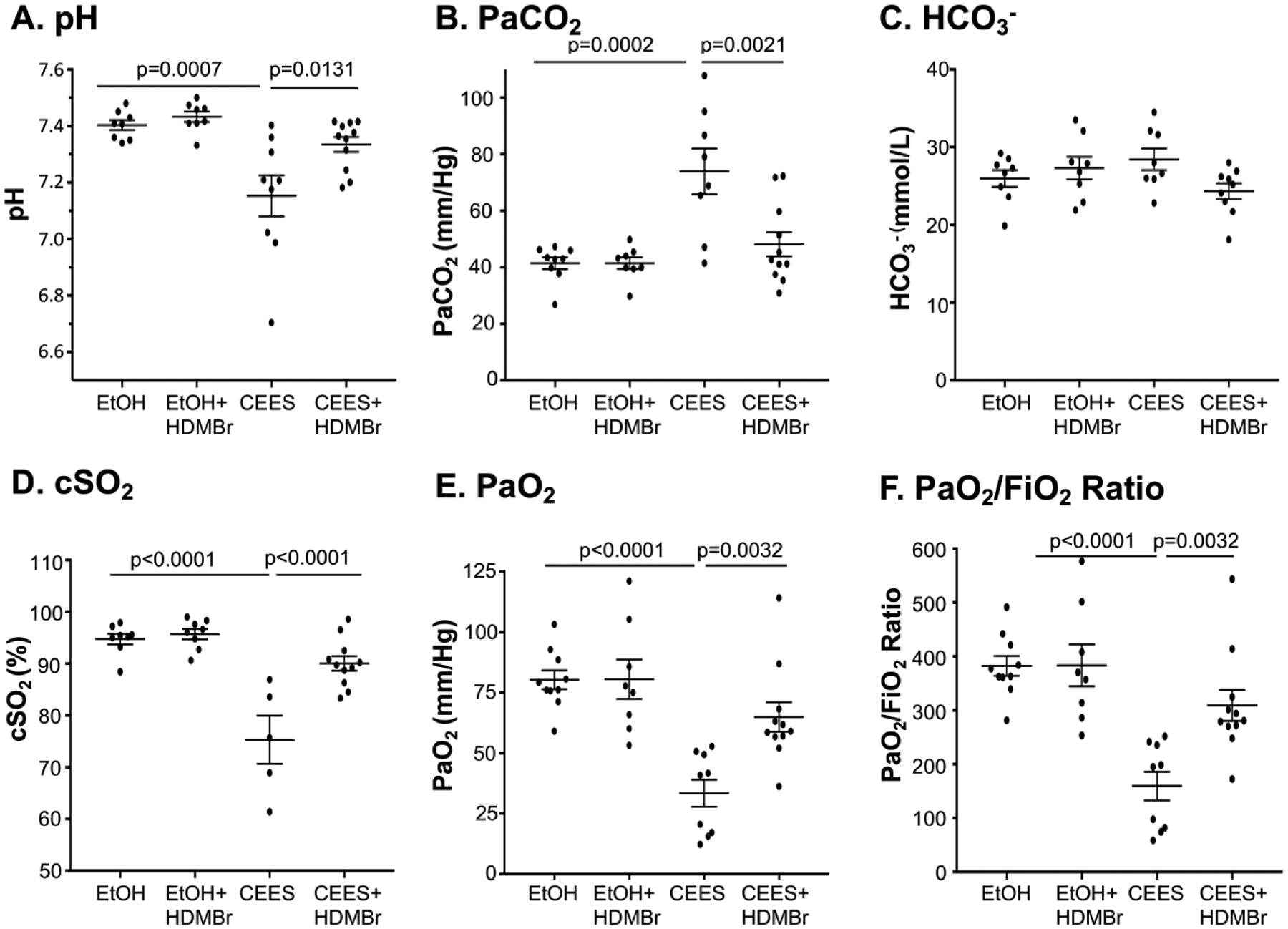
Sulfur mustard (SM) is a highly toxic war chemical that causes significant morbidity and mortality and lacks any effective therapy. Rats exposed to aerosolized CEES (2-chloroethyl ethyl sulfide; 10% in ethanol), an analog of SM, developed acute respiratory distress syndrome (ARDS), which is characterized by increased inflammation, hypoxemia and impaired gas exchange. We observed elevated levels of extracellular nucleic acids (eNA) in the bronchoalveolar lavage fluid (BALF) of CEES-exposed animals. eNA can induce inflammation, coagulation and barrier dysfunction. Treatment with hexadimethrine bromide (HDMBr; 10 mg/kg), an eNA neutralizing agent, 2 h post-exposure, reduced lung injury, inhibited disruption of alveolar-capillary barrier, improved blood oxygenation (PaO/FiO ratio), thus reversing ARDS symptoms. HDMBr treatment also reduced lung inflammation in the CEES-exposed animals by decreasing IL-6, IL-1A, CXCL-1 and CCL-2 mRNA levels in lung tissues and HMGB1 protein in BALF. Furthermore, HDMBr treatment also reduced levels of lung tissue factor and plasminogen activator inhibitor-1 indicating reduction in clot formation and increased fibrinolysis. Fibrin was reduced in BALF of the HDMBr-treated animals. This was further confirmed by histology that revealed diminished airway fibrin, epithelial sloughing and hyaline membrane in the lungs of HDMBr-treated animals. HDMBr completely rescued the CEES-associated mortality 12 h post-exposure when the survival rate in CEES-only group was just 50%. Experimental eNA treatment of cells caused increased inflammation that was reversed by HDMBr. These results demonstrate a role of eNA in the pathogenesis of CEES/SM-induced injury and that its neutralization can serve as a potential therapeutic approach in treating SM toxicity.
芥子气(SM)是一种高毒性的化学战剂,会导致严重的发病率和死亡率,且目前缺乏任何有效的治疗方法。暴露于气溶胶化的 CEES(2-氯乙基乙基硫醚;乙醇中的 10%)的大鼠会发展为急性呼吸窘迫综合征(ARDS),其特征为炎症增加、低氧血症和气体交换受损。我们观察到暴露于 CEES 的动物的支气管肺泡灌洗液(BALF)中细胞外核酸(eNA)水平升高。eNA 可诱导炎症、凝血和屏障功能障碍。在暴露后 2 小时用核酸中和剂六亚甲基二溴化铵(HDMBr;10mg/kg)治疗可减轻肺损伤、抑制肺泡毛细血管屏障破坏、改善血氧(PaO/FiO 比值),从而逆转 ARDS 症状。HDMBr 治疗还通过降低肺组织中的 IL-6、IL-1A、CXCL-1 和 CCL-2 mRNA 水平以及 BALF 中的 HMGB1 蛋白,减少 CEES 暴露动物的肺部炎症。此外,HDMBr 治疗还降低了肺组织因子和纤溶酶原激活物抑制剂-1 的水平,表明血栓形成减少和纤溶增加。HDMBr 治疗动物的 BALF 中纤维蛋白减少。组织学进一步证实了这一点,HDMBr 治疗动物的肺部气道纤维蛋白、上皮脱落和透明膜减少。在暴露后 12 小时,当 CEES 组的存活率仅为 50%时,HDMBr 完全挽救了 CEES 相关的死亡率。实验性 eNA 处理细胞会导致炎症增加,而 HDMBr 可逆转这种增加。这些结果表明 eNA 在 CEES/SM 诱导损伤的发病机制中起作用,其中和作用可能成为治疗 SM 毒性的一种潜在治疗方法。