Adekiya Aruna Olasekan, Agbede Taiwo Michael, Olayanju Adeniyi, Ejue Wutem Sunny, Adekanye Timothy A, Adenusi Titilayo Tolulope, Ayeni Jerry Femi
College of Agricultural Sciences, Landmark University, P.M.B. 1001, Omu-Aran, Kwara, Nigeria.
Department of Crop, Soil and Pest Management Technology, Rufus Giwa Polytechnic, P.M.B. 1019, Owo, Ondo, Nigeria.
ScientificWorldJournal. 2020 Feb 25;2020:9391630. doi: 10.1155/2020/9391630. eCollection 2020.
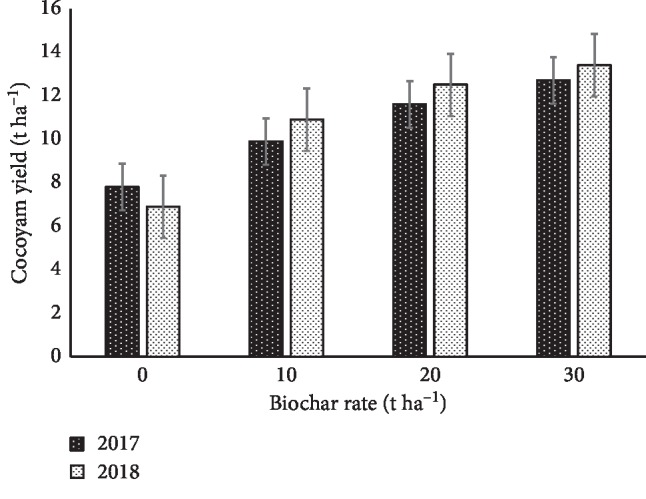
Among agricultural soil amendment that can enhance crop productivity and soil sustainability is biochar. Hence, two-year field experiments were conducted on a sandy loam Alfisol at Owo, southwest Nigeria, to evaluate the effects of biochar produced from hardwood on soil physical and chemical characteristics, erosion potential, and cocoyam ( (L.) Schott) yield. The study was a 2 × 4 factorial experiment with two years (2017 and 2018) and four biochar levels (0 (control), 10, 20, and 30 t ha). The treatments were laid out in a randomized complete block design with three replications. Results indicated that biochar application significantly in both years improved yield of cocoyam and soil physical (bulk density, porosity, moisture content, mean weight diameter (MWD) of soil aggregates, dispersion ratio, and infiltration rate) and chemical (soil organic matter, pH, N, P, K, Ca, Mg, and CEC) properties and erosion resistance. Soil characteristics and cocoyam yield improved with level of biochar from 0-30 t ha. When 2018 is compared with 2017 in term of soil loss, in the amended plots, 2018 reduced soil loss by 7.4, 20, and 73.5%, respectively, for 10, 20, and 30 t habiochar, whereas there was an increase of 2.7% soil loss in the control plot in 2018 compared with 2017. Therefore, application rate of 30 t ha biochar is considered as suitable for severely degraded soil because this application rate efficiently improves cocoyam yield and soil properties and reduces soil loss.
生物炭是一种能够提高作物产量和土壤可持续性的农业土壤改良剂。因此,在尼日利亚西南部奥沃的砂壤土淋溶土上进行了为期两年的田间试验,以评估硬木生物炭对土壤物理和化学特性、侵蚀潜力以及芋艿((L.)肖特)产量的影响。该研究是一项2×4析因试验,为期两年(2017年和2018年),设置四个生物炭水平(0(对照)、10、20和30 t/公顷)。试验处理采用随机完全区组设计,重复三次。结果表明,两年中施用生物炭均显著提高了芋艿产量以及土壤物理性质(容重、孔隙度、含水量、土壤团聚体平均重量直径(MWD)、分散率和入渗率)和化学性质(土壤有机质、pH值、氮、磷、钾、钙、镁和阳离子交换量),并增强了抗侵蚀能力。土壤特性和芋艿产量随生物炭施用量从0至30 t/公顷的增加而改善。就土壤流失而言,将2018年与2017年进行比较,在改良地块中,对于10、20和30 t/公顷生物炭处理,2018年的土壤流失分别减少了7.4%、20%和73.5%,而对照地块在2018年的土壤流失比2017年增加了2.7%。因此,30 t/公顷的生物炭施用量被认为适用于严重退化的土壤,因为该施用量能有效提高芋艿产量和土壤性质,并减少土壤流失。