Sun Jing, Zhang Aimin, Li Wengang, Wang Quan, Wang Jia, Fan Yuze, Sun Yingzhe, Li Dong, Zhang Dan, Duan Xuezhang
Radiation Oncology Center, The Fifth Medical Center of PLA General Hospital (Beijing 302 Hospital), Beijing, China.
Front Oncol. 2020 Feb 25;10:100. doi: 10.3389/fonc.2020.00100. eCollection 2020.
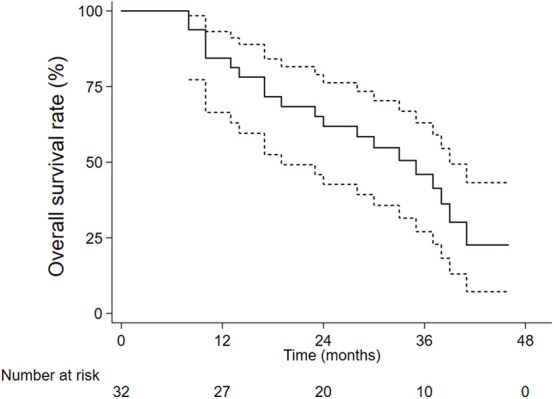
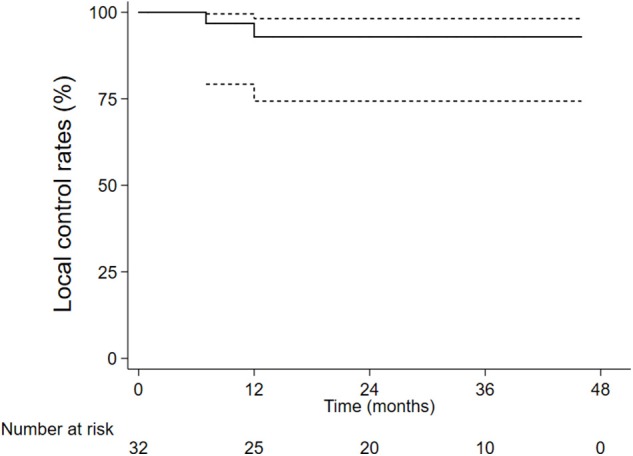
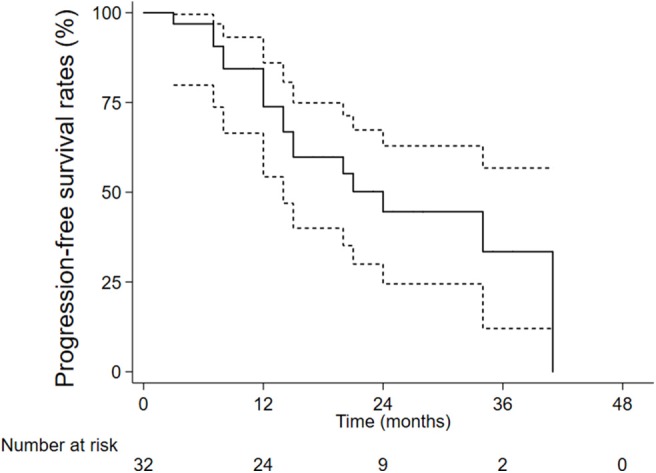
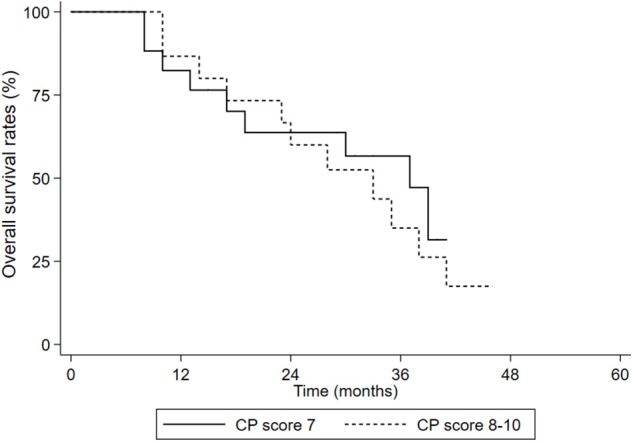
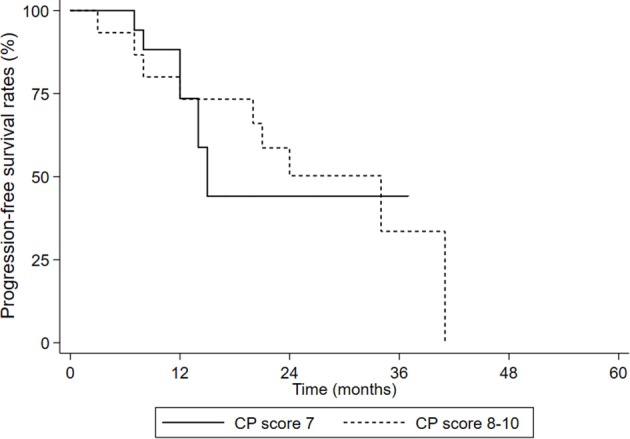
The aim of our study was to evaluate the curative effect and safety of CyberKnife stereotactic body radiation therapy in treating decompensated cirrhosis hepatocellular carcinoma (HCC) patients. From March 2011 to December 2015, 32 HCC patients who refused or were ineligible for other treatments were treated with CyberKnife stereotactic body radiation therapy. Among these patients, 17 were Child-Pugh score 7 (53.13%), 7 were Child-Pugh score 8 (21.87%), 4 were Child-Pugh score 9 (12.50%), and 4 were Child-Pugh score 10 (12.50%). A total dose of 45-54 Gy in 5-10 fractions was given according to the location of lesions. The median follow-up period was 30 months (8-46 months). By July 2019, the tumors were recurrent or metastasized in 17 patients. The overall survival rates of 1, 2, and 3 years were 84.4, 61.8, and 46.0%, respectively. After 1, 2, and 3 years, the local control rates were 92.9%. The progression-free survival rates of the 1, 2, and 3-year treatments were 73.8, 44.6, and 33.4%, respectively. CyberKnife stereotactic body radiation therapy was an effective option for HCC patients with decompensated cirrhosis. The liver injury occurrence rate was acceptable in our study.
我们研究的目的是评估射波刀立体定向体部放射治疗对失代偿期肝硬化肝细胞癌(HCC)患者的疗效和安全性。2011年3月至2015年12月,32例拒绝或不符合其他治疗条件的HCC患者接受了射波刀立体定向体部放射治疗。这些患者中,17例为Child-Pugh评分7分(53.13%),7例为Child-Pugh评分8分(21.87%),4例为Child-Pugh评分9分(12.50%),4例为Child-Pugh评分10分(12.50%)。根据病变位置给予45-54 Gy的总剂量,分5-10次照射。中位随访期为30个月(8-46个月)。截至2019年7月,17例患者出现肿瘤复发或转移。1年、2年和3年的总生存率分别为84.4%、61.8%和46.0%。1年、2年和3年后,局部控制率为92.9%。1年、2年和3年治疗的无进展生存率分别为73.8%、44.6%和33.4%。射波刀立体定向体部放射治疗是失代偿期肝硬化HCC患者的一种有效选择。在我们的研究中,肝损伤发生率是可以接受的。