Thomas Lance R, Adams Clare M, Fesik Stephen W, Eischen Christine M, Tansey William P
Department of Cell and Developmental Biology, Vanderbilt University School of Medicine, Nashville, TN, USA.
Department of Cancer Biology, Sidney Kimmel Cancer Center, Thomas Jefferson University, Philadelphia, PA, USA.
Mol Cell Oncol. 2020 Jan 10;7(2):1709388. doi: 10.1080/23723556.2019.1709388. eCollection 2020.
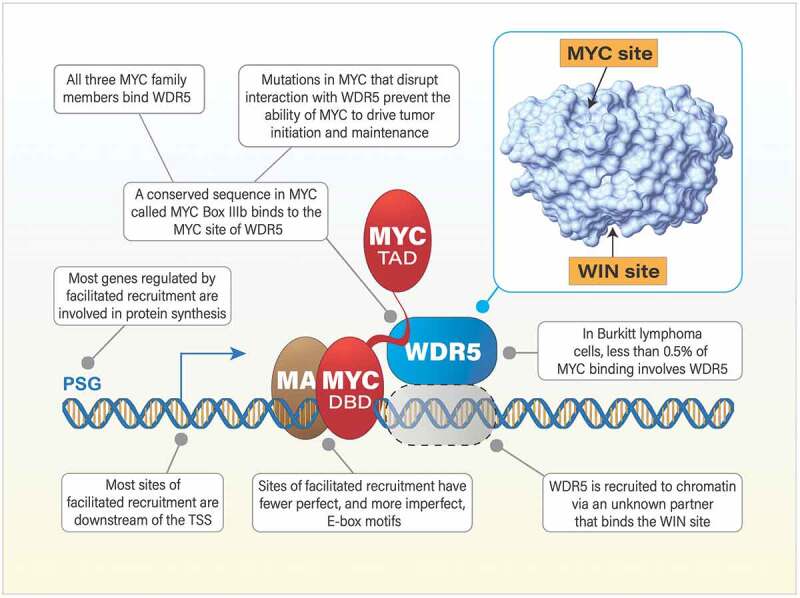
The oncoprotein transcription factor MYC is overexpressed in most cancers and is responsible for hundreds of thousands of cancer deaths worldwide every year. MYC is also a highly validated - but currently undruggable - anti-cancer target. We recently showed that breaking the interaction of MYC with its chromatin co-factor WD repeat-containing protein 5 (WDR5) promotes tumor regression in mouse xenografts, laying the foundation for a new strategy to inhibit MYC in the clinic.
癌蛋白转录因子MYC在大多数癌症中过度表达,每年在全球导致数十万癌症死亡。MYC也是一个经过高度验证但目前无法成药的抗癌靶点。我们最近发现,破坏MYC与其染色质辅因子含WD重复序列蛋白5(WDR5)的相互作用可促进小鼠异种移植瘤中的肿瘤消退,为临床上抑制MYC的新策略奠定了基础。