Shirakabe Akihiro, Asai Kuniya, Kobayashi Nobuaki, Okazaki Hirotake, Matsushita Masato, Shibata Yusaku, Goda Hiroki, Shigihara Shota, Asano Kazuhiro, Tani Kenichi, Kiuchi Kazutaka, Hata Noritake, Shimizu Wataru
Division of Intensive Care Unit, Nippon Medical School Chiba Hokusoh Hospital, Chiba, Japan.
Department of Cardiovascular Medicine, Nippon Medical School, Tokyo, Japan.
CJC Open. 2019 Oct 21;1(6):305-315. doi: 10.1016/j.cjco.2019.10.001. eCollection 2019 Nov.
Plasma volume status (PVS) has been evaluated recently as a prognostic marker of acute heart failure (AHF). However, whether evaluating PVS alone is sufficient remains unclear.
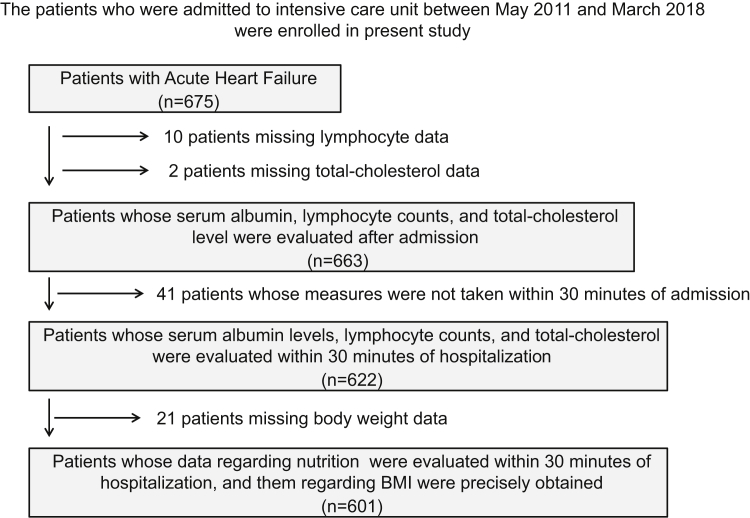
Of 675 patients with AHF screened, 601 were enrolled. The PVS, prognostic nutritional index (PNI) (lower = worse), and Controlling Nutritional Status (CONUT) score (higher = worse) were evaluated. Patients were divided into 2 groups according to PVS value (low- or high-PVS group) and were further subdivided into 4 groups (low- or high-PVS/CONUT group and low- or high-PVS/PNI group).
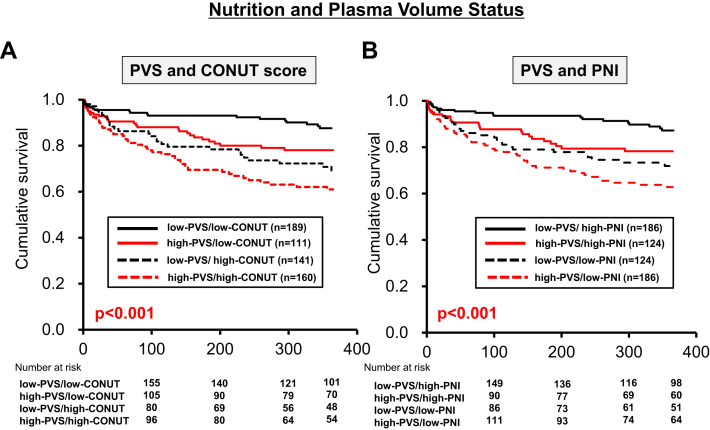
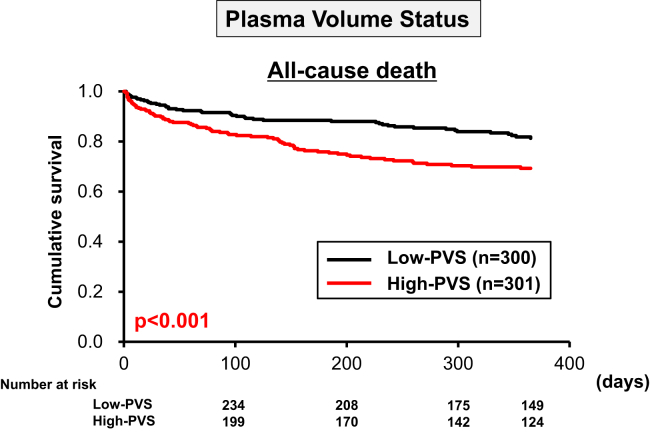
A Kaplan-Meier curve showed a significantly lower survival rate in the high-PVS group than in the low-PVS group, the high-PVS/high-CONUT group than in the high-PVS/low-CONUT group, and the high-PVS/low-PNI group than in the high-PVS/high-PNI group. A multivariate Cox regression model showed that high PVS (hazard ratio [HR], 1.642; 95% confidence interval [CI], 1.049-2.570) and high PVS/high CONUT (HR, 2.076; 95% CI, 1.147-3.757) and high PVS/low PNI (HR, 2.094; 95% CI, 1.166-3.761) were independent predictors of 365-day mortality.
An adverse outcome was predicted by the evaluation of PVS; furthermore, a malnutrition status with a high PVS leads to an adverse outcome. The simultaneous evaluation of nutrition status and PVS is essential to predict an AHF outcome.
血浆容量状态(PVS)最近已被评估为急性心力衰竭(AHF)的预后标志物。然而,单独评估PVS是否足够仍不清楚。
在675例筛查的AHF患者中,601例被纳入研究。评估了PVS、预后营养指数(PNI)(越低=越差)和控制营养状况(CONUT)评分(越高=越差)。根据PVS值将患者分为2组(低PVS组或高PVS组),并进一步细分为4组(低PVS/CONUT组或高PVS/CONUT组以及低PVS/PNI组或高PVS/PNI组)。
Kaplan-Meier曲线显示,高PVS组的生存率显著低于低PVS组,高PVS/高CONUT组低于高PVS/低CONUT组,高PVS/低PNI组低于高PVS/高PNI组。多变量Cox回归模型显示,高PVS(风险比[HR],1.642;95%置信区间[CI],1.049 - 2.570)、高PVS/高CONUT(HR,2.076;95%CI,1.147 - 3.757)和高PVS/低PNI(HR,2.094;95%CI,1.166 - 3.761)是365天死亡率的独立预测因素。
PVS评估可预测不良结局;此外,高PVS的营养不良状态会导致不良结局。同时评估营养状况和PVS对于预测AHF结局至关重要。