Laboratory for the Diagnostic of Somatic and Motor Development, Faculty of Sport, University of Ljubljana, Ljubljana, Slovenia.
PLoS One. 2020 Mar 11;15(3):e0229305. doi: 10.1371/journal.pone.0229305. eCollection 2020.
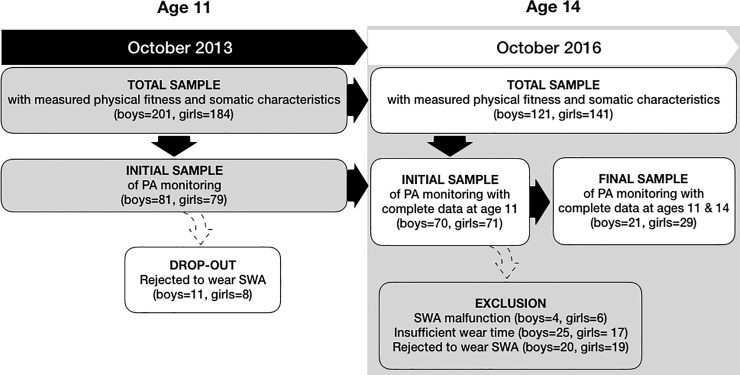
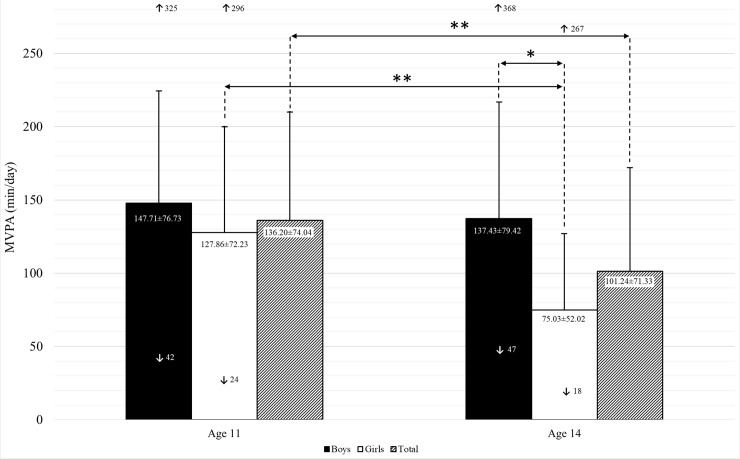
This study analyses the changes of moderate-to-vigorous physical activity (MVPA) in a cohort of boys and girls aged 11 (n = 50) and 14 (n = 50). Physical activity was assessed with Bodymedia SenseWear Pro Armband monitor for 6 days in October 2013 and October 2016, considering 90% of daily wear time (21h and 40min). The initial sample (n = 160) included the children who wore the monitors at age 11 but the final analyzed sample included only those children from the initial sample (n = 50), whose data fulfilled the inclusion criteria at age 11 and 14. Physical fitness and somatic characteristics of the final sample (n = 50) were compared to a representative sample of Slovenian schoolchildren at ages 11 (n = 385) and 14 (n = 236) to detect possible bias. Changes in MVPA were controlled for maturity using the timing of adolescent growth spurt as its indicator. The average MVPA decreased more than one quarter (34.96 min) from age 11 to age 14. Children were significantly more active at age 11 than at age 14 (p < 0.01, d = 0.39). The timing of puberty onset in girls was significantly earlier (12.01 ± 1.0 years) (p < 0.01) than in boys (13.2 ± 0.75 years) (p < 0.01, d = 1.35). There was a significant gender difference in moderate-to vigorous physical activity at age 14 (p < 0.05, η2 = 0.12) and between moderate-to vigorous physical activity at age 11 and 14 (η2 = 0.11). After controlling for the timing of adolescent growth spurt the girls at age 11 showed significantly higher level of physical activity than at age 14 (p < 0.01, η2 = 0.17). Early adolescence is crucial for the development of physical activity behaviours, which is especially pronounced in girls. The significant decline of MVPA between ages 11 and 14 in Slovenia are likely influenced by environmental changes since the timing of adolescent growth spurt did not prove as a factor underlying the decline of MVPA.
这项研究分析了 11 岁(n=50)和 14 岁(n=50)男孩和女孩队列中中度至剧烈体力活动(MVPA)的变化。2013 年 10 月和 2016 年 10 月,使用 Bodymedia SenseWear Pro 臂带监测器对 6 天的体力活动进行评估,考虑到日常佩戴时间的 90%(21 小时 40 分钟)。初始样本(n=160)包括在 11 岁时佩戴监测器的儿童,但最终分析样本仅包括初始样本(n=50)中的儿童,这些儿童在 11 岁和 14 岁时的数据符合纳入标准。最终样本(n=50)的身体素质和身体特征与 11 岁(n=385)和 14 岁(n=236)的斯洛文尼亚学龄儿童的代表性样本进行比较,以检测可能存在的偏差。使用青春期生长突增的时间作为其指标,控制成熟度对 MVPA 的变化进行了控制。从 11 岁到 14 岁,MVPA 平均减少了超过四分之一(34.96 分钟)。与 14 岁相比,儿童在 11 岁时明显更活跃(p<0.01,d=0.39)。女孩的青春期开始时间明显早于男孩(12.01±1.0 岁)(p<0.01)(p<0.01,d=1.35)。14 岁时,男女之间的中到剧烈体力活动存在显著差异(p<0.05,η2=0.12),11 岁和 14 岁之间的中到剧烈体力活动也存在显著差异(η2=0.11)。在控制青春期生长突增的时间后,11 岁时女孩的体力活动水平明显高于 14 岁(p<0.01,η2=0.17)。青春期早期对体力活动行为的发展至关重要,而女孩的情况尤为明显。在斯洛文尼亚,11 岁至 14 岁之间 MVPA 的显著下降可能受到环境变化的影响,因为青春期生长突增的时间并不是 MVPA 下降的根本原因。