Department of Stem Cell Biology, Friedrich-Alexander-Universität Erlangen-Nürnberg, Erlangen 91054, Germany.
Department of Psychiatry and Psychotherapy, University Hospital Erlangen, Friedrich-Alexander-Universität Erlangen-Nürnberg, Erlangen 91054, Germany.
Hum Mol Genet. 2020 May 8;29(7):1180-1191. doi: 10.1093/hmg/ddaa039.
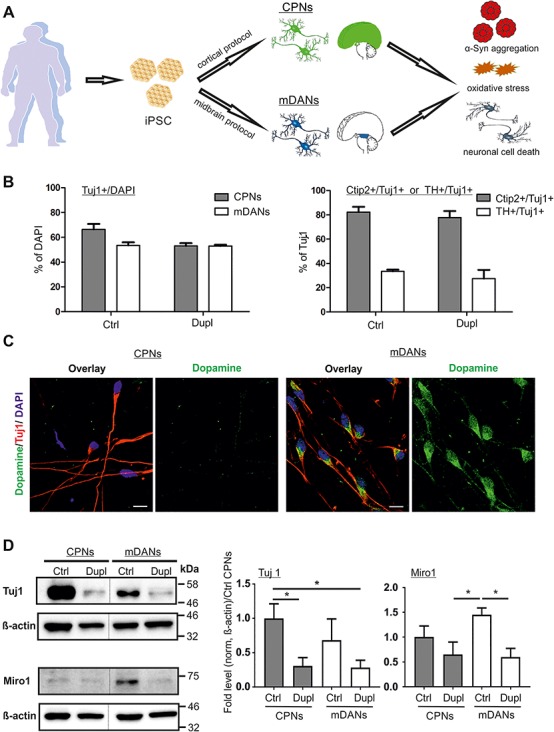
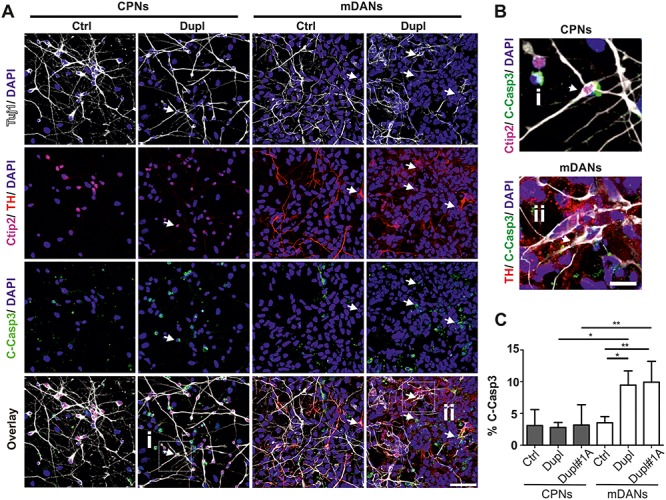
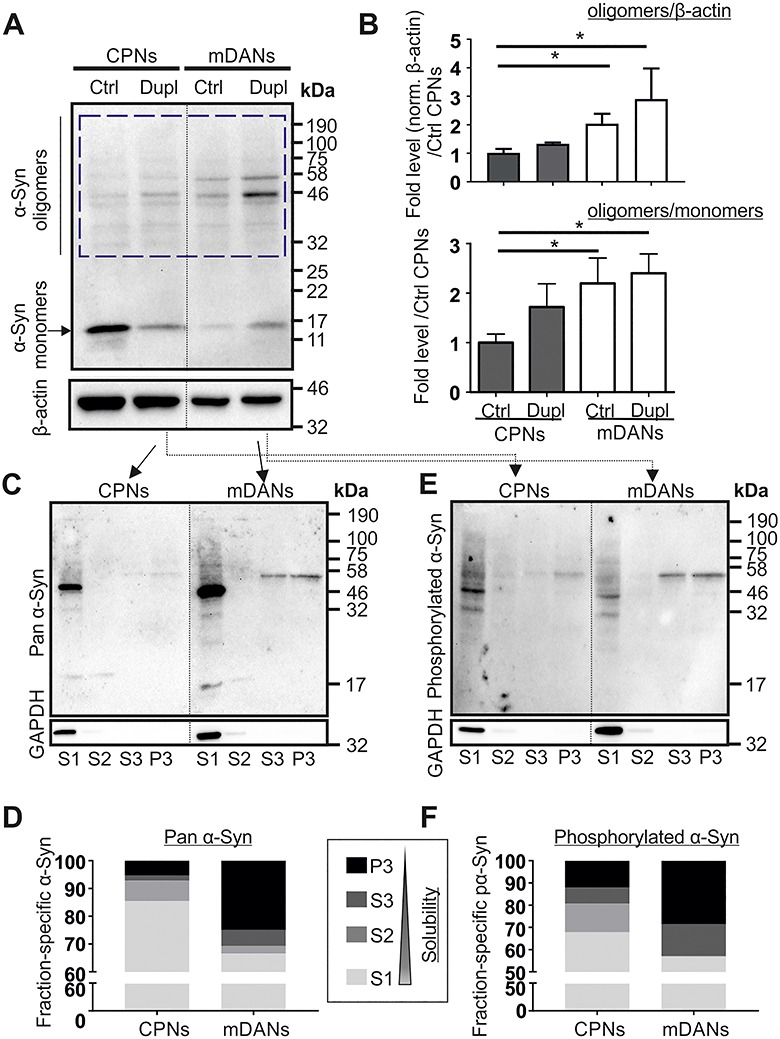
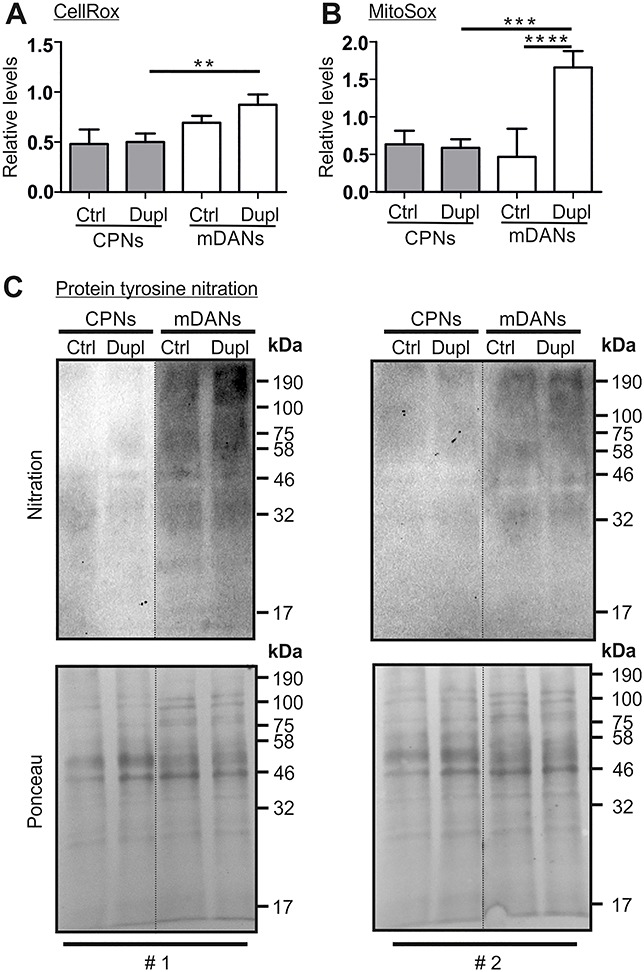
Parkinson's disease (PD) is a neurodegenerative disorder characterized by protein inclusions mostly composed of aggregated forms of α-synuclein (α-Syn) and by the progressive degeneration of midbrain dopaminergic neurons (mDANs), resulting in motor symptoms. While other brain regions also undergo pathologic changes in PD, the relevance of α-Syn aggregation for the preferential loss of mDANs in PD pathology is not completely understood yet. To elucidate the mechanisms of the brain region-specific neuronal vulnerability in PD, we modeled human PD using human-induced pluripotent stem cells (iPSCs) from familial PD cases with a duplication (Dupl) of the α-Syn gene (SNCA) locus. Human iPSCs from PD Dupl patients and a control individual were differentiated into mDANs and cortical projection neurons (CPNs). SNCA dosage increase did not influence the differentiation efficiency of mDANs and CPNs. However, elevated α-Syn pathology, as revealed by enhanced α-Syn insolubility and phosphorylation, was determined in PD-derived mDANs compared with PD CPNs. PD-derived mDANs exhibited higher levels of reactive oxygen species and protein nitration levels compared with CPNs, which might underlie elevated α-Syn pathology observed in mDANs. Finally, increased neuronal death was observed in PD-derived mDANs compared to PD CPNs and to control mDANs and CPNs. Our results reveal, for the first time, a higher α-Syn pathology, oxidative stress level, and neuronal death rate in human PD mDANs compared with PD CPNs from the same patient. The finding implies the contribution of pathogenic α-Syn, probably induced by oxidative stress, to selective vulnerability of substantia nigra dopaminergic neurons in human PD.
帕金森病(PD)是一种神经退行性疾病,其特征是蛋白包涵体主要由聚集形式的α-突触核蛋白(α-Syn)组成,以及中脑多巴胺能神经元(mDAN)的进行性退化,导致运动症状。虽然其他脑区也在 PD 中发生病理变化,但α-Syn 聚集对 PD 病理中 mDAN 优先丧失的相关性尚未完全理解。为了阐明 PD 中脑区特定神经元易损性的机制,我们使用具有α-突触核蛋白基因(SNCA)基因座重复(Dupl)的家族性 PD 病例的人诱导多能干细胞(iPSC)来模拟人类 PD。来自 PD Dupl 患者和对照个体的人 iPSC 分化为 mDAN 和皮质投射神经元(CPN)。mDAN 和 CPN 的分化效率不受 SNCA 剂量增加的影响。然而,与 PD CPN 相比,在 PD 衍生的 mDAN 中确定了增强的α-Syn 病理学,如增强的α-Syn 不溶性和磷酸化所揭示的那样。与 CPN 相比,PD 衍生的 mDAN 表现出更高水平的活性氧和蛋白质硝化水平,这可能是 mDAN 中观察到的升高的α-Syn 病理学的基础。最后,与 PD CPN 和对照 mDAN 和 CPN 相比,在 PD 衍生的 mDAN 中观察到更高的神经元死亡。我们的结果首次揭示,与来自同一患者的 PD CPN 相比,人类 PD mDAN 中具有更高的α-Syn 病理学、氧化应激水平和神经元死亡率。这一发现意味着致病性α-Syn 的贡献,可能是由氧化应激引起的,对人类 PD 中黑质多巴胺能神经元的选择性易损性的贡献。