Department of Electrical Engineering (ESAT), STADIUS Center for Dynamical Systems, Signal Processing and Data Analytics, KU Leuven, Leuven, Belgium.
Byteflies, Antwerp, Belgium.
Epilepsia. 2020 Apr;61(4):766-775. doi: 10.1111/epi.16470. Epub 2020 Mar 11.
Seizure diaries kept by patients are unreliable. Automated electroencephalography (EEG)-based seizure detection systems are a useful support tool to objectively detect and register seizures during long-term video-EEG recording. However, this standard full scalp-EEG recording setup is of limited use outside the hospital, and a discreet, wearable device is needed for capturing seizures in the home setting. We are developing a wearable device that records EEG with behind-the-ear electrodes. In this study, we determined whether the recognition of ictal patterns using only behind-the-ear EEG channels is possible. Second, an automated seizure detection algorithm was developed using only those behind-the-ear EEG channels.
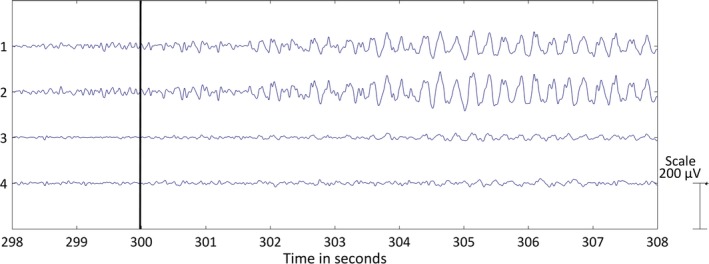
Fifty-four patients with a total of 182 seizures, mostly temporal lobe epilepsy (TLE), and 5284 hours of data, were recorded with a standard video-EEG at University Hospital Leuven. In addition, extra behind-the-ear EEG channels were recorded. First, a neurologist was asked to annotate behind-the-ear EEG segments containing selected seizure and nonseizure fragments. Second, a data-driven algorithm was developed using only behind-the-ear EEG. This algorithm was trained using data from other patients (patient-independent model) or from the same patient (patient-specific model).
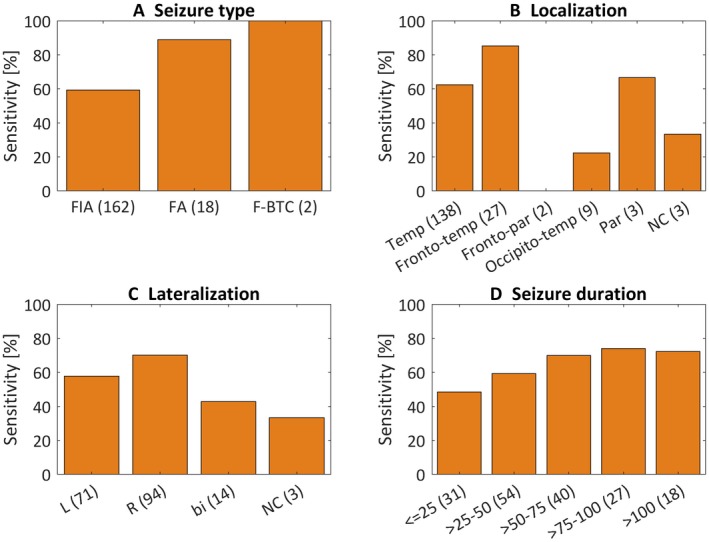
The visual recognition study resulted in 65.7% sensitivity and 94.4% specificity. By using those seizure annotations, the automated algorithm obtained 64.1% sensitivity and 2.8 false-positive detections (FPs)/24 hours with the patient-independent model. The patient-specific model achieved 69.1% sensitivity and 0.49 FPs/24 hours.
Visual recognition of ictal EEG patterns using only behind-the-ear EEG is possible in a significant number of patients with TLE. A patient-specific seizure detection algorithm using only behind-the-ear EEG was able to detect more seizures automatically than what patients typically report, with 0.49 FPs/24 hours. We conclude that a large number of refractory TLE patients can benefit from using this device.
患者的发作日记并不可靠。基于自动脑电图(EEG)的发作检测系统是一种有用的辅助工具,可以客观地检测和记录长时间视频-EEG 记录期间的发作。然而,这种标准的全头皮 EEG 记录设置在医院外的应用有限,需要一种隐蔽的、可穿戴的设备来捕捉家庭环境中的发作。我们正在开发一种使用耳后电极记录 EEG 的可穿戴设备。在这项研究中,我们确定仅使用耳后 EEG 通道是否可以识别发作模式。其次,仅使用那些耳后 EEG 通道开发了一种自动发作检测算法。
54 名患者共 182 次发作(主要为颞叶癫痫[TLE]),以及 5284 小时的数据,在鲁汶大学医院使用标准视频-EEG 进行记录。此外,还记录了额外的耳后 EEG 通道。首先,要求神经科医生对包含选定发作和非发作片段的耳后 EEG 段进行注释。其次,仅使用耳后 EEG 开发了一种数据驱动的算法。该算法使用来自其他患者的数据(患者独立模型)或来自同一患者的数据(患者特定模型)进行训练。
视觉识别研究的敏感性为 65.7%,特异性为 94.4%。通过使用这些发作注释,使用患者独立模型的自动算法获得了 64.1%的敏感性和 2.8 次假阳性检测(FPs)/24 小时。患者特定模型的敏感性为 69.1%,24 小时内的假阳性率为 0.49。
仅使用耳后 EEG 识别发作期 EEG 模式在很大一部分 TLE 患者中是可行的。使用仅耳后 EEG 的患者特定发作检测算法能够自动检测到比患者通常报告的更多的发作,24 小时内的假阳性率为 0.49。我们得出结论,大量难治性 TLE 患者可以从使用该设备中受益。