Department of Psychiatry , Washington University School of Medicine, St. Louis, Missouri.
Department of Psychological Sciences , University of Missouri, Columbia, Missouri.
Alcohol Clin Exp Res. 2018 Oct;42(10):1939-1950. doi: 10.1111/acer.13859. Epub 2018 Aug 23.
Recent trends in alcoholic liver disease, alcohol-related emergency room admissions, and alcohol use disorder prevalence as measured by general-population surveys have raised concerns about rising alcohol-related morbidity and mortality in the United States. In contrast, upward trends in per capita alcohol consumption have been comparatively modest.
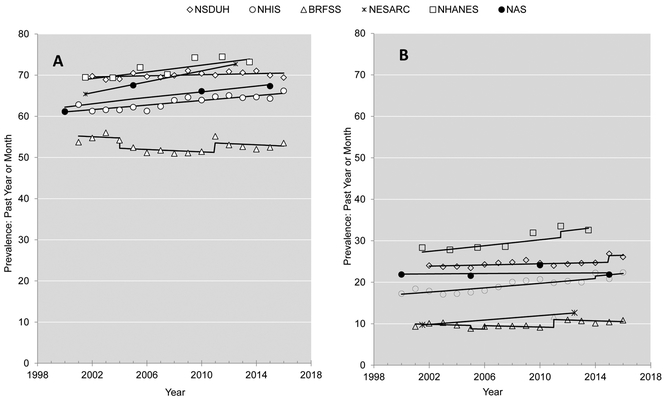
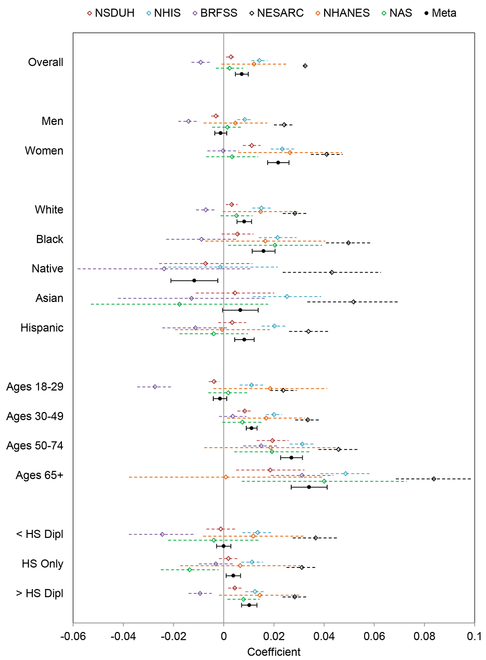
To resolve these discordant observations, we sought to examine trends in the prevalence of alcohol use and binge drinking from 6 regularly or periodically administered national surveys using a meta-analytic approach. Annual or periodic prevalence estimates for past-12-month or past-30-day alcohol use and binge drinking were estimated for available time points between the years 2000 and 2016. Estimates were combined in a random-effects regression model in which prevalence was modeled as a log-linear function of time to obtain meta-analytic trend estimates for the full population and by sex, race, age, and educational attainment.
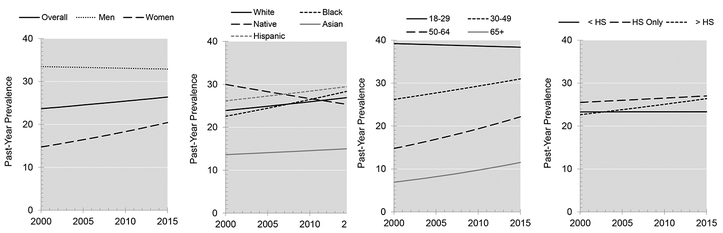
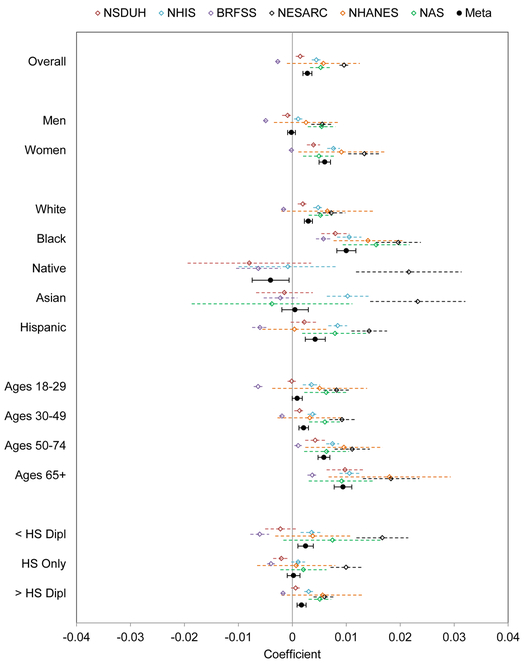
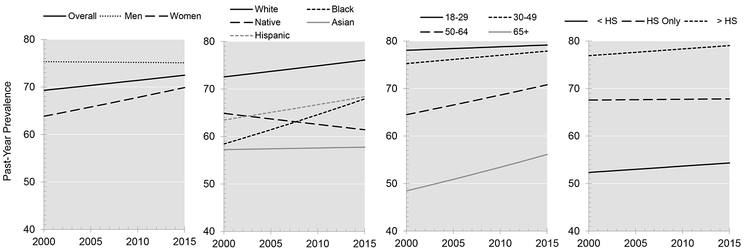
Meta-analysis-derived estimates of average annual percentage increase in the prevalence of alcohol use and binge drinking were 0.30% per year (95% CI: 0.22%, 0.38%) and 0.72% per year (95% CI: 0.46%, 0.98%), respectively. There was substantial between-survey heterogeneity among trend estimates, although there was notable consistency in the degree to which trends have impacted various demographic groups. For example, most surveys found that the changes in prevalence for alcohol use and binge drinking were large and positive for ages 50 to 64 and 65 and up, and smaller, negative, or nonsignificant for ages 18 to 29.
Significant increases in the prevalence of alcohol use and of binge drinking over the past 10 to 15 years were observed, but not for all demographic groups. However, the increase in binge drinking among middle-aged and older adults is substantial and may be driving increasing rates of alcohol-related morbidity and mortality.
近年来,酒精性肝病、与酒精相关的急诊入院和酒精使用障碍的流行率(通过一般人群调查衡量)的趋势令人担忧,因为这表明美国的酒精相关发病率和死亡率正在上升。相比之下,人均酒精消费量的上升趋势相对较为温和。
为了解决这些相互矛盾的观察结果,我们试图通过荟萃分析方法,检查使用 6 个定期或定期进行的全国性调查的酒精使用和狂饮趋势。对 2000 年至 2016 年期间可获得的各个时间点进行了过去 12 个月或过去 30 天的酒精使用和狂饮的年度或定期流行率估计。使用随机效应回归模型对流行率进行建模,将流行率作为时间的对数线性函数进行建模,以获得全人群和按性别、种族、年龄和教育程度划分的荟萃分析趋势估计。
荟萃分析得出的酒精使用和狂饮流行率的平均年百分比增长率估计值分别为 0.30%(95%CI:0.22%,0.38%)和 0.72%(95%CI:0.46%,0.98%)。尽管在各种趋势对不同人群的影响程度上存在显著的一致性,但趋势估计之间仍存在很大的调查间异质性。例如,大多数调查发现,50 至 64 岁和 65 岁及以上人群的酒精使用和狂饮流行率变化较大且呈阳性,而 18 至 29 岁人群的变化则较小、呈阴性或不显著。
在过去 10 至 15 年中,观察到酒精使用和狂饮流行率显著增加,但并非所有人群都如此。然而,中年和老年人群中狂饮的增加幅度很大,可能导致与酒精相关的发病率和死亡率上升。