Department of Medicine, University of Minnesota, Minneapolis, MN, United States of America.
Department of Veterinary and Biomedical Sciences, University of Minnesota, St Paul, MN, United States of America.
PLoS One. 2020 Mar 12;15(3):e0229565. doi: 10.1371/journal.pone.0229565. eCollection 2020.
Despite achievements in the reduction of malaria globally, imported malaria cases to the United States by returning international travelers continue to increase. Immigrants to the United States from sub-Saharan Africa (SSA) who then travel back to their homelands to visit friends and relatives (VFRs) experience a disproportionate burden of malaria illness. Various studies have explored barriers to malaria prevention among VFRs and non-VFRs-travelers to the same destinations with other purpose for travel-but few employed robust epidemiologic study designs or performed comparative analyses of these two groups. To better quantify the key barriers that VFRs face to implement effective malaria prevention measures, we conducted a comprehensive community-based, cross-sectional, survey to identify differences in malaria prevention knowledge, attitudes, and practices (KAP) among VFRs and others traveling to Africa and describe the differences between VFRs and other types of international travelers.
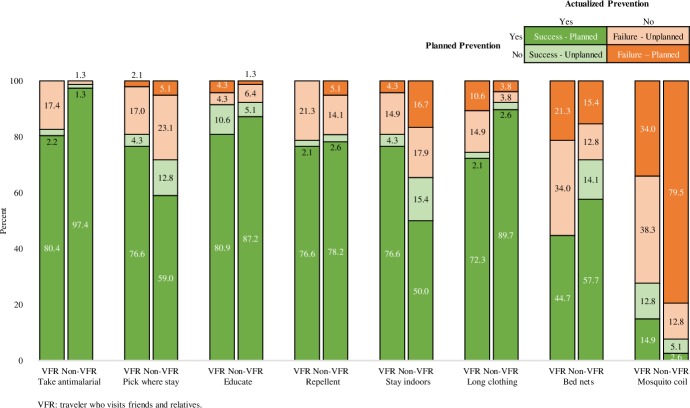
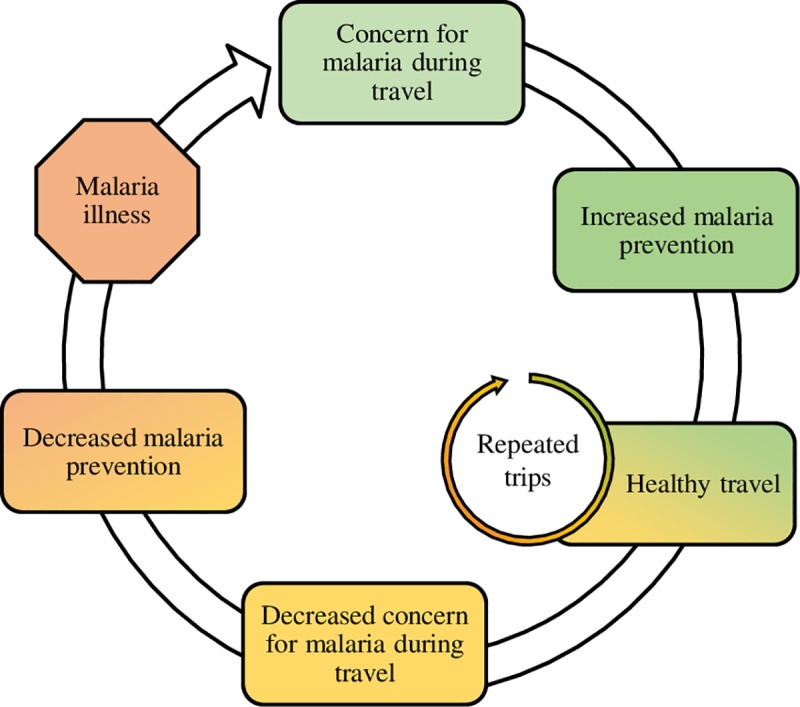
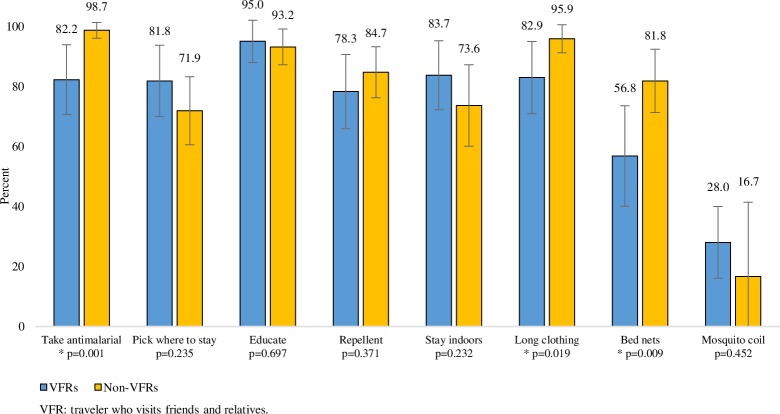
Three distinct populations of travelers with past or planned travel to malaria-endemic countries of SSA were surveyed: VFRs diagnosed with malaria as reported through a state health department; members of the general VFR population (community); and VFR and non-VFR travelers presenting to a travel health clinic, both before their pretravel consultation and again, after return from travel. A Community Advisory Board of African immigrants and prior qualitative research informed survey development and dissemination. Across the three groups, 489 travelers completed surveys: 351 VFRs and 138 non-VFRs. VFRs who reported taking antimalarials on their last trip rated their concern about malaria higher than those who did not. Having taken five or more trips to SSA was reported more commonly among VFRs diagnosed with malaria than community VFRs (44.0% versus 20.4%; p = 0.008). Among travel health clinic patients surveyed before and after travel, VFR travelers were less successful than non-VFRs in adhering to their planned use of antimalarials (82.2% versus 98.7%; p = 0.001) and employing mosquito bite avoidance techniques (e.g., using bed nets: 56.8% versus 81.8%; p = 0.009). VFRs who visited the travel health clinic were more likely than VFR respondents from the community to report taking an antimalarial (83.0% versus 61.9%; p = 0.009), or to report bite avoidance behaviors (e.g., staying indoors when mosquitoes were out: 80.9% versus 59.5%; p = 0.009).
We observed heterogeneity in malaria prevention behaviors among VFRs and between VFR and non-VFR traveler populations. Although VFRs attending the travel health clinic appear to demonstrate better adherence to malaria prevention measures than VFR counterparts surveyed in the community, specialized pretravel care is not sufficient to ensure chemoprophylaxis use and bite avoidance behaviors among VFRs. Even when seeking specialized pretravel care, VFRs experience greater barriers to the use of malaria prevention than non-VFRs. Addressing access to health care and upstream barrier reduction strategies that make intended prevention more achievable, affordable, easier, and resonant among VFRs may improve malaria prevention intervention effectiveness.
尽管全球在减少疟疾方面取得了成就,但返回国际旅行者输入的美国疟疾病例仍在不断增加。从撒哈拉以南非洲(SSA)移民到美国的人,然后回到家乡探亲访友(VFR),他们承受着不成比例的疟疾负担。各种研究都探讨了 VFR 预防疟疾的障碍,以及前往同一目的地的非 VFR 旅行者(出于其他旅行目的),但很少有研究采用强有力的流行病学研究设计或对这两组人群进行比较分析。为了更好地量化 VFR 实施有效疟疾预防措施所面临的关键障碍,我们进行了一项全面的基于社区的横断面调查,以确定 VFR 和前往非洲的其他旅行者之间在疟疾预防知识、态度和实践(KAP)方面的差异,并描述 VFR 和其他类型的国际旅行者之间的差异。
对过去或计划前往 SSA 疟疾流行国家旅行的三种不同旅行者人群进行了调查:通过州卫生部门报告诊断患有疟疾的 VFR;一般 VFR 人群(社区)的成员;以及在旅行前咨询和旅行归来后再次前往旅行健康诊所的 VFR 和非 VFR 旅行者。一个由非洲移民组成的社区咨询委员会和先前的定性研究为调查的制定和传播提供了信息。在这三组人群中,共有 489 名旅行者完成了调查:351 名 VFR 和 138 名非 VFR。在上次旅行中服用抗疟药的 VFR 报告者比未服用者更关注疟疾。与社区 VFR 相比,被诊断患有疟疾的 VFR 更常报告去过 SSA 五次或更多次(44.0% 与 20.4%;p = 0.008)。在旅行前和旅行后接受调查的旅行健康诊所患者中,VFR 旅行者在坚持使用计划中的抗疟药(82.2% 与 98.7%;p = 0.001)和采取蚊虫叮咬避免措施(例如,使用蚊帐:56.8% 与 81.8%;p = 0.009)方面的成功率低于非 VFR。与社区 VFR 受访者相比,前往旅行健康诊所的 VFR 更有可能报告服用了抗疟药(83.0% 与 61.9%;p = 0.009)或报告了蚊虫叮咬避免行为(例如,蚊子外出时待在室内:80.9% 与 59.5%;p = 0.009)。
我们观察到 VFR 之间以及 VFR 和非 VFR 旅行者群体之间的疟疾预防行为存在差异。尽管前往旅行健康诊所的 VFR 似乎比在社区中接受调查的 VFR 更能坚持预防疟疾的措施,但专门的旅行前护理不足以确保 VFR 使用化学预防和蚊虫叮咬避免行为。即使在寻求专门的旅行前护理时,VFR 也面临着比非 VFR 更大的疟疾预防障碍。解决获得医疗保健的机会和减少上游障碍的策略,使 VFR 更有可能实现预防目标,降低成本,更容易实施并更能引起共鸣,可能会提高疟疾预防干预措施的效果。