Department of Thoracic Medical Oncology, The Cancer Institute Hospital, Japanese Foundation for Cancer Research, Tokyo, Japan.
Department of Pulmonary Medicine and Oncology, Graduate School of Medicine, Nippon Medical School, Tokyo, Japan.
BMC Cancer. 2020 Mar 12;20(1):207. doi: 10.1186/s12885-020-6704-z.
Dissociated responses (DR) are phenomena in which some tumors shrink, whereas others progress during treatment of patients with cancer. The purpose of the present study was to evaluate the frequency and prognosis of DR in non-small cell lung cancer (NSCLC) patients treated with anti-programmed cell death-1/ligand 1 (anti-PD-1/L1) inhibitors.
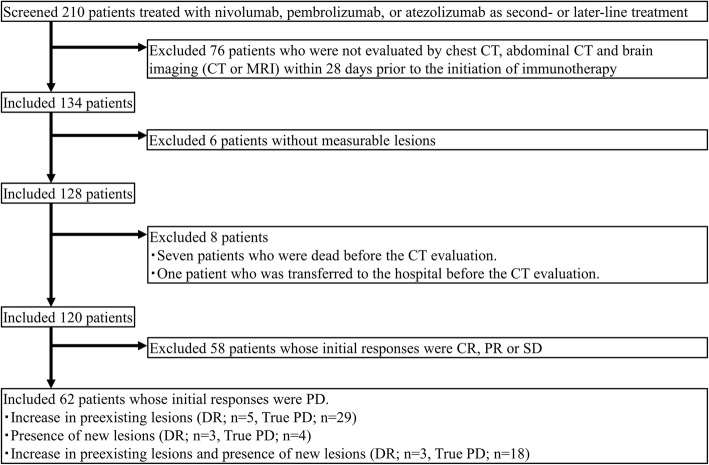
This retrospective study included NSCLC patients who received anti-PD-1/L1 inhibitor as second- or later-line treatment. We excluded patients without radiological evaluation. In patients who showed progressive disease (PD) according to the RECIST 1.1 at the initial CT evaluation, we evaluated all measurable lesions in each organ to identify DR independently of RECIST 1.1. We defined DR as a disease with some shrinking lesions as well as growing or emerging new lesions. Cases not classified as DR were defined as 'true PD'. Overall survival was compared between patients with DR and those with true PD using Cox proportional hazards models.
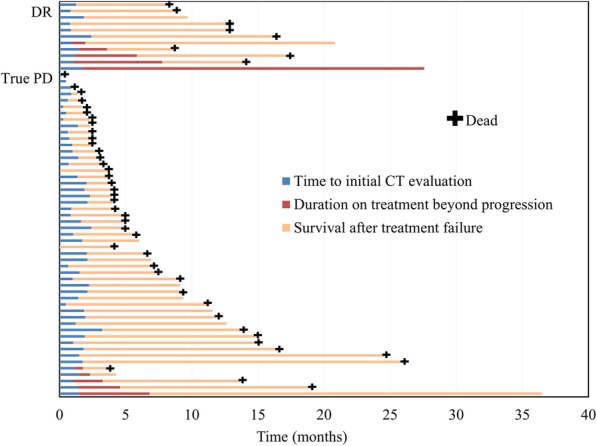
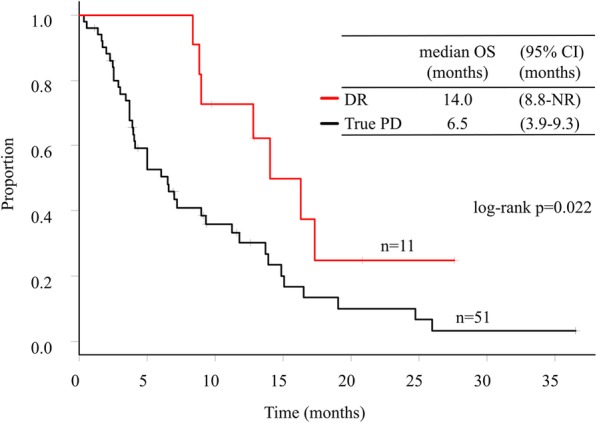
The present study included 62 NSCLC patients aged 27-82 years (median: 65 years). DR and true PD were observed in 11 and 51 patients, respectively. The frequency of DR in NSCLC patients who showed PD to anti-PD-1/L1 was 17.7%. Median overall survival was significantly longer in patients with DR versus true PD (14.0 vs. 6.6 months, respectively; hazard ratio for death: 0.40; 95% confidence interval: 0.17-0.94).
Patients with DR exhibited a relatively favorable prognosis.
在癌症患者的治疗过程中,一些肿瘤缩小,而另一些肿瘤进展,这是分离反应(DR)的现象。本研究的目的是评估接受抗程序性细胞死亡-1/配体 1(抗 PD-1/L1)抑制剂治疗的非小细胞肺癌(NSCLC)患者中 DR 的频率和预后。
本回顾性研究纳入了接受抗 PD-1/L1 抑制剂二线或以上治疗的 NSCLC 患者。我们排除了没有影像学评估的患者。在初始 CT 评估时根据 RECIST 1.1 显示疾病进展(PD)的患者中,我们评估了每个器官的所有可测量病变,以独立于 RECIST 1.1 识别 DR。我们将 DR 定义为一些病变缩小但同时存在生长或新出现的新病变的疾病。未分类为 DR 的病例被定义为“真正的 PD”。使用 Cox 比例风险模型比较 DR 患者和真正 PD 患者的总生存期。
本研究纳入了年龄为 27-82 岁(中位数:65 岁)的 62 例 NSCLC 患者。11 例患者出现 DR,51 例患者出现真正 PD。在对抗 PD-1/L1 出现 PD 的 NSCLC 患者中,DR 的频率为 17.7%。DR 患者的总生存期明显长于真正 PD 患者(分别为 14.0 个月和 6.6 个月;死亡风险比:0.40;95%置信区间:0.17-0.94)。
出现 DR 的患者表现出相对较好的预后。