Biology Department, Pennsylvania State University, University Park, PA, USA.
Department of Symbiosis, Max Planck Institute for Marine Microbiology, Bremen, Germany.
Microbiome. 2020 Mar 12;8(1):34. doi: 10.1186/s40168-020-00798-w.
Apicomplexans are the causative agents of major human diseases such as malaria and toxoplasmosis. A novel group of apicomplexans, recently named corallicolids, have been detected in corals inhabiting tropical shallow reefs. These apicomplexans may represent a transitional lifestyle between free-living phototrophs and obligate parasites. To shed light on the evolutionary history of apicomplexans and to investigate their ecology in association with corals, we screened scleractinians, antipatharians, alcyonaceans, and zoantharians from shallow, mesophotic, and deep-sea communities. We detected corallicolid plastids using 16S metabarcoding, sequenced the nuclear 18S rRNA gene of corallicolids from selected samples, assembled and annotated the plastid and mitochondrial genomes from a corallicolid that associates with a deep-sea coral, and screened the metagenomes of four coral species for corallicolids.
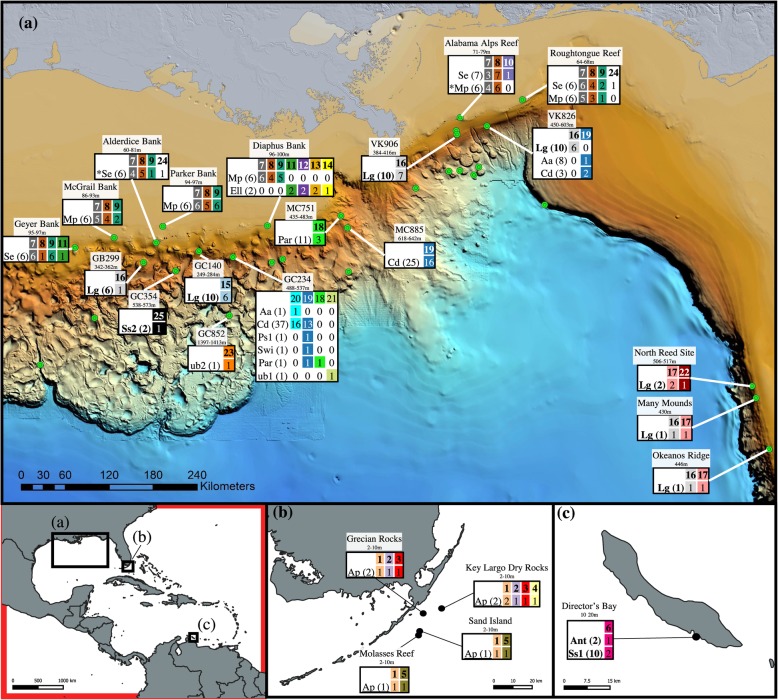
We detected 23 corallicolid plastotypes that were associated with 14 coral species from three orders and depths down to 1400 m. Individual plastotypes were restricted to coral hosts within a single depth zone and within a single taxonomic order of corals. Some clusters of closely related corallicolids were revealed that associated with closely related coral species. However, the presence of divergent corallicolid lineages that associated with similar coral species and depths suggests that corallicolid/coral relations are flexible over evolutionary timescales and that a large diversity of apicomplexans may remain undiscovered. The corallicolid plastid genome from a deep-sea coral contained four genes involved in chlorophyll biosynthesis: the three genes of the LIPOR complex and acsF.
The presence of corallicolid apicomplexans in corals below the photic zone demonstrates that they are not restricted to shallow-water reefs and are more general anthozoan symbionts. The presence of LIPOR genes in the deep-sea corallicolid precludes a role involving photosynthesis and suggests they may be involved in a different function. Thus, these genes may represent another set of genetic tools whose function was adapted from photosynthesis as the ancestors of apicomplexans evolved towards parasitic lifestyles. Video abstract.
顶复门是疟疾和弓形体病等主要人类疾病的病原体。最近在栖息于热带浅礁的珊瑚中发现了一类新的顶复门生物,称为珊瑚虫。这些顶复门生物可能代表着从自由生活的光合生物到专性寄生虫的过渡生活方式。为了阐明顶复门的进化历史,并研究它们与珊瑚的生态关系,我们从浅海、中层和深海群落中筛选了珊瑚、柳珊瑚、海葵和珊瑚虫。我们使用 16S 代谢组学检测珊瑚虫质体,从选定的样本中测序珊瑚虫的核 18S rRNA 基因,组装和注释与深海珊瑚相关的珊瑚虫质体和线粒体基因组,并筛选了四种珊瑚物种的宏基因组以检测珊瑚虫。
我们检测到与 14 种珊瑚物种相关的 23 种珊瑚虫质体,这些珊瑚物种来自三个门,深度可达 1400 米。单个质体仅限于单个深度带和珊瑚分类阶元内的珊瑚宿主。揭示了一些密切相关的珊瑚虫簇,它们与密切相关的珊瑚物种相关。然而,与类似珊瑚物种和深度相关的分歧珊瑚虫谱系的存在表明,珊瑚虫/珊瑚的关系在进化时间尺度上是灵活的,并且可能还有大量未被发现的顶复门生物。深海珊瑚的珊瑚虫质体基因组包含四个参与叶绿素生物合成的基因:LIPOR 复合物的三个基因和 acsF。
在光区以下的珊瑚中存在珊瑚虫顶复门生物表明它们不仅限于浅海水域,而是更普遍的珊瑚共生体。深海珊瑚虫的 LIPOR 基因的存在排除了与光合作用有关的作用,并表明它们可能参与了不同的功能。因此,这些基因可能代表另一组遗传工具,其功能是从光合作用适应而来的,因为顶复门生物的祖先向寄生虫生活方式进化。视频摘要。