National Research Center for Protozoan Diseases, Obihiro University of Agriculture and Veterinary Medicine, Inada-cho, Obihiro, Hokkaido, 080-8555, Japan.
Veterinary Research Institute, Peradeniya, Sri Lanka.
Parasit Vectors. 2022 Aug 24;15(1):299. doi: 10.1186/s13071-022-05374-9.
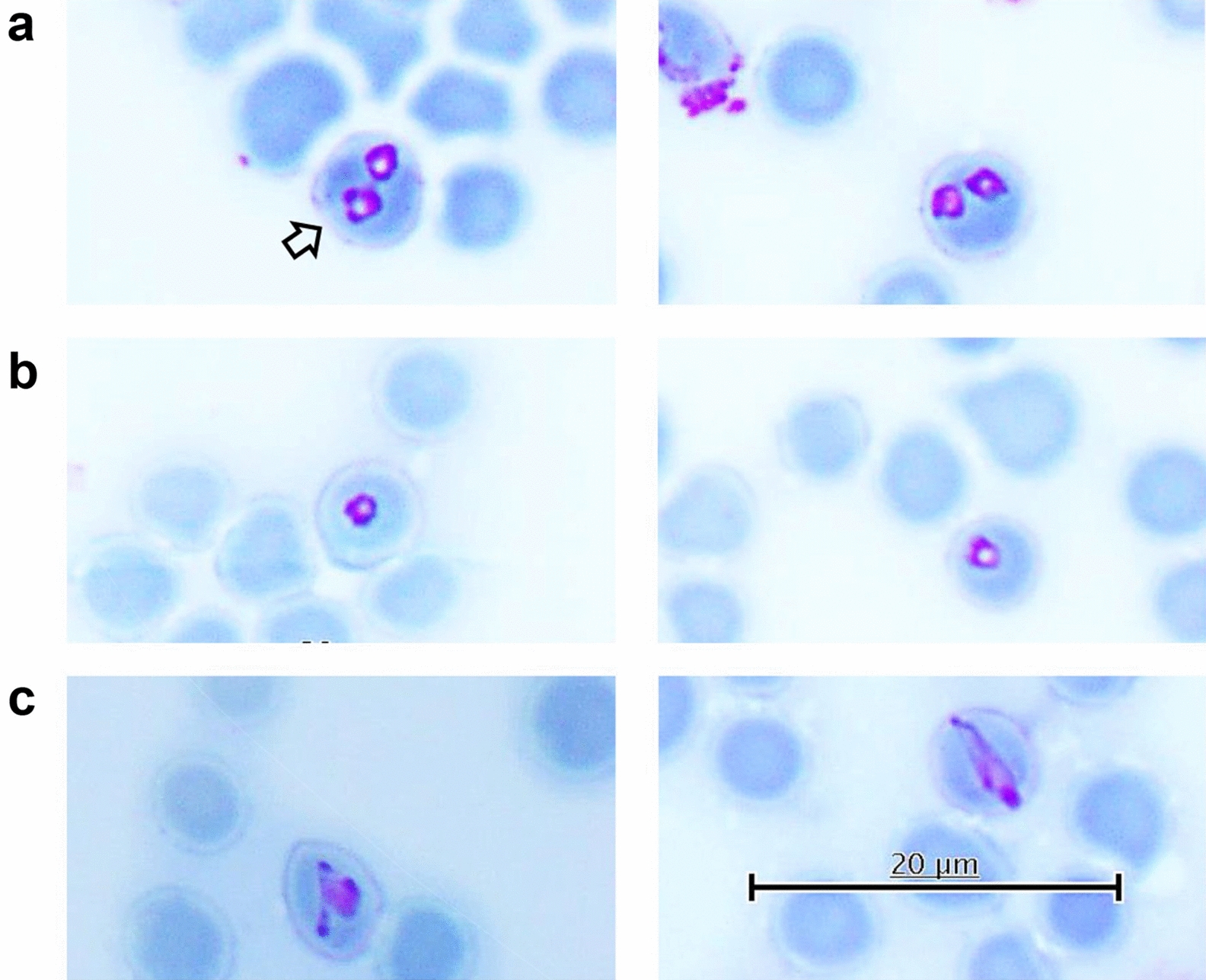
The recently discovered Babesia sp. Mymensingh, which causes clinical bovine babesiosis, has a wide geographical distribution. We investigated the phylogenetic position of Babesia sp. Mymensingh using its mitochondrial, plastid, and nuclear genes. Based on morphological and molecular data, Babesia sp. Mymensingh is a unique species and we named it as Babesia naoakii n. sp.
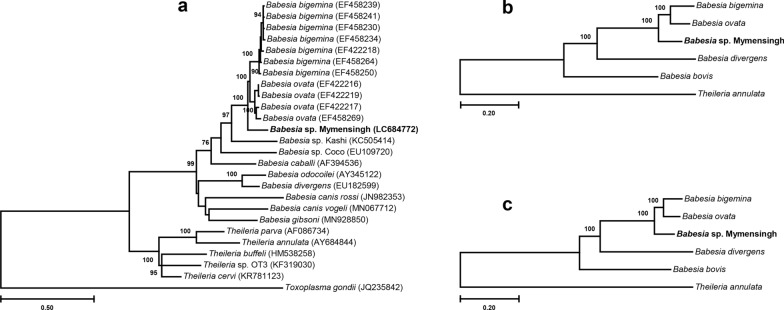
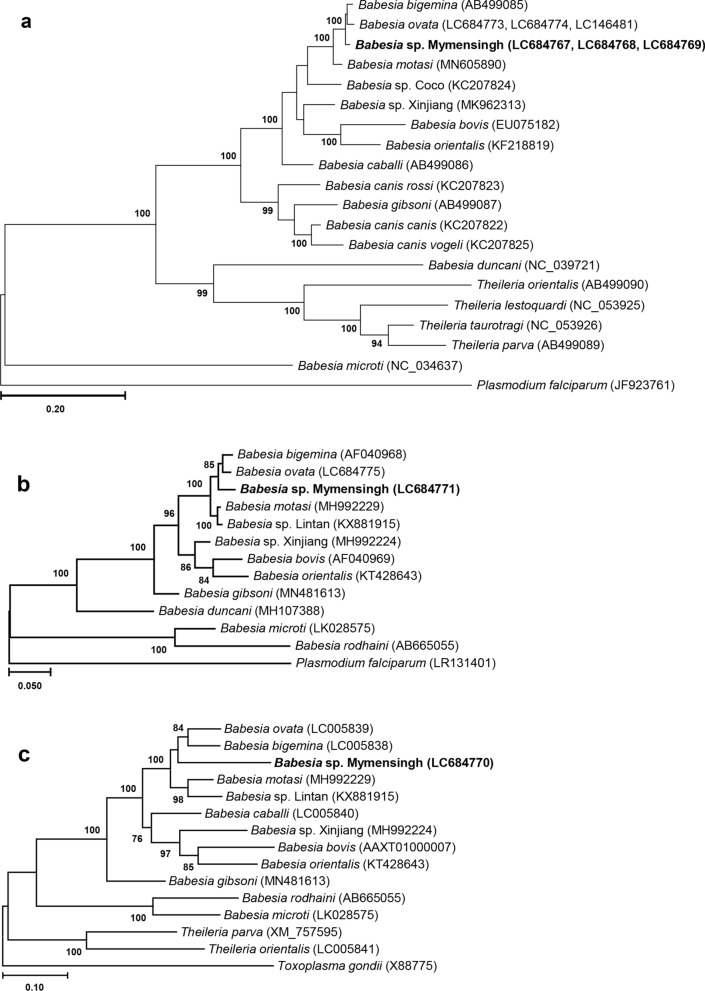
A blood DNA sample from a Babesia sp. Mymensingh-infected cow was subjected to genome sequencing to obtain the sequences of mitochondrial, plastid, and nuclear genes. Six phylogenetic trees were then constructed with (1) concatenated amino acid sequences of cytochrome oxidase subunit I, cytochrome oxidase subunit III, and cytochrome b genes of the mitochondrial genome; (2) 16S rRNA of the plastid genome; (3) nucleotide sequences of the elongation factor Tu gene of the plastid genome; (4) ITS1-5.8S rRNA-ITS2; (5) concatenated nucleotide sequences of 89 nuclear genes; and (6) concatenated amino acid sequences translated from the 89 nuclear genes.
In all six phylogenetic trees, B. naoakii n. sp. formed a sister clade to the common ancestor of Babesia bigemina and B. ovata. The concatenated nuclear genes of B. naoakii n. sp. and their translated amino acid sequences shared lower identity scores with the sequences from B. bigemina (82.7% and 84.7%, respectively) and B. ovata (83.5% and 85.5%, respectively) compared with the identity scores shared between the B. bigemina and B. ovata sequences (86.3% and 87.9%, respectively).
Our study showed that B. naoakii n. sp. occupies a unique phylogenetic position distinct from existing Babesia species. Our findings, together with morphological differences, identify B. naoakii n. sp. as a distinct parasite species.
最近发现的引起临床牛巴贝斯虫病的巴贝斯虫属 Mymensingh 分布广泛。我们使用其线粒体、质体和核基因研究了巴贝斯虫属 Mymensingh 的系统发育位置。根据形态学和分子数据,巴贝斯虫属 Mymensingh 是一个独特的种,我们将其命名为巴贝斯虫 Naoakii n. sp.。
从感染巴贝斯虫属 Mymensingh 的牛的血液 DNA 样本中进行基因组测序,获得线粒体、质体和核基因的序列。然后构建了 6 个系统发育树,包括:(1)线粒体基因组细胞色素氧化酶亚基 I、细胞色素氧化酶亚基 III 和细胞色素 b 的氨基酸序列的串联;(2)质体基因组 16S rRNA;(3)质体基因组延伸因子 Tu 基因的核苷酸序列;(4)ITS1-5.8S rRNA-ITS2;(5)89 个核基因的核苷酸序列串联;(6)从 89 个核基因翻译的氨基酸序列的串联。
在所有 6 个系统发育树中,巴贝斯虫 Naoakii n. sp.与双芽巴贝斯虫和卵形巴贝斯虫的共同祖先形成姐妹分支。巴贝斯虫 Naoakii n. sp.的串联核基因及其翻译的氨基酸序列与双芽巴贝斯虫(分别为 82.7%和 84.7%)和卵形巴贝斯虫(分别为 83.5%和 85.5%)的序列相比,与双芽巴贝斯虫和卵形巴贝斯虫的序列之间的同一性得分(分别为 86.3%和 87.9%)较低。
我们的研究表明,巴贝斯虫 Naoakii n. sp.占据独特的系统发育位置,与现有的巴贝斯虫物种不同。我们的研究结果,加上形态学差异,确定巴贝斯虫 Naoakii n. sp.为一个独特的寄生虫种。