Department of Rheumatology, Tokyo Medical and Dental University, 1-5-45 Yushima, Bunkyo-ku, Tokyo, 113-8519, Japan.
Department of Pharmacovigilance, Tokyo Medical and Dental University, 1-5-45 Yushima, Bunkyo-ku, Tokyo, 113-8519, Japan.
Arthritis Res Ther. 2020 Mar 12;22(1):46. doi: 10.1186/s13075-020-2137-y.
Abatacept (ABA) is a biological disease-modifying antirheumatic drug (bDMARD) for rheumatoid arthritis (RA). The aim of this study was to identify molecules that are associated with therapeutic responses to ABA in patients with RA.
Peripheral blood was collected using a PAX gene Blood RNA kit from 45 bDMARD-naïve patients with RA at baseline and at 6 months after the initiation of ABA treatment. Gene expression levels of responders (n = 27) and non-responders (n = 8) to ABA treatment among patients with RA at baseline were compared using a microarray. The gene expression levels were confirmed using real-time quantitative polymerase chain reaction (RT-qPCR).
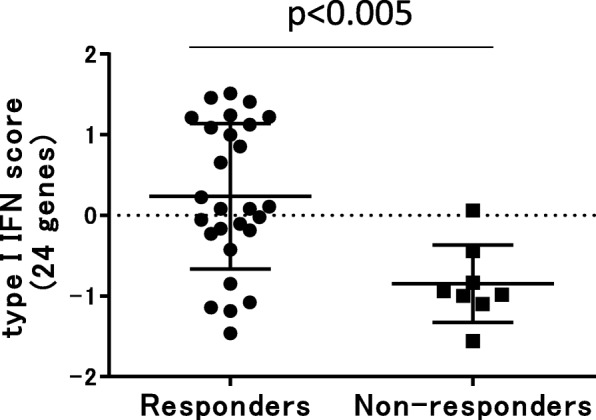
Gene expression analysis revealed that the expression levels of 218 genes were significantly higher and those of 392 genes were significantly lower in the responders compared to the non-responders. Gene ontology analysis of the 218 genes identified "response to type I interferon (IFN)" with 24 type I IFN-related genes. RT-qPCR confirmed that there was a strong correlation between the score calculated using the 24 genes and that using OAS3, MX1, and IFIT3 (type I IFN score) (rho with the type I IFN score 0.981); the type I IFN score was significantly decreased after treatment with ABA in the responders (p < 0.05), but not in the non-responders. The receiver operating characteristic curve analysis of the type I IFN score showed that sensitivity, specificity, and AUC (95% confidence interval) for the responders were 0.82, 1.00, and 0.92 (0.82-1.00), respectively. Further, RT-qPCR demonstrated higher expression levels of BATF2, LAMP3, CD83, CLEC4A, IDO1, IRF7, STAT1, STAT2, and TNFSF10 in the responders, all of which are dendritic cell-related genes or type I IFN-related genes with significant biological implications.
Type I IFN score and expression levels of the nine genes may serve as novel biomarkers associated with a clinical response to ABA in patients with RA.
阿巴西普(ABA)是一种治疗类风湿关节炎(RA)的生物性疾病修饰抗风湿药物(bDMARD)。本研究旨在确定与 RA 患者接受 ABA 治疗后的疗效相关的分子。
采用 PAXgene Blood RNA 试剂盒采集 45 例初治 RA 患者的外周血,分别于基线和接受 ABA 治疗 6 个月后采集。采用基因芯片比较治疗应答者(n=27)和无应答者(n=8)的基因表达水平。采用实时定量聚合酶链反应(RT-qPCR)验证基因表达水平。
基因表达分析显示,与无应答者相比,应答者的 218 个基因表达水平显著升高,392 个基因表达水平显著降低。218 个基因的基因本体分析确定了“对 I 型干扰素(IFN)的反应”,其中包含 24 个 I 型 IFN 相关基因。RT-qPCR 证实,使用这 24 个基因计算的评分与使用 OAS3、MX1 和 IFIT3(I 型 IFN 评分)计算的评分之间具有很强的相关性(I 型 IFN 评分的 rho 值为 0.981);在应答者中,ABA 治疗后 I 型 IFN 评分显著降低(p<0.05),而非应答者中则无此改变。I 型 IFN 评分的受试者工作特征曲线分析显示,对应答者的敏感性、特异性和 AUC(95%置信区间)分别为 0.82、1.00 和 0.92(0.82-1.00)。此外,RT-qPCR 显示,应答者中 BATF2、LAMP3、CD83、CLEC4A、IDO1、IRF7、STAT1、STAT2 和 TNFSF10 的表达水平更高,这些基因均为树突状细胞相关基因或与 I 型 IFN 相关的基因,具有重要的生物学意义。
I 型 IFN 评分和 9 个基因的表达水平可能成为与 RA 患者接受 ABA 治疗临床应答相关的新型生物标志物。