Derambure C, Dzangue-Tchoupou G, Berard C, Vergne N, Hiron M, D'Agostino M A, Musette P, Vittecoq O, Lequerré T
Normandie Univ, UNIROUEN, Inserm U 1245, F 76000, Rouen, France.
Normandie Univ, UNIROUEN, Inserm U 905, F 76000, Rouen, France.
Arthritis Res Ther. 2017 May 25;19(1):109. doi: 10.1186/s13075-017-1319-8.
In the current context of personalized medicine, one of the major challenges in the management of rheumatoid arthritis (RA) is to identify biomarkers that predict drug responsiveness. From the European APPRAISE trial, our main objective was to identify a gene expression profile associated with responsiveness to abatacept (ABA) + methotrexate (MTX) and to understand the involvement of this signature in the pathophysiology of RA.
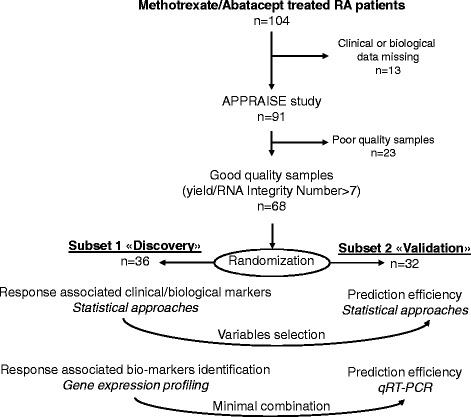
Whole human genome microarrays (4 × 44 K) were performed from a first subset of 36 patients with RA. Data validation by quantitative reverse-transcription (qRT)-PCR was performed from a second independent subset of 32 patients with RA. Gene Ontology and WikiPathways database allowed us to highlight the specific biological mechanisms involved in predicting response to ABA/MTX.
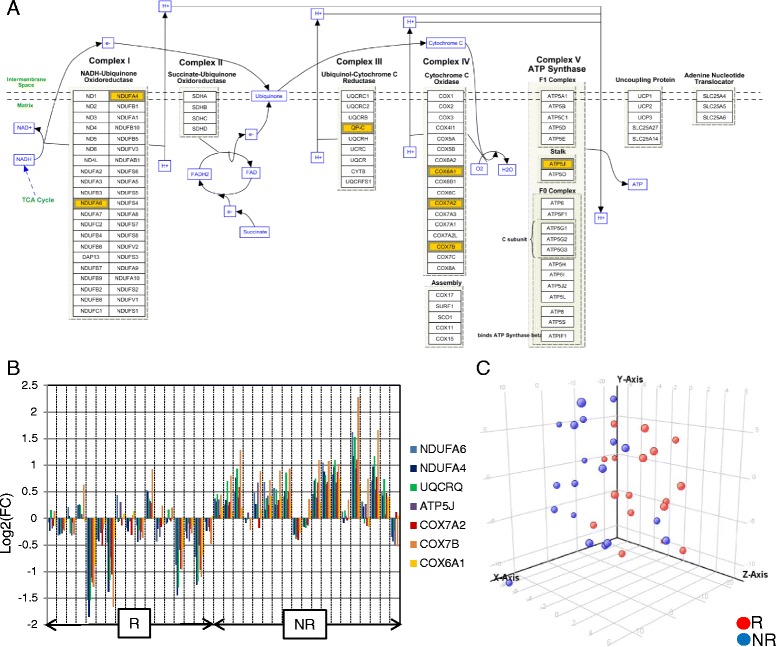
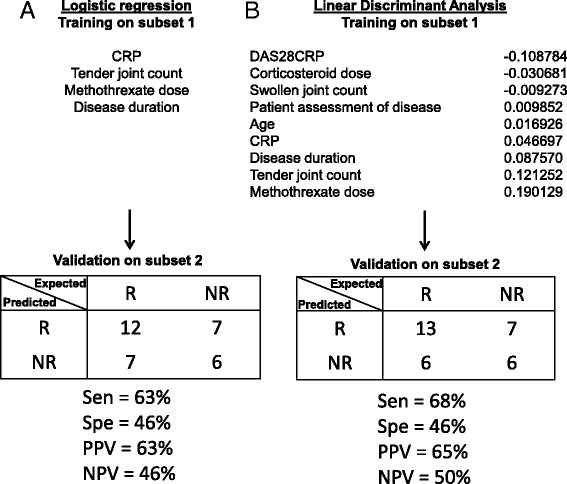
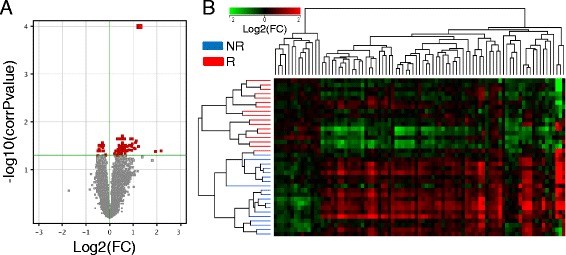
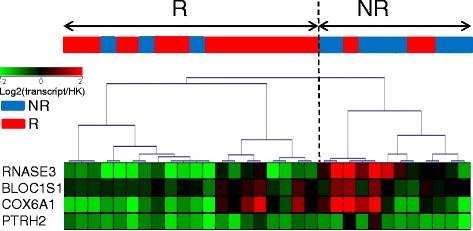
From the first subset of 36 patients with RA, a combination including 87 transcripts allowed almost perfect separation between responders and non-responders to ABA/MTX. Next, the second subset of patients 32 with RA allowed validation by qRT-PCR of a minimal signature with only four genes. This latter signature categorized 81% of patients with RA with 75% sensitivity, 85% specificity and 85% negative predictive value. This combination showed a significant enrichment of genes involved in electron transport chain (ETC) pathways. Seven transcripts from ETC pathways (NDUFA6, NDUFA4, UQCRQ, ATP5J, COX7A2, COX7B, COX6A1) were significantly downregulated in responders versus non-responders to ABA/MTX. Moreover, dysregulation of these genes was independent of inflammation and was specific to ABA response.
Pre-silencing of ETC genes is associated with future response to ABA/MTX and might be a crucial key to susceptibility to ABA response.
在当前个性化医疗的背景下,类风湿关节炎(RA)管理中的主要挑战之一是识别预测药物反应性的生物标志物。在欧洲APPRAISE试验中,我们的主要目标是确定与阿巴西普(ABA)+甲氨蝶呤(MTX)反应性相关的基因表达谱,并了解该特征在RA病理生理学中的作用。
对36例RA患者的第一个亚组进行全人类基因组微阵列(4×44K)检测。通过定量逆转录(qRT)-PCR对32例RA患者的第二个独立亚组进行数据验证。基因本体论和WikiPathways数据库使我们能够突出预测对ABA/MTX反应所涉及的特定生物学机制。
在36例RA患者的第一个亚组中,一个包含87个转录本的组合几乎能完美区分对ABA/MTX的反应者和无反应者。接下来,32例RA患者的第二个亚组通过qRT-PCR验证了仅含四个基因的最小特征。后一个特征对81%的RA患者进行了分类,敏感性为75%,特异性为85%,阴性预测值为85%。该组合显示参与电子传递链(ETC)途径的基因有显著富集。与对ABA/MTX的无反应者相比,ETC途径的七个转录本(NDUFA6、NDUFA4、UQCRQ、ATP5J、COX7A2、COX7B、COX6A1)在反应者中显著下调。此外,这些基因的失调与炎症无关,且是ABA反应特有的。
ETC基因的预沉默与未来对ABA/MTX的反应相关,可能是ABA反应易感性的关键因素。