Department of Obstetrics and Gynecology, Klinikum rechts der Isar, Technische Universität München, Ismaningerstr. 22, 81675, Munich, Germany.
Seoul National University Hospital Cancer Research Institute, Seoul National University College of Medicine, Seoul, South Korea.
Breast Cancer Res. 2020 Mar 12;22(1):27. doi: 10.1186/s13058-020-01263-0.
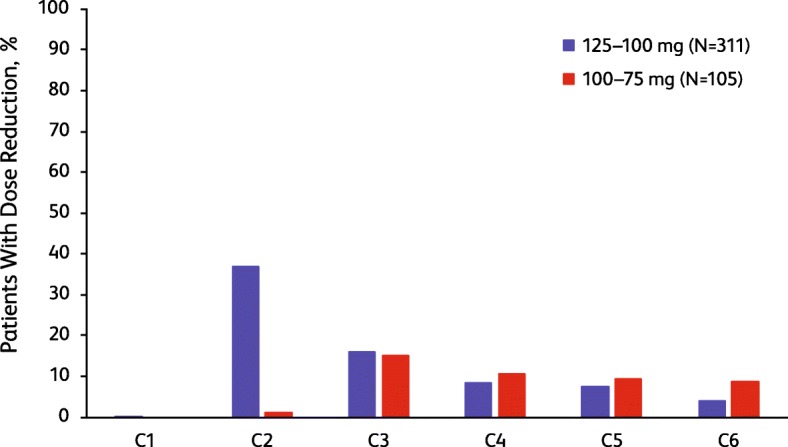
Palbociclib improves outcomes for women with hormone receptor-positive/human epidermal growth factor receptor 2-negative advanced breast cancer (HR+/HER2- ABC). Dose reductions are recommended for the management of hematologic toxicities. A previous pooled analysis from the PALOMA clinical trials showed that 36.9% of patients required dose reduction, predominantly during the first 6 months of treatment and with decreasing frequency during subsequent 28-day treatment cycles (C). Previous data have shown that palbociclib dose reductions do not affect efficacy. This pooled, post hoc analysis evaluated the frequency of hematologic adverse events (AEs) before and after palbociclib dose reduction in PALOMA-1, PALOMA-2, and PALOMA-3.
This analysis evaluated the frequency of hematologic AEs 30 days before dose reduction and during each subsequent treatment from C1 to C6 among patients who required palbociclib dose reduction. Data were pooled from 3 randomized studies. PALOMA-1 was a phase 2, open-label study of postmenopausal patients untreated for ABC receiving palbociclib plus letrozole or letrozole alone. PALOMA-2 was a phase 3, double-blind study of postmenopausal patients untreated for ABC receiving palbociclib plus letrozole or placebo plus letrozole. PALOMA-3 was a phase 3, double-blind study of pre/perimenopausal or postmenopausal patients, whose disease progressed on prior endocrine therapy, receiving palbociclib plus fulvestrant or placebo plus fulvestrant.
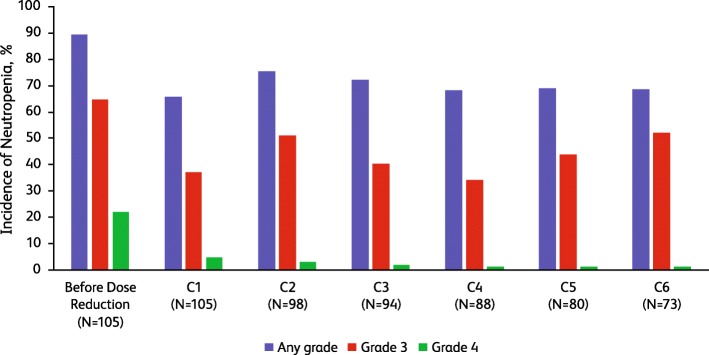
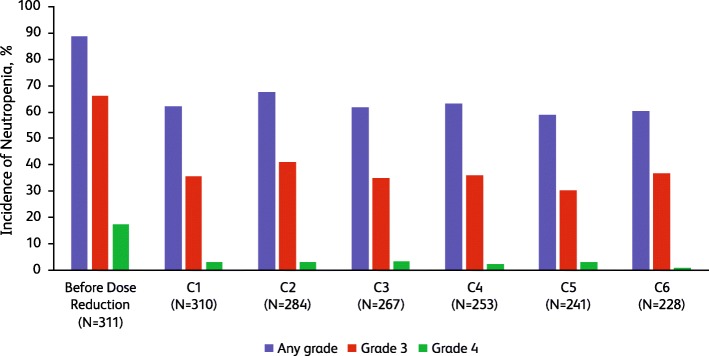
A total of 311 (35.5%) patients with HR+/HER2- ABC required a palbociclib dose reduction (93.6% due to AEs) from 125 to 100 mg. Mean patient age was 59.9 years, and 46.9% of patients had visceral disease. Median time to dose reduction was 70 days. The majority of dose reductions occurred within 3 months of starting palbociclib treatment. Incidences of all-grade and grades 3/4 hematologic AEs were lower following dose reduction.
A decrease in frequency and severity of hematologic AEs, including febrile neutropenia, following palbociclib dose reduction was observed, supporting the recommended use of dose reduction in AE management.
These studies were sponsored by Pfizer. ClinicalTrials.gov: NCT00721409; registration date July 24, 2008. ClinicalTrials.gov: NCT01740427; registration date December 4, 2012. ClinicalTrials.gov: NCT01942135; registration date September 13, 2013.
哌柏西利可改善激素受体阳性/人表皮生长因子受体 2 阴性晚期乳腺癌(HR+/HER2-ABC)患者的预后。建议减少剂量以管理血液学毒性。来自 PALOMA 临床试验的先前汇总分析显示,36.9%的患者需要减少剂量,主要发生在治疗的前 6 个月,随后 28 天治疗周期中减少频率(C)。先前的数据表明,哌柏西利剂量减少不会影响疗效。这项汇总的事后分析评估了 PALOMA-1、PALOMA-2 和 PALOMA-3 中接受哌柏西利剂量减少的患者在剂量减少前和 C1 至 C6 期间每个后续治疗周期中血液学不良事件(AE)的发生频率。该分析从 3 项随机研究中评估了需要减少哌柏西利剂量的患者在剂量减少前 30 天和随后每个治疗周期(C1 至 C6)中的血液学 AE 频率。PALOMA-1 是一项针对未接受 ABC 治疗的绝经后患者的 2 期、开放标签研究,这些患者接受哌柏西利联合来曲唑或来曲唑单药治疗。PALOMA-2 是一项针对未接受 ABC 治疗的绝经后患者的 3 期、双盲研究,这些患者接受哌柏西利联合来曲唑或安慰剂联合来曲唑治疗。PALOMA-3 是一项针对先前内分泌治疗疾病进展的绝经前/围绝经期或绝经后患者的 3 期、双盲研究,这些患者接受哌柏西利联合氟维司群或安慰剂联合氟维司群治疗。
共有 311(35.5%)名 HR+/HER2-ABC 患者需要减少哌柏西利剂量(93.6%是由于 AE),从 125 毫克减少至 100 毫克。患者平均年龄为 59.9 岁,46.9%的患者有内脏疾病。剂量减少的中位时间为 70 天。大多数剂量减少发生在开始哌柏西利治疗的 3 个月内。剂量减少后,所有级别和 3/4 级血液学 AE 的发生率均降低。
观察到哌柏西利剂量减少后血液学 AE 的频率和严重程度降低,包括发热性中性粒细胞减少症,支持在 AE 管理中使用剂量减少。
这些研究由辉瑞公司赞助。ClinicalTrials.gov:NCT00721409;注册日期 2008 年 7 月 24 日。ClinicalTrials.gov:NCT01740427;注册日期 2012 年 12 月 4 日。ClinicalTrials.gov:NCT01942135;注册日期 2013 年 9 月 13 日。