Sun Lu, Pan Yan, Wang Xiaochun, Gao Gang, Wu Lina, Piao Chunnan, Ruan Jianlei, Liu Jianxiang
Key Laboratory of Radiological Protection and Nuclear Emergency, National Institute for Radiological Protection, Chinese Center for Disease Control and Prevention, Beijing, China.
Liaoning Center for Disease Control and Prevention, Shenyang, China.
Dose Response. 2020 Feb 28;18(1):1559325820904600. doi: 10.1177/1559325820904600. eCollection 2020 Jan-Mar.
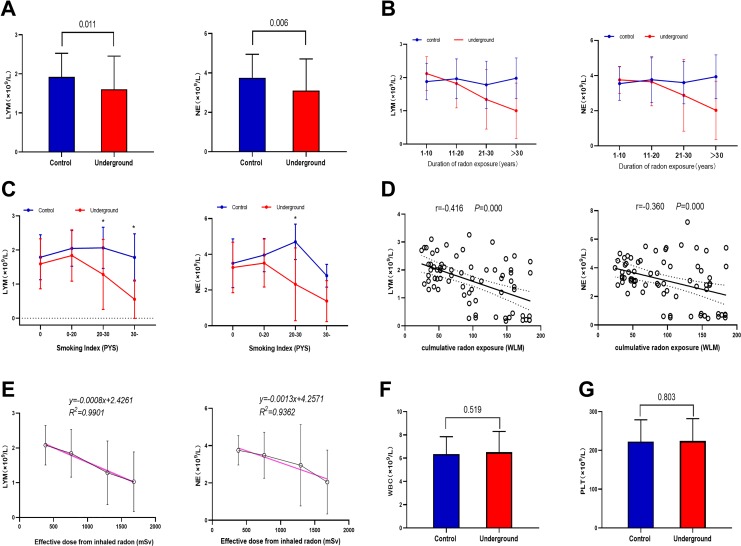
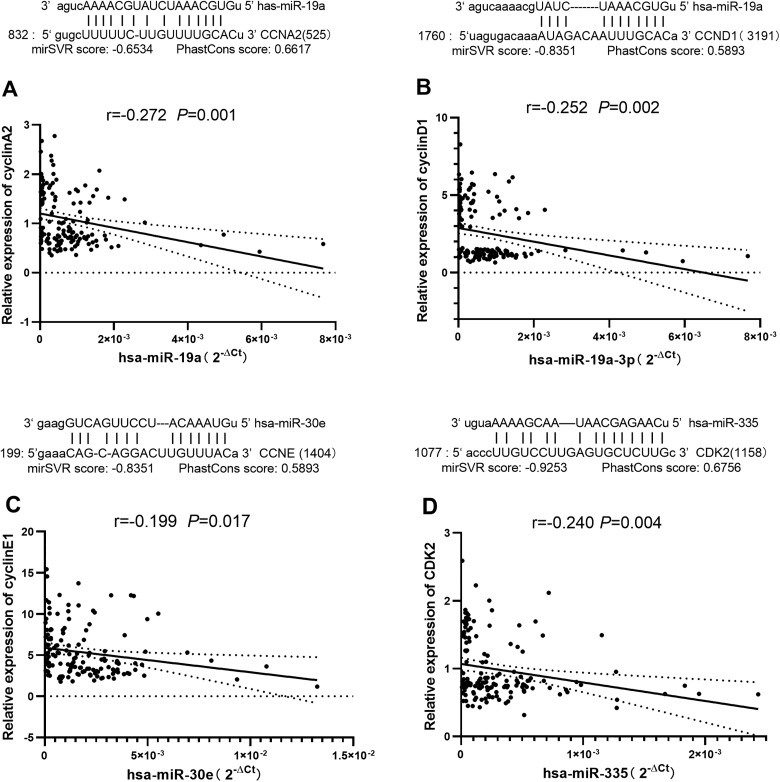
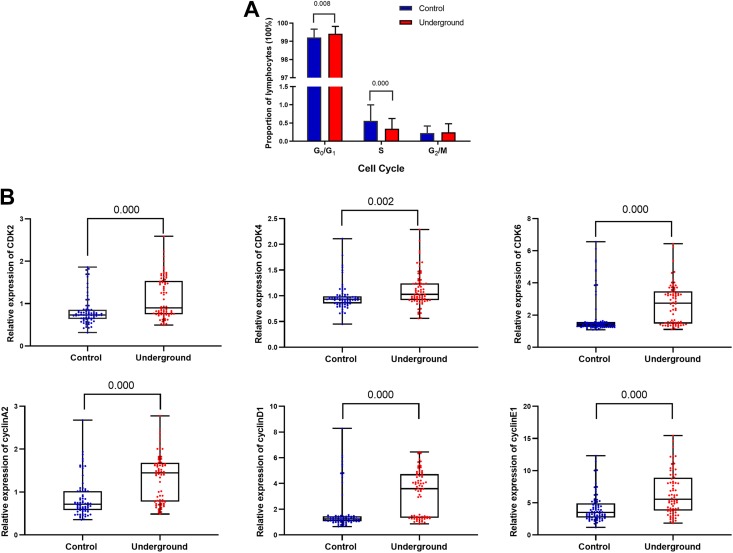
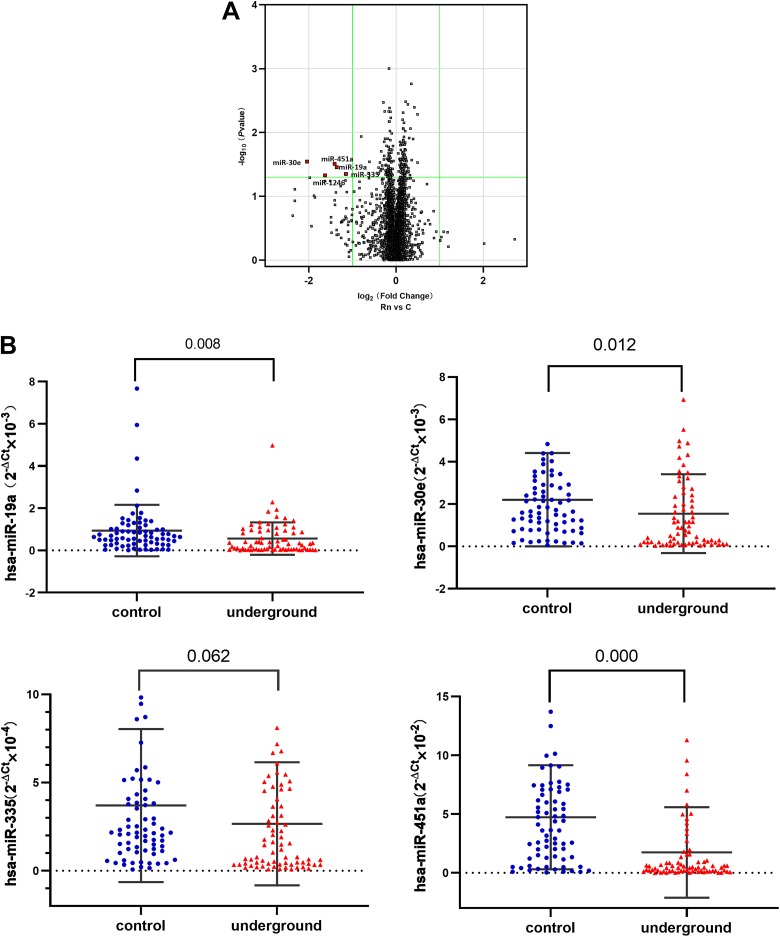
In this cohort study of 144 miners, 72 miners worked underground (the study group) and 72 miners worked aboveground (the control group). Based on questionnaire data and of radon concentration measurements, the cumulative radon exposure dose was calculated for each miner using the parameters recommended in International Commission on Radiological Protection Publication 137. Hematological parameters such as lymphocyte count (LYM) and neutrophil count (NE) were assessed, cell cycle phases and regulatory proteins were detected by flow cytometry, and microRNA (miRNA) microarray screening and real-time polymerase chain reaction (PCR) were used to detect miRNAs in plasma. The interrelationships between various potential biomarkers were analyzed using bioinformatics and statistical methods. The mean cumulative exposure dose of underground miners and controls was 982 and 48 mSv, respectively. Hematological parameters (such as LYM and NE) were significantly lower in the underground group. Cyclin-dependent kinase (CDK)-2, CDK4, CDK6, CyclinA2, CyclinD1, and CyclinE1 were significantly higher in the underground group. MicroRNA microarray screening showed that 5 miRNAs were downregulated (fold-change >2) in the underground group. The real-time PCR detection results of miR-19a, miR-30e, miR-335, and miR-451a were consistent with the screening results. LYM, NE, CDK2, CDK4, CDK6, Cyclin A2, Cyclin D1, Cyclin E1, miR-19a, miR-30e, miR-335, and miR451a are potential biomarkers of radon radiation damage.
在这项针对144名矿工的队列研究中,72名矿工在地下工作(研究组),72名矿工在地面工作(对照组)。根据问卷调查数据和氡浓度测量结果,使用国际放射防护委员会第137号出版物推荐的参数为每名矿工计算累积氡暴露剂量。评估血液学参数,如淋巴细胞计数(LYM)和中性粒细胞计数(NE),通过流式细胞术检测细胞周期阶段和调节蛋白,并使用微小RNA(miRNA)微阵列筛选和实时聚合酶链反应(PCR)检测血浆中的miRNA。使用生物信息学和统计方法分析各种潜在生物标志物之间的相互关系。地下矿工和对照组的平均累积暴露剂量分别为982和48 mSv。地下组的血液学参数(如LYM和NE)显著较低。地下组的细胞周期蛋白依赖性激酶(CDK)-2、CDK4、CDK6、细胞周期蛋白A2、细胞周期蛋白D1和细胞周期蛋白E1显著较高。miRNA微阵列筛选显示,地下组中有5种miRNA下调(倍数变化>2)。miR-19a、miR-30e、miR-335和miR-451a的实时PCR检测结果与筛选结果一致。LYM、NE、CDK2、CDK4、CDK6、细胞周期蛋白A2、细胞周期蛋白D1、细胞周期蛋白E1、miR-19a、miR-30e、miR-335和miR451a是氡辐射损伤的潜在生物标志物。