Sun Yilun, Hawkins Peter G, Bi Nan, Dess Robert T, Tewari Muneesh, Hearn Jason W D, Hayman James A, Kalemkerian Gregory P, Lawrence Theodore S, Ten Haken Randall K, Matuszak Martha M, Kong Feng-Ming, Jolly Shruti, Schipper Matthew J
Department of Biostatistics, University of Michigan, Ann Arbor, Michigan.
Department of Radiation Oncology, University of Michigan, Ann Arbor, Michigan.
Int J Radiat Oncol Biol Phys. 2018 Jan 1;100(1):107-114. doi: 10.1016/j.ijrobp.2017.08.039. Epub 2017 Sep 4.
To assess the utility of circulating serum microRNAs (c-miRNAs) to predict response to high-dose radiation therapy for locally advanced non-small cell lung cancer (NSCLC).
Data from 80 patients treated from 2004 to 2013 with definitive standard- or high-dose radiation therapy for stages II-III NSCLC as part of 4 prospective institutional clinical trials were evaluated. Pretreatment serum levels of 62 miRNAs were measured by quantitative reverse transcription-polymerase chain reaction array. We combined miRNA data and clinical factors to generate a dose-response score (DRS) for predicting overall survival (OS) after high-dose versus standard-dose radiation therapy. Elastic net Cox regression was used for variable selection and parameter estimation. Model assessment and tuning parameter selection were performed through full cross-validation. The DRS was also correlated with local progression, distant metastasis, and grade 3 or higher cardiac toxicity using Cox regression, and grade 2 or higher esophageal and pulmonary toxicity using logistic regression.
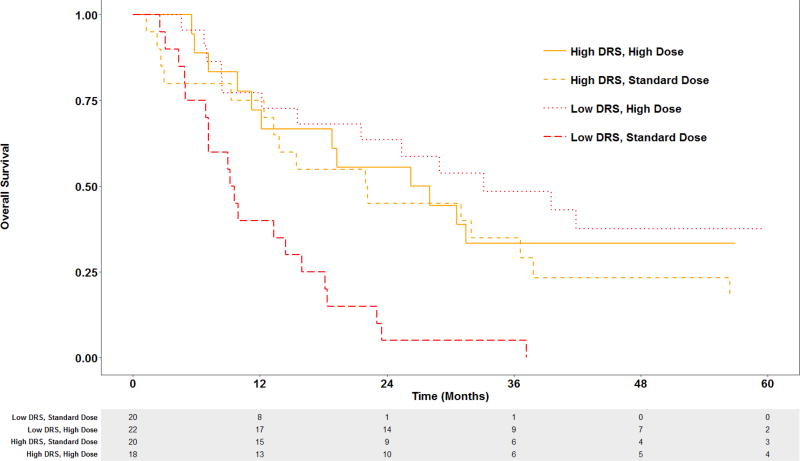
Eleven predictive miRNAs were combined with clinical factors to generate a DRS for each patient. In patients with low DRS, high-dose radiation therapy was associated with significantly improved OS compared to treatment with standard-dose radiation therapy (hazard ratio 0.22). In these patients, high-dose radiation also conferred lower risk of distant metastasis and local progression, although the latter association was not statistically significant. Patients with high DRS exhibited similar rates of OS regardless of dose (hazard ratio 0.78). The DRS did not correlate with treatment-related toxicity.
Using c-miRNA signature and clinical factors, we developed a DRS that identified a subset of patients with locally advanced NSCLC who derive an OS benefit from high-dose radiation therapy. This DRS may guide dose escalation in a patient-specific manner.
评估循环血清微小RNA(c-miRNAs)预测局部晚期非小细胞肺癌(NSCLC)对高剂量放射治疗反应的效用。
评估了2004年至2013年期间作为4项前瞻性机构临床试验一部分接受明确标准剂量或高剂量放射治疗的80例II - III期NSCLC患者的数据。通过定量逆转录-聚合酶链反应阵列测量62种miRNA的预处理血清水平。我们将miRNA数据与临床因素相结合,生成剂量反应评分(DRS),以预测高剂量与标准剂量放射治疗后的总生存期(OS)。弹性网Cox回归用于变量选择和参数估计。通过完全交叉验证进行模型评估和调整参数选择。使用Cox回归将DRS与局部进展、远处转移和3级或更高等级的心脏毒性相关联,并使用逻辑回归将其与2级或更高等级的食管和肺部毒性相关联。
将11种预测性miRNA与临床因素相结合,为每位患者生成DRS。在DRS低的患者中,与标准剂量放射治疗相比,高剂量放射治疗与显著改善的OS相关(风险比0.22)。在这些患者中,高剂量放射治疗也降低了远处转移和局部进展的风险,尽管后者的关联无统计学意义。DRS高的患者无论剂量如何,OS率相似(风险比0.78)。DRS与治疗相关毒性无关。
利用c-miRNA特征和临床因素,我们开发了一种DRS,该DRS识别出一部分局部晚期NSCLC患者,他们从高剂量放射治疗中获得了OS益处。这种DRS可能以患者特异性方式指导剂量递增。