Medical Department, University Medical Center Hamburg-Eppendorf, Hamburg, Germany.
PLoS One. 2020 Mar 13;15(3):e0230307. doi: 10.1371/journal.pone.0230307. eCollection 2020.
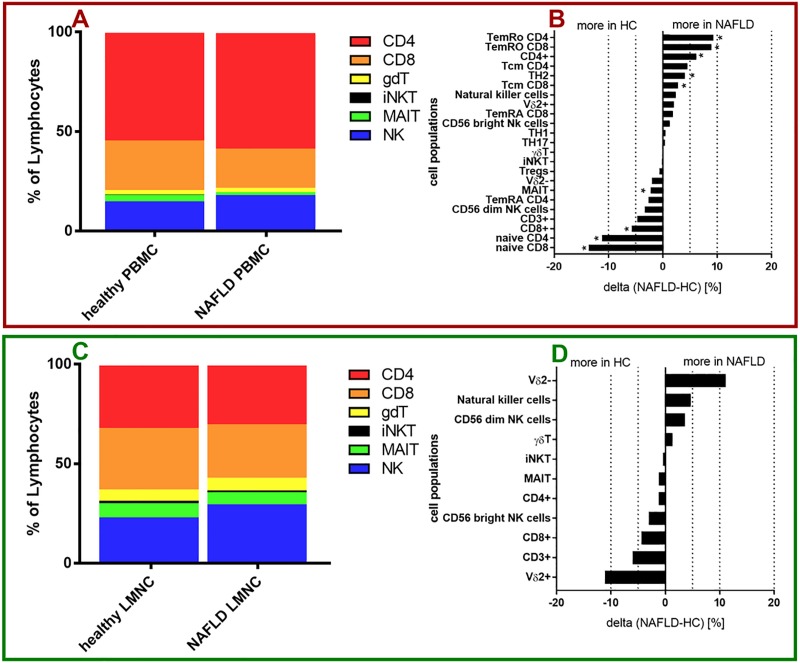
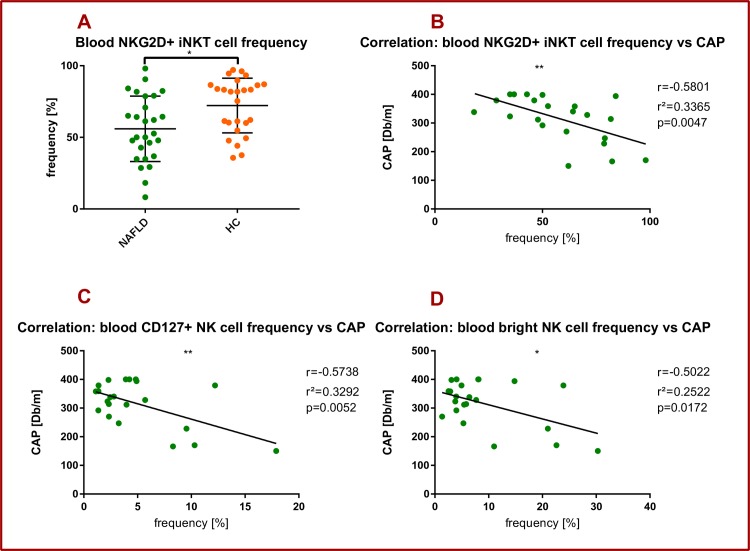
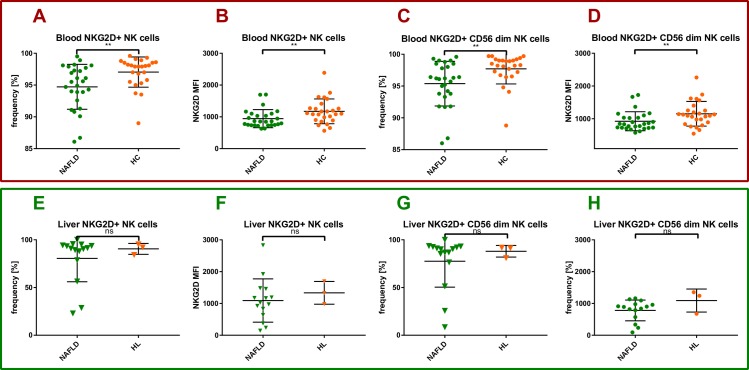
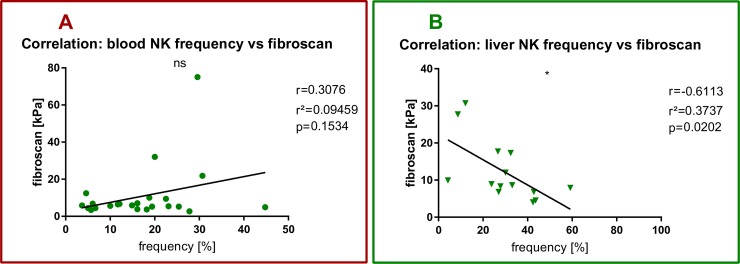
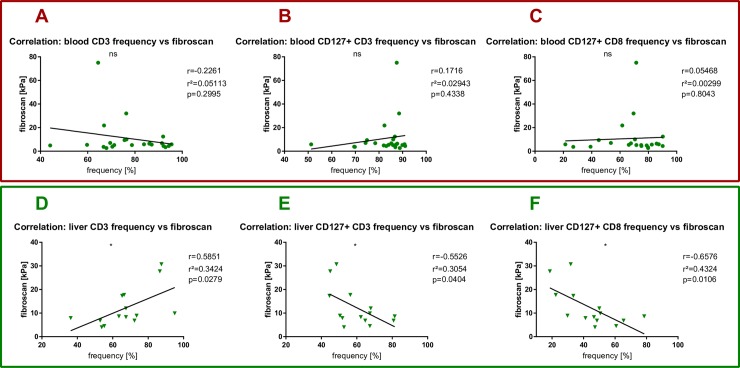
Multiple factors are involved in the pathogenesis of non-alcoholic fatty liver disease (NAFLD), but the exact immunological mechanisms that cause inflammation and fibrosis of the liver remain enigmatic. In this current study, cellular samples of a cohort of NAFLD patients (peripheral blood mononuclear cells (PBMC): n = 27, liver samples: n = 15) and healthy individuals (PBMC: n = 26, liver samples: n = 3) were analyzed using 16-color flow cytometry, and the frequency and phenotype of 23 immune cell subtypes was assessed. PBMC of NAFLD patients showed decreased frequencies of total CD3+, CD8+ T cells, CD56dim NK cells and MAIT cells, but elevated frequencies of CD4+ T cells and Th2 cells compared to healthy controls. Intrahepatic lymphocytes (IHL) of NAFLD patients showed decreased frequencies of total T cells, total CD8+ T cells, Vd2+γδ T cells, and CD56bright NK cells, but elevated frequencies of Vδ2-γδ T cells and CD56dim NK cells compared to healthy controls. The activating receptor NKG2D was significantly less frequently expressed among iNKT cells, total NK cells and CD56dim NK cells of PBMC of NAFLD patients compared to healthy controls. More strikingly, hepatic fibrosis as measured by fibroscan elastography negatively correlated with the intrahepatic frequency of total NK cells (r2 = 0,3737, p = 0,02). Hepatic steatosis as measured by controlled attenuation parameter (CAP) value negatively correlated with the frequency of circulating NKG2D+ iNKT cells (r2 = 0,3365, p = 0,0047). Our data provide an overview of the circulating and intrahepatic immune cell composition of NAFLD patients, and point towards a potential role of NK cells and iNKT cells for the regulation of hepatic fibrosis and steatosis in NAFLD.
多种因素参与非酒精性脂肪性肝病(NAFLD)的发病机制,但导致肝脏炎症和纤维化的确切免疫机制仍不清楚。在本研究中,使用 16 色流式细胞术分析了一组 NAFLD 患者(外周血单核细胞(PBMC):n = 27,肝组织样本:n = 15)和健康个体(PBMC:n = 26,肝组织样本:n = 3)的细胞样本,评估了 23 种免疫细胞亚群的频率和表型。与健康对照组相比,NAFLD 患者的 PBMC 中总 CD3+、CD8+T 细胞、CD56dim NK 细胞和 MAIT 细胞的频率降低,但 CD4+T 细胞和 Th2 细胞的频率升高。NAFLD 患者的肝内淋巴细胞(IHL)中总 T 细胞、总 CD8+T 细胞、Vd2+γδ T 细胞和 CD56bright NK 细胞的频率降低,但 Vd2-γδ T 细胞和 CD56dim NK 细胞的频率升高。与健康对照组相比,NAFLD 患者 PBMC 中的 iNKT 细胞、总 NK 细胞和 CD56dim NK 细胞中激活受体 NKG2D 的表达频率显著降低。更引人注目的是,肝纤维化的测量值通过 fibroscan 弹性成像与肝内总 NK 细胞的频率呈负相关(r2 = 0.3737,p = 0.02)。肝脂肪变性的测量值通过受控衰减参数(CAP)值与循环 NKG2D+iNKT 细胞的频率呈负相关(r2 = 0.3365,p = 0.0047)。我们的数据提供了 NAFLD 患者循环和肝内免疫细胞组成的概述,并指出 NK 细胞和 iNKT 细胞在调节 NAFLD 中的肝纤维化和脂肪变性方面可能发挥作用。