Center for HIV and STI, National Institute for Communicable Diseases, Johannesburg, South Africa.
School of Public Health, University of the Witwatersrand, Johannesburg, South Africa.
PLoS One. 2020 Mar 13;15(3):e0229874. doi: 10.1371/journal.pone.0229874. eCollection 2020.
Knowledge of HIV status in South Africa (SA) is reported to be 90% among people living with HIV. National level estimates could mask population-specific levels, which are critical to monitor program coverage and potential impact. Using data from the 2017 national antenatal sentinel survey, we assessed knowledge of HIV-positive status, initiation of antiretroviral therapy (ART), and socio-demographic characteristics associated with knowledge of HIV-positive status prior to the current pregnancy among women attending antenatal care.
Between 1 October and 15 November 2017, a nationally representative sample of 32,716 pregnant women were enrolled from 1,595 public health facilities selected from all districts of SA. Data on age, gravidity, knowledge of HIV-positive status and ART initiation prior to pregnancy were extracted from medical records. A blood sample was collected from each woman regardless of prior knowledge of HIV status or ART history, and tested for HIV in the laboratory. All HIV-positive pregnant women enrolled in the survey were eligible for inclusion in the analysis. Multivariable survey logistic regression was used to examine factors associated with knowledge of HIV-positive status prior to the current pregnancy.
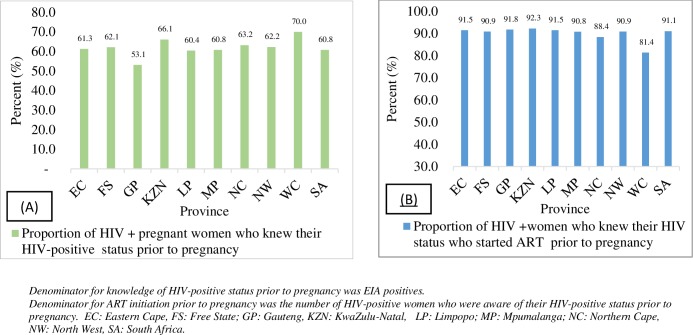
Of 10,065 eligible HIV-positive women, 60.8% (95% confidence interval (CI):59.9%-61.7%) knew their HIV status prior to the current pregnancy, of whom 91.1% (95% CI: 90.4%-91.7%) initiated ART prior to the current pregnancy. Knowledge of HIV-positive status was lower among adolescent girls and young women (15-24 years) (38.9%) and primigravid women (40.5%) compared with older women (35-49 years) (75.5%) and multigravid women (64.7%). In a multivariable analysis, significant effect modification was found between gravidity and age (P value = 0.047). Being in the age group 15-24 years compared to the age group 35-49 years decreased the odds of knowing HIV-positive status by 80% (adjusted odds ratio (AOR): 0.2, 95% CI:0.1-0.4) among primigravid women and by 60%(AOR: 0.4, 95% CI:0.3-0.4) among multigravid women.
Knowledge of HIV-positive status prior to the current pregnancy fell short of the target of 90% among pregnant women living with HIV. This was especially low among adolescent girls and young women, highlighting the gap in youth friendly reproductive health and HIV testing services.
据报道,南非(SA)HIV 感染者中,有 90%了解自己的 HIV 状况。国家层面的估计可能掩盖了特定人群的水平,这些水平对于监测项目覆盖率和潜在影响至关重要。本研究利用 2017 年全国产前哨点监测的数据,评估了在当前妊娠前,HIV 阳性状态、抗逆转录病毒治疗(ART)的启动以及与 HIV 阳性状态相关的社会人口特征,这些特征与在产前保健中接受检查的孕妇有关。
2017 年 10 月 1 日至 11 月 15 日,从 SA 所有地区的 1595 个公共卫生机构中选取了具有代表性的 32716 名孕妇,参与了这项全国性的产前哨点监测。从医疗记录中提取了年龄、孕次、妊娠前 HIV 阳性状态和 ART 启动的知识等数据。每个女性都采集了一份血样,无论她之前是否知道自己的 HIV 状态或接受过 ART 治疗,然后在实验室中对血样进行了 HIV 检测。所有参与调查的 HIV 阳性孕妇都有资格纳入分析。多变量调查逻辑回归用于检查与当前妊娠前 HIV 阳性状态相关的因素。
在 10065 名符合条件的 HIV 阳性孕妇中,60.8%(95%置信区间(CI):59.9%-61.7%)在当前妊娠前知道自己的 HIV 状况,其中 91.1%(95% CI:90.4%-91.7%)在当前妊娠前启动了 ART。与年龄较大的妇女(35-49 岁)(75.5%)和多产妇(64.7%)相比,青少年女孩和年轻妇女(15-24 岁)和初产妇(40.5%)知道 HIV 阳性状态的比例较低。在多变量分析中,妊娠次数和年龄之间存在显著的交互作用(P 值=0.047)。与年龄较大的妇女(35-49 岁)相比,15-24 岁的年龄组知道 HIV 阳性状态的可能性降低了 80%(调整后的优势比(AOR):0.2,95%CI:0.1-0.4),初产妇为 60%(AOR:0.4,95%CI:0.3-0.4),多产妇为 60%(AOR:0.4,95%CI:0.3-0.4)。
在当前妊娠前,了解 HIV 阳性状态的孕妇比例未达到 90%的目标。这在青少年女孩和年轻妇女中尤其低,突出了青少年友好型生殖健康和 HIV 检测服务方面的差距。