Tomaz Pedro Luiz Santos, Sousa Letícia Almeida de, Aguiar Kayanne Freire de, Oliveira Thales de Sá, Matochek Marcelo Henrick Maia, Polassi Mackeler Ramos, D'Alpino Paulo Henrique Perlatti
Biotechnology and Innovation in Health Program, Universidade Anhanguera de São Paulo (UNIAN-SP), São Paulo, São Paulo, Brazil.
Eur J Dent. 2020 Feb;14(1):161-170. doi: 10.1055/s-0040-1705072. Epub 2020 Mar 13.
This study investigated the remineralization potential of 1450 ppm, fluoride-containing toothpastes containing different active remineralization agents after cariogenic challenge with pH cycling. The enamel surface roughness after brushing and the chemical and physical characteristics of the toothpastes tested were also analyzed.
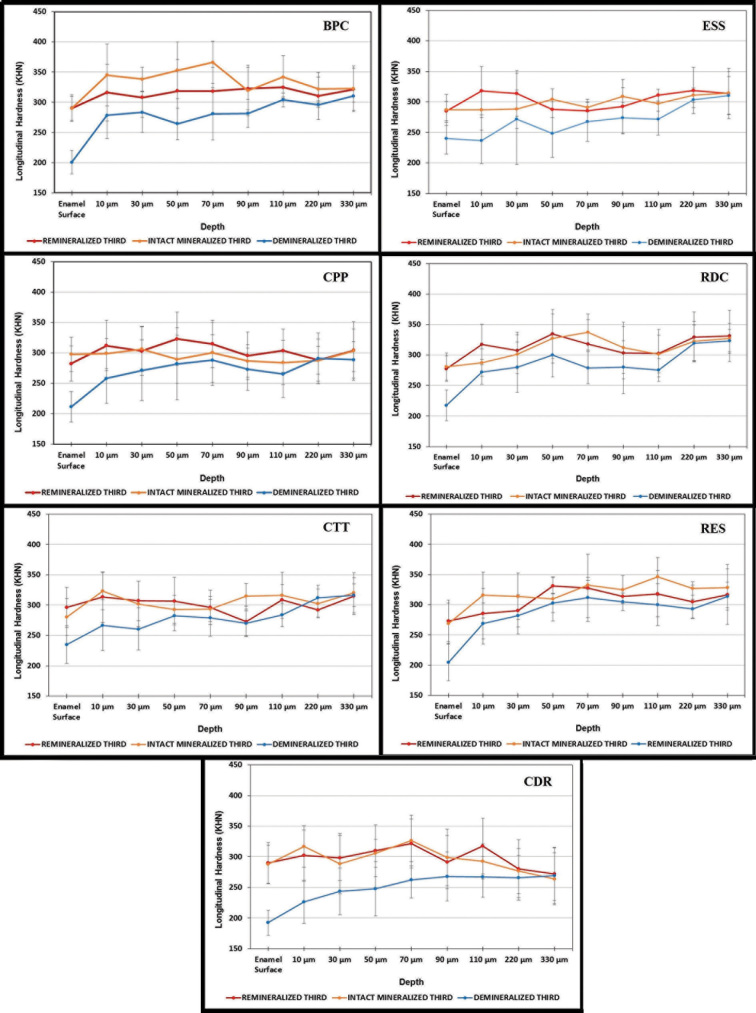
Fifty-six bovine enamel blocks were obtained (4 × 4 × 6 mm) and divided into three thirds: intact (untreated), demineralized (artificial caries lesion), and treated (caries lesion, pH cycling, and brushing with dentifrices). Seven commercially available fluoride toothpastes (1450 ppm F): three with anti-erosion claims (Candida Professional [CPP], Colgate Total 12 Daily Repair [CDR], Regenerate Enamel Science [RES]); three with desensitizing claims (Bianco Pro Clinical [BPP], Elmex Sensitive [ESS], and Regenerador Diário DentalClean [RDC]); and one standard regular-fluoride toothpaste Colgate Total 12 (CTT) were selected. During pH cycling (demineralization 6 h/remineralization 18 h) for 7 days, the treated third was brushed with the different dentifrices for 10 minutes in a brushing machine before immersion in a remineralizing solution. The Knoop hardness (25 g, 10 second of the surface, and longitudinal section were then evaluated at eight depths (10 to 330 μm). Mean and percentage of surface hardness recovery (% SHR) were calculated. Surface enamel roughness (Ra) was also evaluated. The pH, %weight of particles, zeta potential, and polydispersity index of toothpaste slurries were also evaluated.
Data were statistically analyzed (ANOVA/Tukey, 5%).
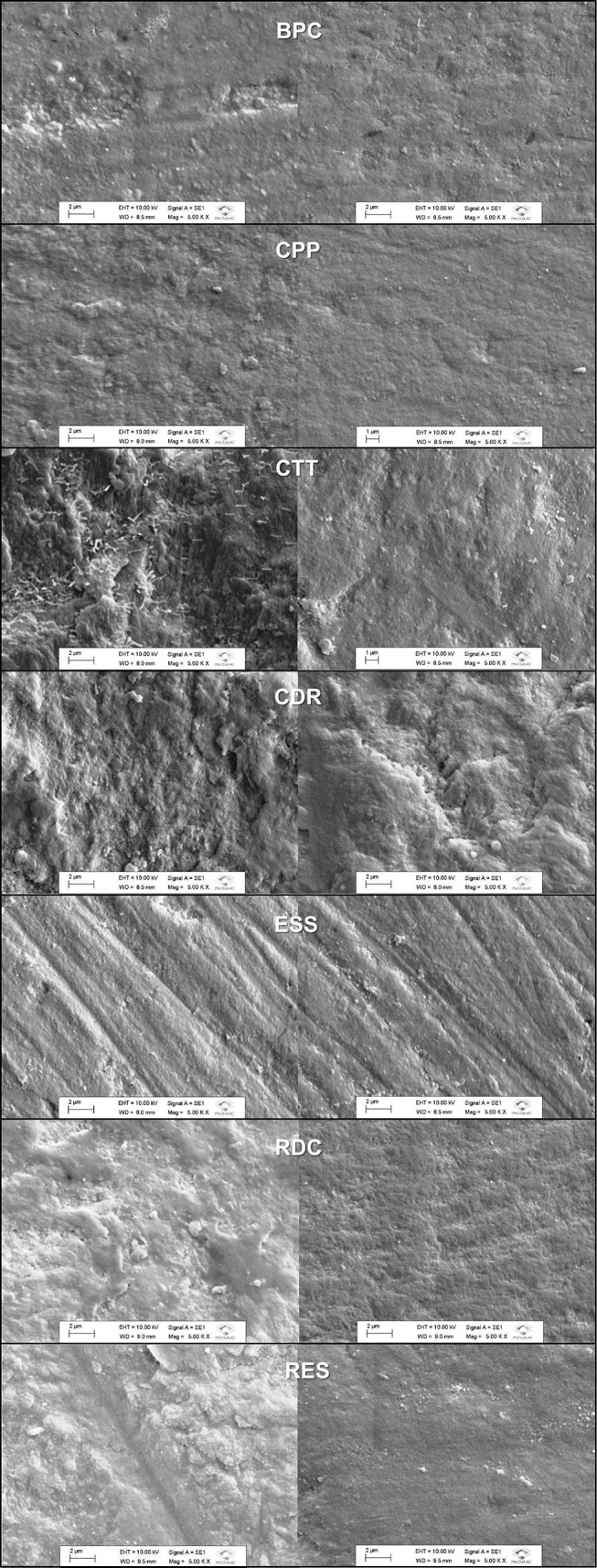
The %SHR of CPP was significantly lower than the others ( < 0.05). The enamel subsurface was more effectively remineralized when treated with BPP, ESS, and RDC. The surface roughness was higher when the demineralized third was treated with CTT, RDC, and RES and after the cariogenic challenge ( < 0.05). For some of the products tested, there was no relationship between surface remineralization and subsurface remineralization. Although toothpastes CPP and RDC present the lowest %SHR means, both products effectively remineralize within the subsurface carious lesion. Regression analysis demonstrated no strong correlations of the enamel surface roughness with the chemical and physical parameters.
Most but not all the fluoride toothpastes were able to remineralize the enamel surface. No specific chemical or physical parameter alone correlated with the surface roughness.
本研究调查了在pH循环致龋挑战后,含有不同活性再矿化剂的1450 ppm含氟牙膏的再矿化潜力。还分析了刷牙后牙釉质表面粗糙度以及所测试牙膏的化学和物理特性。
获取56个牛牙釉质块(4×4×6 mm),并将其分成三等份:完整(未处理)、脱矿(人工龋损)和处理(龋损、pH循环以及用牙膏刷牙)。选择了七种市售含氟牙膏(1450 ppm F):三种具有防侵蚀宣称(Candida Professional [CPP]、高露洁全效12日常修复 [CDR]、Regenerate Enamel Science [RES]);三种具有脱敏宣称(Bianco Pro Clinical [BPP]、舒适达敏感 [ESS]、Regenerador Diário DentalClean [RDC]);以及一种标准常规含氟牙膏高露洁全效12(CTT)。在为期7天的pH循环(脱矿6小时/再矿化18小时)过程中,处理的那一等份在浸入再矿化溶液之前,在刷牙机中用不同牙膏刷牙10分钟。然后在八个深度(10至330μm)处评估努氏硬度(25 g,表面10秒,纵向截面)。计算表面硬度恢复的平均值和百分比(%SHR)。还评估了牙釉质表面粗糙度(Ra)。还评估了牙膏浆液的pH、颗粒重量百分比、zeta电位和多分散指数。
对数据进行统计学分析(方差分析/图基检验,5%)。
CPP的%SHR显著低于其他产品(<0.05)。用BPP、ESS和RDC处理时,牙釉质次表面再矿化更有效。当脱矿的那一等份用CTT、RDC和RES处理时以及在致龋挑战后,表面粗糙度更高(<0.05)。对于一些测试产品,表面再矿化与次表面再矿化之间没有关系。尽管牙膏CPP和RDC的%SHR平均值最低,但这两种产品在龋损次表面内均能有效再矿化。回归分析表明牙釉质表面粗糙度与化学和物理参数之间没有强相关性。
大多数但并非所有含氟牙膏都能够使牙釉质表面再矿化。没有单一的特定化学或物理参数与表面粗糙度相关。