Department of Ophthalmology, College of Medicine, Catholic University of Korea, Seoul, South Korea.
Department of Ophthalmology, Bucheon St. Mary's Hospital, 327 Sosa-ro, Wonmi-gu, Bucheon, Gyeonggi-do, 14647, South Korea.
BMC Ophthalmol. 2020 Mar 13;20(1):98. doi: 10.1186/s12886-020-01352-w.
To evaluate the effect of toric intraocular lens implantation in cataract patient with corneal opacity and high astigmatism.
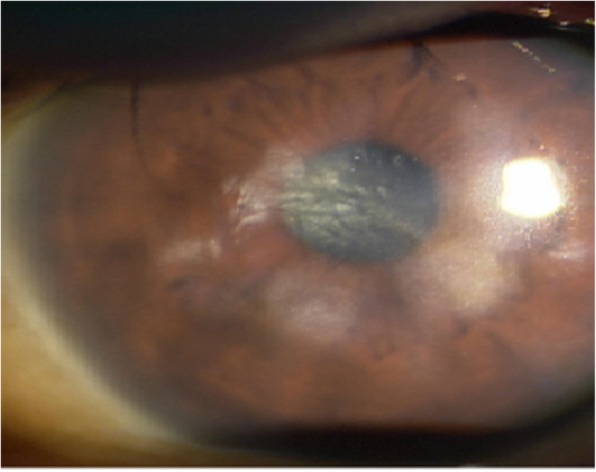
Thirty-one eyes of 31 patients who underwent cataract surgery with toric intraocular lens implantation were included. All patients had corneal opacity with astigmatism. Preoperative total corneal astigmatism was determined considering posterior astigmatism using a rotating Scheimpflug camera (Pentacam®: Oculus, Wetzlar, Germany). At 2 months after toric intraocular lens implantation, we evaluated residual astigmatism, uncorrected visual acuity (UCVA) and best corrected visual acuity (BCVA).
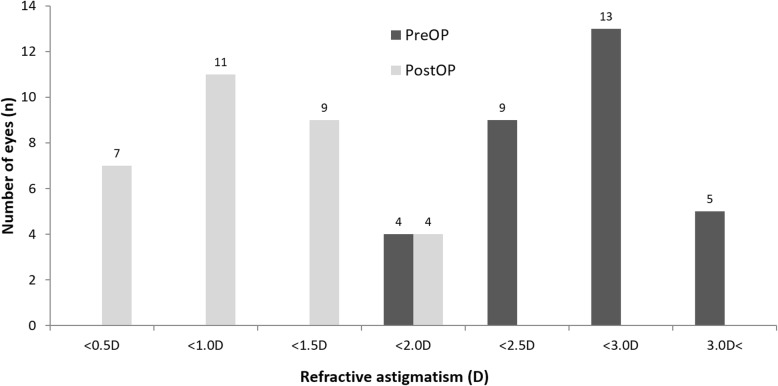
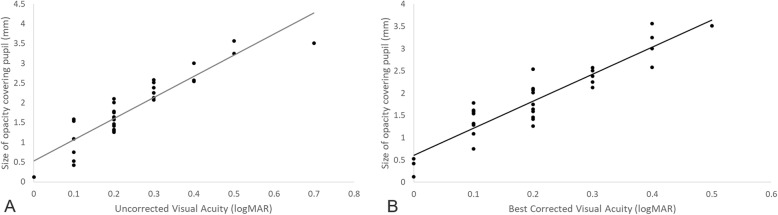
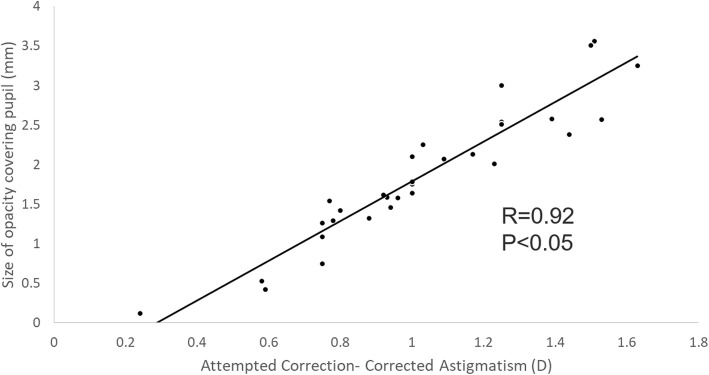
Postoperative UCVA and BCVA (0.30 ± 0.17, 0.22 ± 0.16LogMAR) were statistically improved compared to preoperative UCVA and BCVA (1.2 ± 0.34, 1.1 ± 0.30LogMAR, respectively) (P < 0.01). Postoperative residual refractive astigmatism (1.2 ± 0.35D) was statistically reduced compared to preoperative refractive astigmatism (2.4 ± 0.65D) (P < 0.05). Preoperative and postoperative total corneal astigmatism values were not statistically different. All eyes achieved postoperative visual acuity as good as or better than preoperative one. The size of corneal opacity covering pupil had significant negative correlation with postoperative UCVA and BCVA (logMAR) (R = 0.91 P < 0.05 and R = 0.92 P < 0.05, respectively).
Toric intraocular lens implantation can improve UCVA, BCVA, and refractive astigmatism in cataract patient with corneal opacity. The size of corneal opacity covering pupil is the major prognostic factor for postoperative visual improvement. Therefore, toric intraocular lens implantation should be considered for cataract patients who have corneal opacity with high astigmatism.
评估散光型人工晶状体植入术治疗白内障合并角膜混浊及高度散光患者的效果。
本研究纳入 31 例(31 眼)行白内障超声乳化吸除联合散光型人工晶状体植入术的患者,所有患者均为角膜混浊合并散光。术前使用旋转式 Scheimpflug 眼前节分析系统(Pentacam:Oculus,德国威茨拉尔)考虑后表面散光来确定总角膜散光。术后 2 个月评估残余散光、未矫正视力(UCVA)和最佳矫正视力(BCVA)。
术后 UCVA(0.30 ± 0.17)和 BCVA(0.22 ± 0.16LogMAR)较术前的 UCVA(1.2 ± 0.34)和 BCVA(1.1 ± 0.30LogMAR)均明显提高(P < 0.01)。术后残余等效球镜度(1.2 ± 0.35D)较术前(2.4 ± 0.65D)明显降低(P < 0.05)。术前和术后总的角膜散光值无统计学差异。所有患者术后视力均优于或等于术前。瞳孔区角膜混浊的大小与术后 UCVA 和 BCVA(logMAR)呈显著负相关(R = 0.91,P < 0.05;R = 0.92,P < 0.05)。
散光型人工晶状体植入术可改善白内障合并角膜混浊及高度散光患者的 UCVA、BCVA 和等效球镜度。瞳孔区角膜混浊的大小是影响术后视力提高的主要预后因素。因此,对于角膜混浊合并高度散光的白内障患者,应考虑行散光型人工晶状体植入术。