Boyce Thompson Institute, Ithaca, NY, USA.
Plant Biology Section, Cornell University, Ithaca, NY, USA.
Nat Plants. 2020 Mar;6(3):259-272. doi: 10.1038/s41477-020-0618-2. Epub 2020 Mar 13.
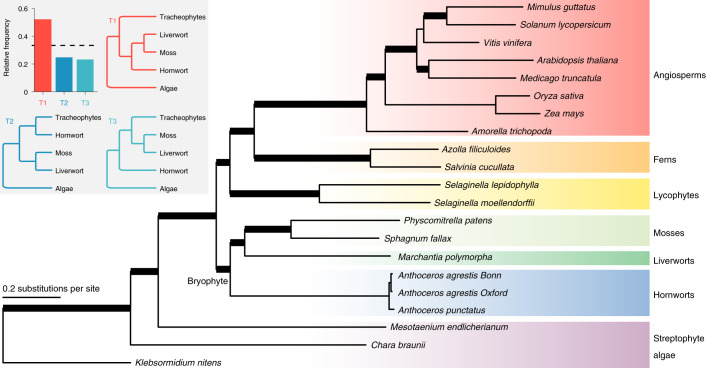
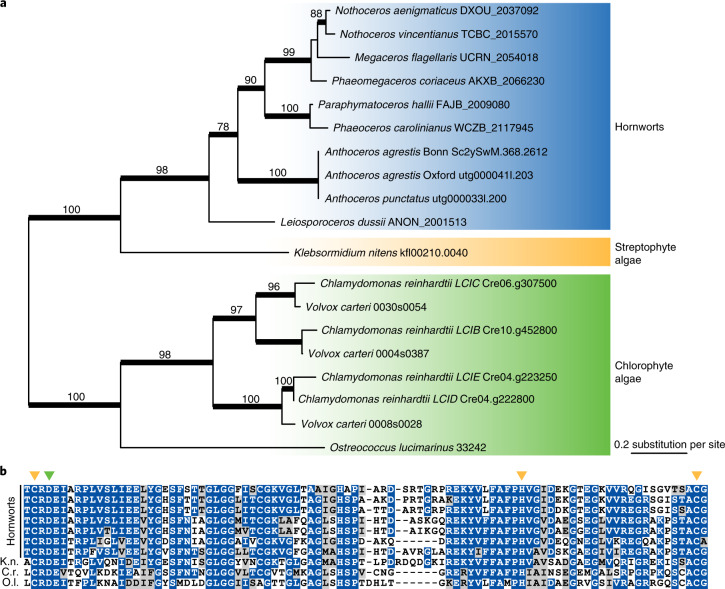
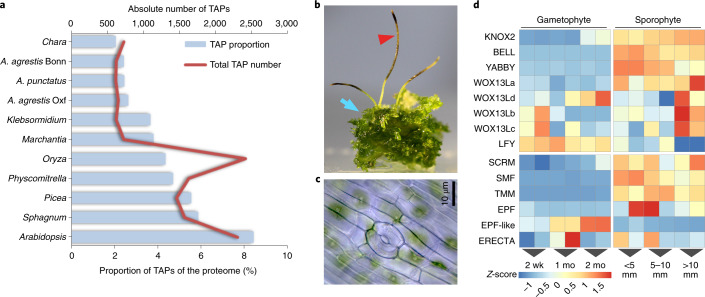
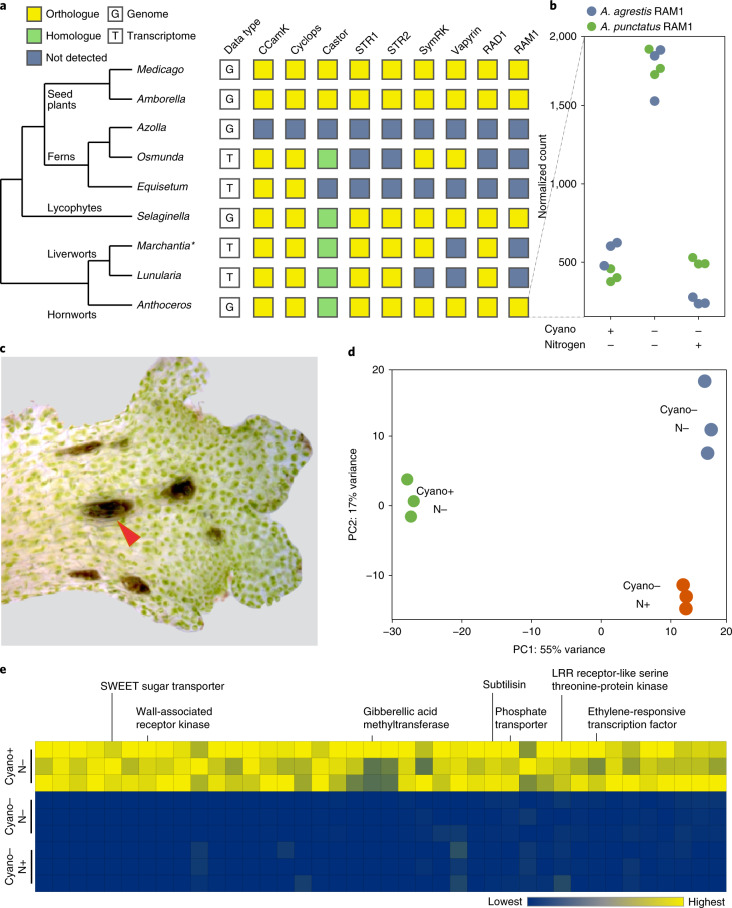
Hornworts comprise a bryophyte lineage that diverged from other extant land plants >400 million years ago and bears unique biological features, including a distinct sporophyte architecture, cyanobacterial symbiosis and a pyrenoid-based carbon-concentrating mechanism (CCM). Here, we provide three high-quality genomes of Anthoceros hornworts. Phylogenomic analyses place hornworts as a sister clade to liverworts plus mosses with high support. The Anthoceros genomes lack repeat-dense centromeres as well as whole-genome duplication, and contain a limited transcription factor repertoire. Several genes involved in angiosperm meristem and stomatal function are conserved in Anthoceros and upregulated during sporophyte development, suggesting possible homologies at the genetic level. We identified candidate genes involved in cyanobacterial symbiosis and found that LCIB, a Chlamydomonas CCM gene, is present in hornworts but absent in other plant lineages, implying a possible conserved role in CCM function. We anticipate that these hornwort genomes will serve as essential references for future hornwort research and comparative studies across land plants.
角苔属于苔藓植物门,与其他现存的陆地植物在 4 亿多年前就已经分化开来,具有独特的生物学特征,包括独特的孢子体结构、蓝藻共生和基于淀粉核的碳浓缩机制(CCM)。本文提供了三种角苔的高质量基因组。系统发育基因组分析表明,角苔与地钱植物门和苔藓植物门具有很高的亲缘关系。Anthoceros 基因组缺乏重复密集的着丝粒和全基因组重复,转录因子的种类也很有限。角苔中几个与被子植物顶端分生组织和气孔功能相关的基因保守,并且在孢子体发育过程中上调表达,这表明在遗传水平上可能存在同源性。我们鉴定了参与蓝藻共生的候选基因,并发现角苔中存在 Chlamydomonas CCM 基因 LCIB,但在其他植物谱系中缺失,这暗示了其在 CCM 功能中可能具有保守作用。我们预计这些角苔基因组将成为未来角苔研究和陆地植物比较研究的重要参考。