Heart Centre for Children The Children's Hospital at Westmead Sydney New South Wales Australia.
Discipline of Paediatrics School of Women's and Children's Health University of New South Wales Medicine The University of New South Wales Sydney New South Wales Australia.
J Am Heart Assoc. 2020 Mar 17;9(6):e014172. doi: 10.1161/JAHA.119.014172. Epub 2020 Mar 16.
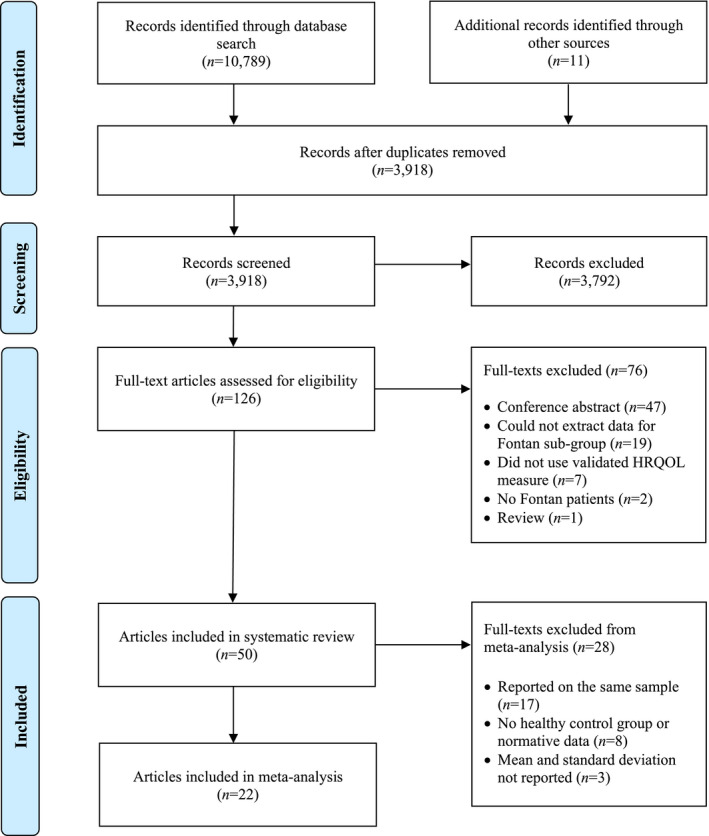
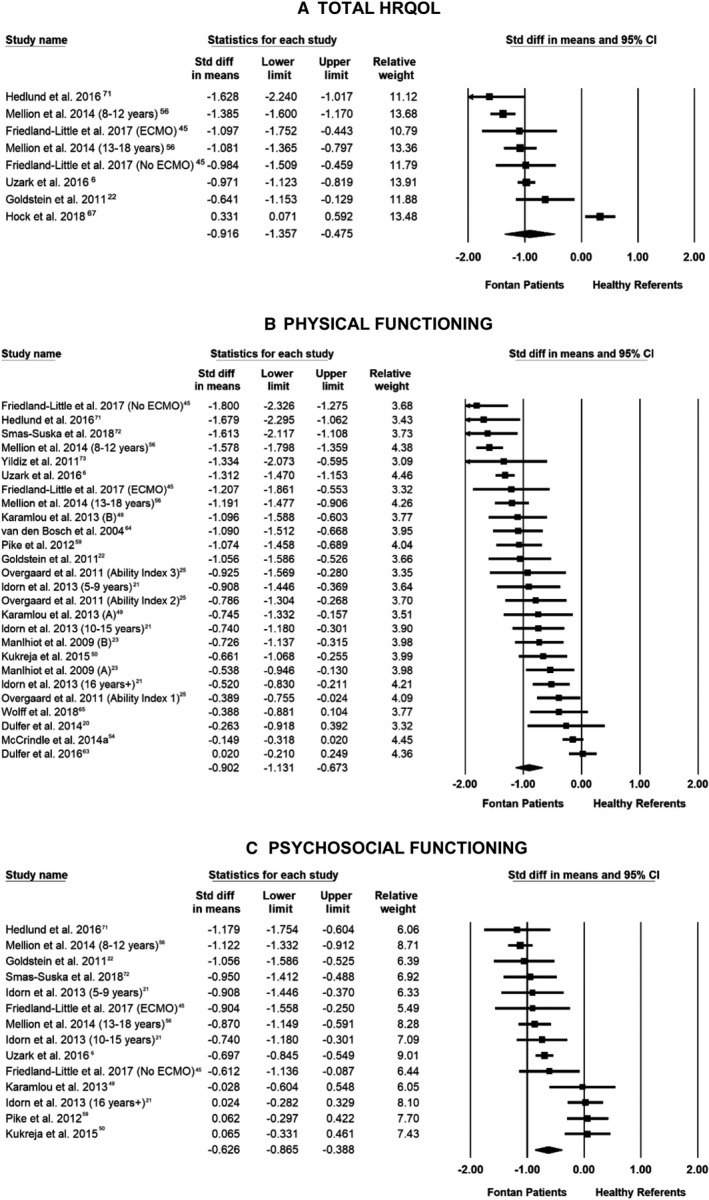
Background People with a Fontan circulation experience a range of physical, psychosocial and neurodevelopmental challenges alongside, or caused by, their cardiac condition, with significant consequences for health-related quality of life (HRQOL). We meta-analyzed HRQOL outcomes reported by people with a Fontan circulation or their proxies and evaluated predictors of poorer HRQOL. Methods and Results Six electronic databases were searched for peer-reviewed, English-language articles published before March 2019. Standardized mean differences (SMD) were calculated using fixed and random-effects models. Fifty articles reporting on 29 unique studies capturing HRQOL outcomes for 2793 people with a Fontan circulation and 1437 parent-proxies were analyzed. HRQOL was lower in individuals with a Fontan circulation compared with healthy referents or normative samples (SMD, -0.92; 95% CI, -1.36 to -0.48; <0.001). Lower scores were reported across all HRQOL domains, with the largest differences found for physical (SMD, -0.90; 95% CI, -1.13 to -0.67; <0.001) and school/work functioning (SMD, -0.71; 95% CI, -0.90 to -0.52; <0.001). Meta-regression analyses found no significant predictors of self-reported physical functioning, but older age at Fontan operation was associated with poorer emotional functioning (β=-0.124; =0.004), and diagnosis of hypoplastic left heart was associated with poorer social functioning (β=-0.007; =0.048). Sensitivity analyses showed use of the PedsQL Core Module was associated with lower HRQOL scores compared with the Short-Form Health Survey-36. Conclusions HRQOL outcomes for people with a Fontan circulation are lower than the general population. Optimal care acknowledges the lifelong impact of the Fontan circulation on HRQOL and offers targeted strategies to improve outcomes for this growing population.
患有 Fontan 循环的人群经历了一系列身体、心理社会和神经发育方面的挑战,这些挑战是由他们的心脏状况引起的,对健康相关生活质量(HRQOL)有重大影响。我们对患有 Fontan 循环的人群或其代理人报告的 HRQOL 结果进行了荟萃分析,并评估了 HRQOL 较差的预测因素。
我们在六个电子数据库中搜索了 2019 年 3 月之前发表的同行评审的英文文章。使用固定效应模型和随机效应模型计算标准化均数差(SMD)。分析了 50 篇报告 29 项独特研究的文章,这些研究共纳入了 2793 名患有 Fontan 循环的患者和 1437 名父母代理人,评估了他们的 HRQOL 结果。与健康对照组或参考人群相比,Fontan 循环患者的 HRQOL 较低(SMD,-0.92;95%CI,-1.36 至-0.48;<0.001)。所有 HRQOL 领域的评分均较低,身体功能(SMD,-0.90;95%CI,-1.13 至-0.67;<0.001)和学校/工作功能(SMD,-0.71;95%CI,-0.90 至-0.52;<0.001)的差异最大。元回归分析发现,自我报告的身体功能没有显著的预测因素,但 Fontan 手术时年龄较大与较差的情绪功能有关(β=-0.124;=0.004),左心发育不全的诊断与较差的社会功能有关(β=-0.007;=0.048)。敏感性分析表明,与 Short-Form Health Survey-36 相比,使用 PedsQL 核心模块与较低的 HRQOL 评分相关。
Fontan 循环患者的 HRQOL 结果低于一般人群。最佳护理承认 Fontan 循环对 HRQOL 的终身影响,并为这一不断增长的人群提供有针对性的策略来改善结果。