Institute of Agrobiological Sciences, National Agriculture and Food Research Organization (NARO), Ibaraki 305-8602, Japan.
AgResearch Ltd., Ruakura Research Centre, Hamilton, New Zealand.
J Reprod Dev. 2020 Jun 12;66(3):281-286. doi: 10.1262/jrd.2019-156. Epub 2020 Mar 14.
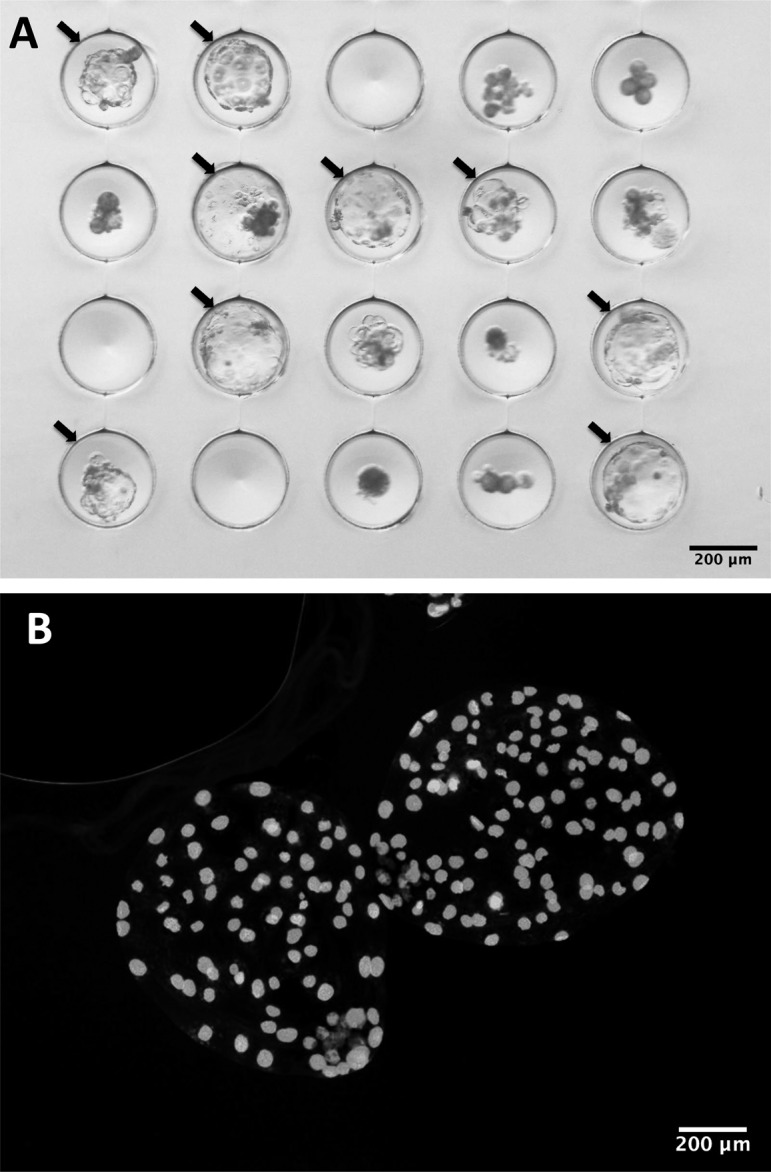
The discovery of how to utilize CRISPR (clustered, regularly interspaced, short, palindromic repeats)-Cas (CRISPR-associated) systems for genome modification has accelerated development of the field of genome editing, especially in large animals such as pigs. The low efficiency of somatic cell nuclear transfer (SCNT) is now becoming a major obstacle in the production of genome-edited animals via cell-mediated approaches and improving efficacy of this technique is crucial. In this study, we propose a few simple modifications to a zona-free SCNT protocol that are effective to produce numerous high-quality blastocysts. To refine the SCNT protocol we modified the following steps/factors: 1) culture medium for SCNT embryos, 2) chemical treatment to prevent precocious activation of the manipulated/reconstructed oocytes and 3) donor cell serum starvation treatment. Although changes in each of these steps only resulted in small improvements, the combination of all modifications altogether significantly enhanced developmental competence of SCNT embryos. Our modified method yielded approximately three times greater blastocyst formation rates. Moreover, resulting blastocysts had roughly twice as many cells as compared to blastocysts produced by the conventional SCNT method. With these significant in vitro improvements, our refined SCNT method is potentially suited for use in the production of genome edited pigs.
如何利用 CRISPR(成簇、规律间隔、短、回文重复)-Cas(CRISPR 相关)系统进行基因组修饰的发现加速了基因组编辑领域的发展,特别是在猪等大型动物中。体细胞核移植(SCNT)的低效率现在成为通过细胞介导方法生产基因组编辑动物的主要障碍,提高该技术的效率至关重要。在这项研究中,我们对无透明带 SCNT 方案提出了一些简单的修改,这些修改有效地产生了大量高质量的囊胚。为了完善 SCNT 方案,我们修改了以下步骤/因素:1)SCNT 胚胎的培养基,2)防止操作/重构卵母细胞过早激活的化学处理,以及 3)供体细胞血清饥饿处理。尽管这些步骤中的每一个变化仅导致了微小的改进,但所有修改的组合都显著提高了 SCNT 胚胎的发育能力。我们的改良方法使囊胚形成率提高了约三倍。此外,与传统 SCNT 方法产生的囊胚相比,所得囊胚的细胞数大约增加了一倍。通过这些显著的体外改进,我们改良的 SCNT 方法可能适合用于生产基因组编辑猪。