Sun Tao, Xiong Xiaofeng, Dai Zhendong, Manoonpong Poramate
Institute of Bio-inspired Structure and Surface Engineering, College of Mechanical and Electrical Engineering, Nanjing University of Aeronautics and Astronautics, Nanjing, China.
Embodied AI & Neurobotics Lab, SDU Biorobotics, Mærsk Mc-Kinney Møller Institute, University of Southern Denmark, Odense, Denmark.
Front Neurorobot. 2020 Feb 26;14:14. doi: 10.3389/fnbot.2020.00014. eCollection 2020.
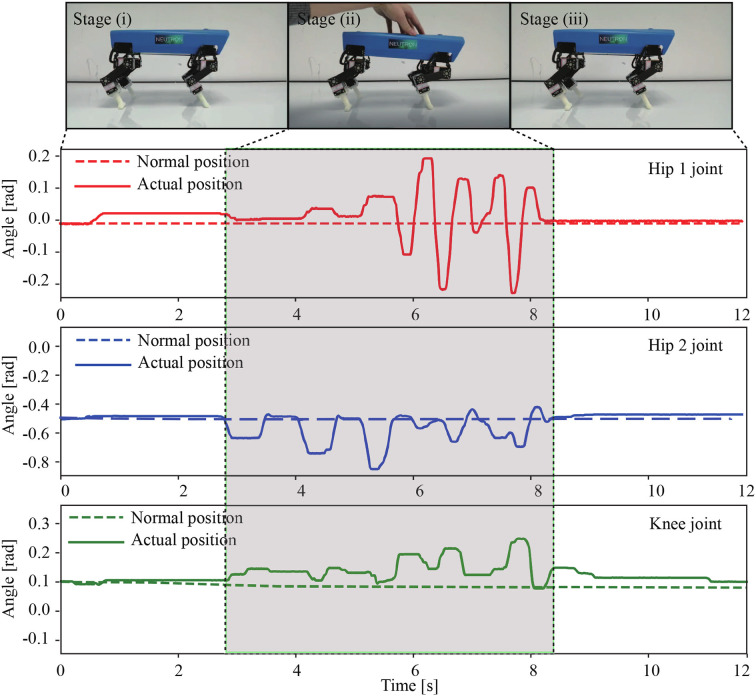
Self-organization of locomotion characterizes the feature of automatically spontaneous gait generation without preprogrammed limb movement coordination. To study this feature in quadruped locomotion, we propose here a new open-source, small-sized reconfigurable quadruped robot, called Lilibot, with multiple sensory feedback and its physical simulation. Lilibot was designed as a friendly quadrupedal platform with unique characteristics, including light weight, easy handling, modular components, and multiple real-time sensory feedback. Its modular components can be flexibly reconfigured to obtain features, such as different leg orientations for testing the effectiveness and generalization of self-organized locomotion control. Its multiple sensory feedback (i.e., joint angles, joint velocities, joint currents, joint voltages, and body inclination) can support vestibular reflexes and compliant control mechanisms for body posture stabilization and compliant behavior, respectively. To evaluate the performance of Lilibot, we implemented our developed adaptive neural controller on it. The experimental results demonstrated that Lilibot can autonomously and rapidly exhibit adaptive and versatile behaviors, including spontaneous self-organized locomotion (i.e., adaptive locomotion) under different leg orientations, body posture stabilization on a tiltable plane, and leg compliance for unexpected external load compensation. To this end, we successfully developed an open-source, friendly, small-sized, and lightweight quadruped robot with reconfigurable legs and multiple sensory feedback that can serve as a generic quadrupedal platform for research and education in the fields of locomotion, vestibular reflex-based, and compliant control.
运动的自组织特性表现为在没有预先编程的肢体运动协调情况下自动自发地产生步态。为了研究四足动物运动的这一特性,我们在此提出一种新型的开源小型可重构四足机器人,名为Lilibot,并对其进行了物理模拟,该机器人具有多种感官反馈。Lilibot被设计成一个具有独特特性的友好型四足平台,包括重量轻、易于操作、模块化组件以及多种实时感官反馈。其模块化组件可以灵活重新配置,以获得不同的腿部朝向等特性,用于测试自组织运动控制的有效性和通用性。其多种感官反馈(即关节角度、关节速度、关节电流、关节电压和身体倾斜度)分别可以支持前庭反射以及用于身体姿势稳定和柔顺行为的柔顺控制机制。为了评估Lilibot的性能,我们在其上实现了我们开发的自适应神经控制器。实验结果表明,Lilibot能够自主快速地展现出适应性和多功能行为,包括在不同腿部朝向情况下的自发自组织运动(即适应性运动)、在可倾斜平面上的身体姿势稳定以及用于意外外部负载补偿的腿部柔顺性。为此,我们成功开发了一种具有可重构腿部和多种感官反馈的开源、友好、小型且轻量级的四足机器人,它可以作为运动、基于前庭反射和柔顺控制领域研究与教育的通用四足平台。