Zhang Yin, Zhao Heru, Liu Bin, Li Li, Zhang Lulu, Bao Mei, Ji Xinyu, He Xiaojuan, Yi Jianfeng, Chen Peng, Lu Cheng, Lu Aiping
Key Laboratory for Research on Active Ingredients in Natural Medicine of Jiangxi Province, Yichun University, Yichun, China.
Institute of Basic Research in Clinical Medicine, China Academy of Chinese Medical Sciences, Beijing, China.
Front Pharmacol. 2020 Feb 27;11:195. doi: 10.3389/fphar.2020.00195. eCollection 2020.
Natural autoantibodies have been implicated to play a key role in the pathogenesis of coronary heart disease (CHD) because they augment autoimmune activation. The aim of this study was to identify novel specific autoantibodies of CHD, and analyze the relationship between their levels and CHD risk indicators.
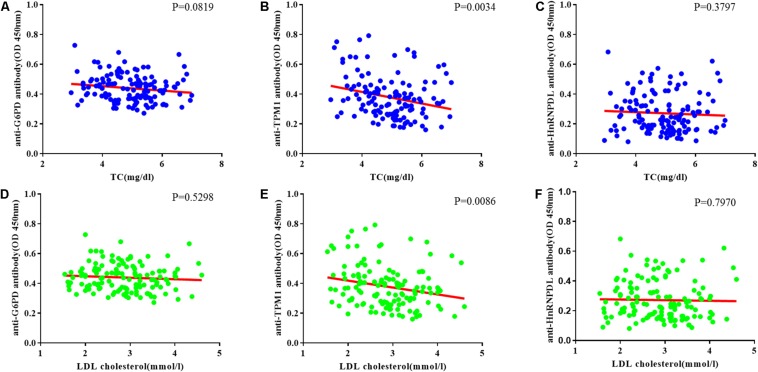
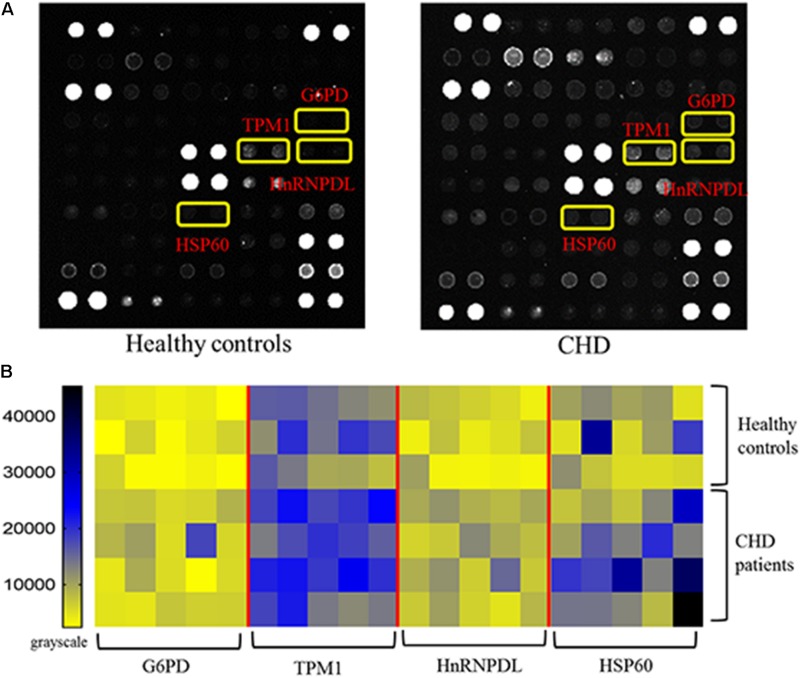
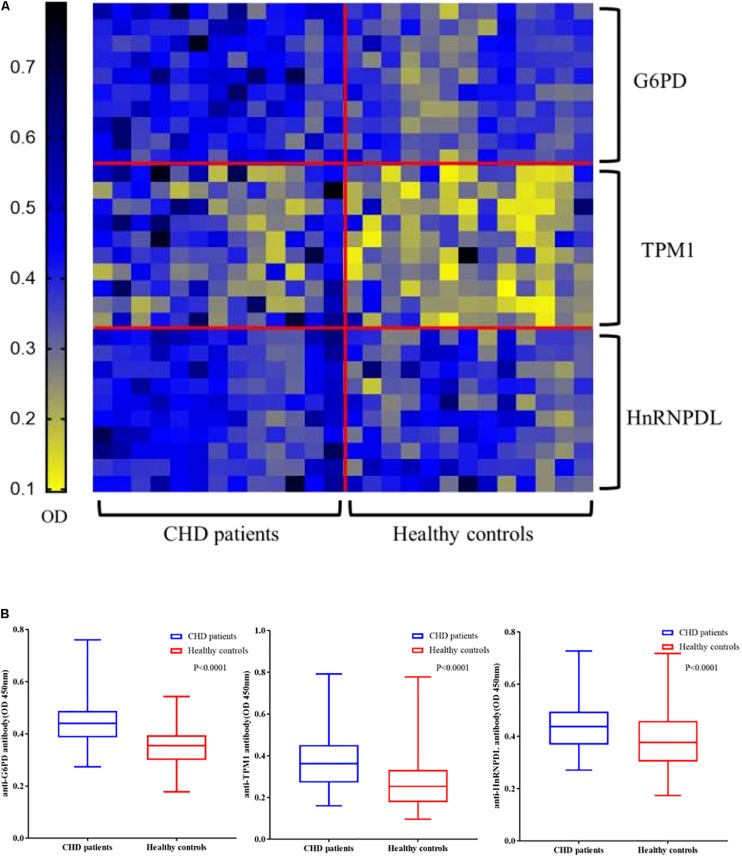
First, clinical data and sera from CHD patients were collected. Then, one protein microarray containing 37 proteins that represent candidate autoantigens was developed. The arrays were used to profile autoantibodies in randomly selected sera from 35 samples (20 CHD patients, and 15 healthy controls). After that, microarray data were analyzed and autoantibodies for CHD were screened out. Then, ELISA detection was conducted to validate the differentiable autoantibodies using larger numbers of serum samples (131 CHD patients, and 131 healthy controls). Finally, the associations of antibodies with CHD risk indicator parameters were assessed. Inter-group comparison by microarray indicated that three CHD novel autoantibodies, including glucose-6-phosphate isomerase (G6PI), alpha-tropomyosin (TPM1), and heterogeneous nuclear ribonucleoprotein D-like (HnRNPDL), were significantly ( < 0.05) increased when compared with the healthy controls. Moreover, a significant increase of IgG autoantibodies for these three autoantigens was confirmed in CHD patients by ELISA ( < 0.0001). The correction analysis revealed a negative correlation of anti-TPM1 antibody levels and total cholesterol ( = 0.0034), and low-density lipoprotein cholesterol ( = 0.0086), respectively.
G6PI, TPM1, and HnRNPDL were CHD natural autoantigens, and serum anti-TPM1 antibody could be used as a potential marker to predict the risk for CHD patients.
天然自身抗体因增强自身免疫激活作用而被认为在冠心病(CHD)发病机制中起关键作用。本研究旨在鉴定冠心病新的特异性自身抗体,并分析其水平与冠心病风险指标之间的关系。
首先,收集冠心病患者的临床资料和血清。然后,构建了一个包含37种代表候选自身抗原的蛋白质微阵列。该阵列用于分析从35个样本(20例冠心病患者和15例健康对照)中随机选取的血清中的自身抗体。之后,分析微阵列数据并筛选出冠心病相关的自身抗体。接着,采用酶联免疫吸附测定(ELISA)法,使用更多血清样本(131例冠心病患者和131例健康对照)对可区分的自身抗体进行验证。最后,评估抗体与冠心病风险指标参数之间的关联。微阵列组间比较表明,与健康对照相比,三种冠心病新自身抗体,即葡萄糖-6-磷酸异构酶(G6PI)、α-原肌球蛋白(TPM1)和不均一核核糖核蛋白D样蛋白(HnRNPDL)显著升高(<0.05)。此外,ELISA法证实冠心病患者中这三种自身抗原的IgG自身抗体显著升高(<0.0001)。校正分析显示,抗TPM1抗体水平分别与总胆固醇(=0.0034)和低密度脂蛋白胆固醇(=0.0086)呈负相关。
G6PI、TPM1和HnRNPDL是冠心病的天然自身抗原,血清抗TPM1抗体可作为预测冠心病患者风险的潜在标志物。