Bumbaširević Marko, Lesic Aleksandar, Palibrk Tomislav, Milovanovic Darko, Zoka Milan, Kravić-Stevović Tamara, Raspopovic Stanisa
School of Medicine, University of Belgrade, Serbia.
University Clinic for Orthopaedic Surgery and Traumatology, Clinical Centre of Serbia, Serbia.
EFORT Open Rev. 2020 Feb 26;5(2):65-72. doi: 10.1302/2058-5241.5.180038. eCollection 2020 Feb.
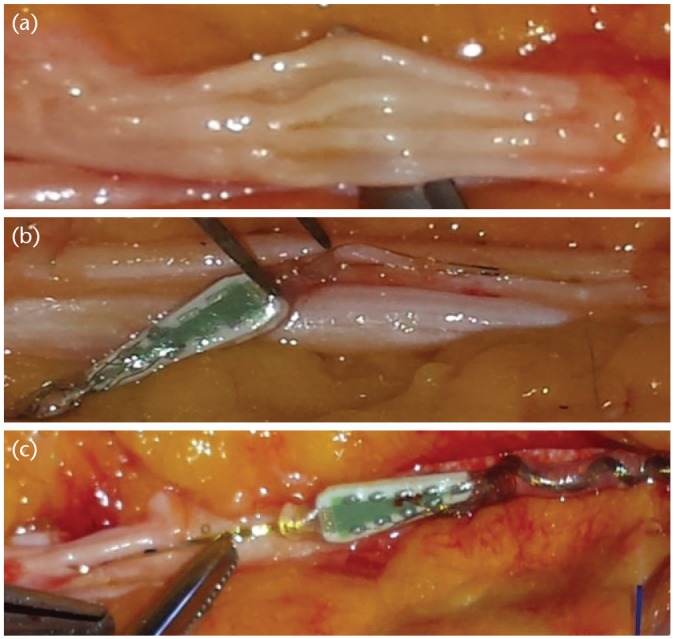
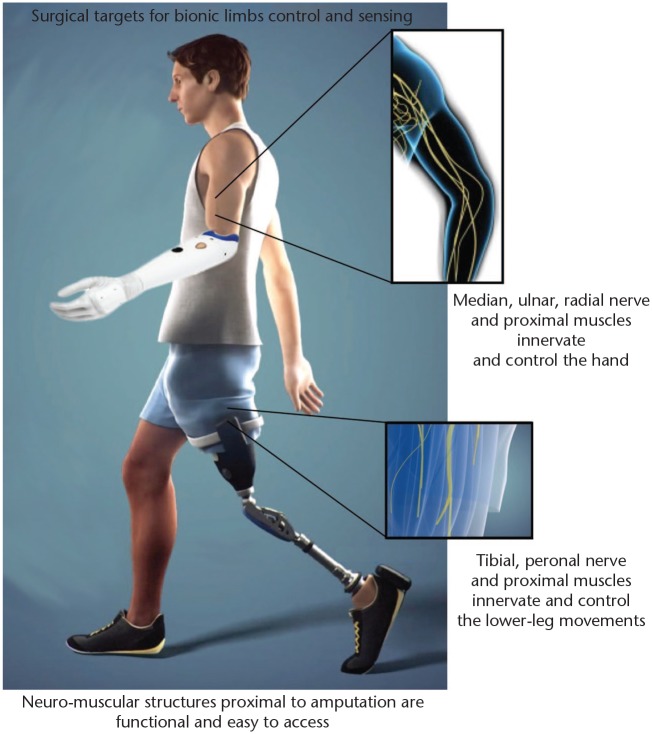
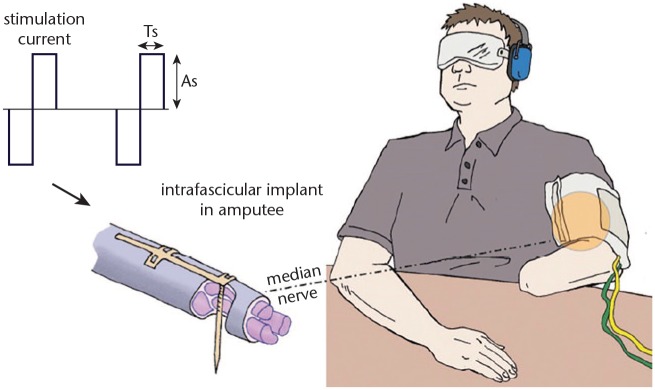
Amputations have a devastating impact on patients' health with consequent psychological distress, economic loss, difficult reintegration into society, and often low embodiment of standard prosthetic replacement.The main characteristic of bionic limbs is that they establish an interface between the biological residuum and an electronic device, providing not only motor control of prosthesis but also sensitive feedback.Bionic limbs can be classified into three main groups, according to the type of the tissue interfaced: nerve-transferred muscle interfacing (targeted muscular reinnervation), direct muscle interfacing and direct nerve interfacing.Targeted muscular reinnervation (TMR) involves the transfer of the remaining nerves of the amputated stump to the available muscles.With direct muscle interfacing, direct intramuscular implants record muscular contractions which are then wirelessly captured through a coil integrated in the socket to actuate prosthesis movement.The third group is the direct interfacing of the residual nerves using implantable electrodes that enable reception of electric signals from the prosthetic sensors. This can improve sensation in the phantom limb.The surgical procedure for electrode implantation consists of targeting the proximal nerve area, competently introducing, placing, and fixing the electrodes and cables, while retaining movement of the arm/leg and nerve, and avoiding excessive neural damage.Advantages of bionic limbs are: the improvement of sensation, improved reintegration/embodiment of the artificial limb, and better controllability. Cite this article: 2020;5:65-72. DOI: 10.1302/2058-5241.5.180038.
截肢对患者的健康有着毁灭性的影响,随之而来的是心理困扰、经济损失、重新融入社会困难,而且标准假肢置换的接受程度往往较低。仿生肢体的主要特点是在生物残肢与电子设备之间建立接口,不仅能对假肢进行运动控制,还能提供灵敏的反馈。根据所连接组织的类型,仿生肢体可分为三大类:神经移位肌肉连接(靶向肌肉再支配)、直接肌肉连接和直接神经连接。靶向肌肉再支配(TMR)涉及将截肢残端剩余的神经转移到可用的肌肉上。在直接肌肉连接中,直接的肌内植入物记录肌肉收缩,然后通过集成在假肢接受腔中的线圈无线捕捉这些收缩,以驱动假肢运动。第三类是使用可植入电极直接连接残余神经,使假肢能够接收来自假肢传感器的电信号,这可以改善幻肢的感觉。电极植入的手术过程包括定位近端神经区域,熟练地插入、放置和固定电极及电缆,同时保持手臂/腿部和神经能够活动,并避免过度的神经损伤。仿生肢体的优点包括:感觉改善、更好地重新融入/接受假肢以及更好的可控性。引用本文:2020;5:65 - 72。DOI:10.1302/2058 - 5241.5.180038。