Clinical Pharmacy Group, Faculty of Pharmacy, University of Helsinki; Helsinki, Finland.
J Patient Saf. 2021 Dec 1;17(8):e1669-e1680. doi: 10.1097/PTS.0000000000000688.
Intravenous medication delivery is a complex process that poses systemic risks of errors. The objective of our study was to identify systemic defenses that can prevent in-hospital intravenous (IV) medication errors.
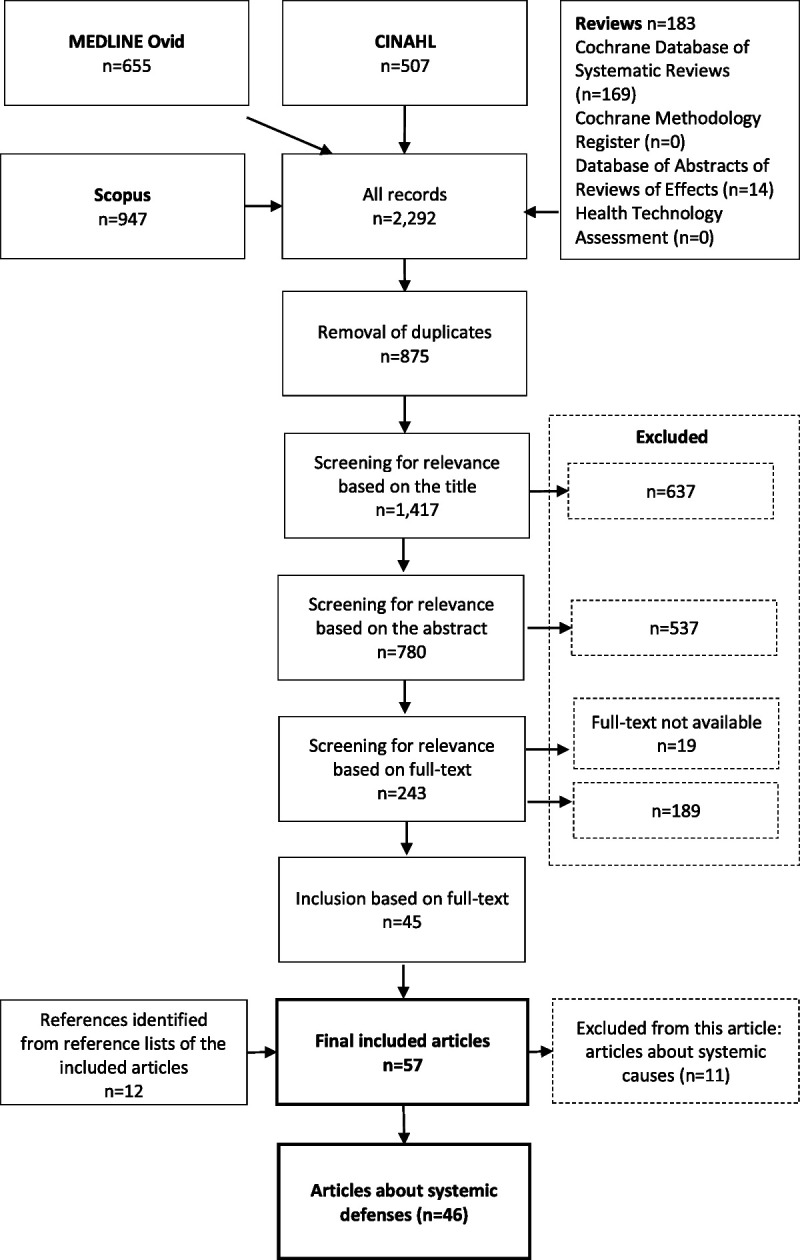
A systematic review adhering to Preferred Reporting Items for Systematic Reviews and Meta-Analyses guidelines was conducted. We searched MEDLINE (Ovid), Scopus, CINAHL, and EMB reviews for articles published between January 2005 and June 2016. Peer-reviewed journal articles published in English were included. Two reviewers independently selected articles according to a predetermined PICO tool. The quality of studies was assessed using the Grading of Recommendations Assessment, Development and Evaluation system, and the evidence was analyzed using qualitative content analysis.
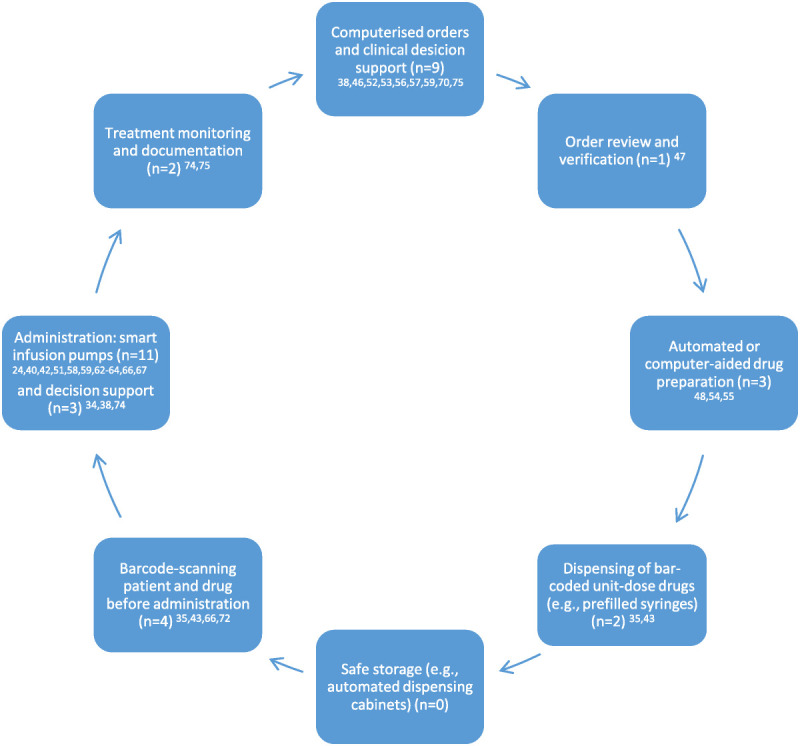
Forty-six studies from 11 countries were included in the analysis. We identified systemic defenses related to administration (n = 24 studies), prescribing (n = 8), preparation (n = 6), treatment monitoring (n = 2), and dispensing (n = 1). In addition, 5 studies explored defenses related to multiple stages of the drug delivery process. Systemic defenses including features of closed-loop medication management systems appeared in 61% of the studies, with smart pumps being the defense most widely studied (24%). The evidence quality of the included articles was limited, as 83% were graded as low quality, 13% were of moderate quality, and only 4% were of high quality.
In-hospital IV medication processes are developing toward closed-loop medication management systems. Our study provides health care organizations with preliminary knowledge about systemic defenses that can prevent IV medication errors, but more rigorous evidence is needed. There is a need for further studies to explore combinations of different systemic defenses and their effectiveness in error prevention throughout the drug delivery process.
静脉给药是一个复杂的过程,会带来全身性的用药错误风险。本研究旨在确定能预防院内静脉(IV)用药错误的系统性防护措施。
我们遵循系统评价和荟萃分析的首选报告项目进行了系统综述。我们检索了 MEDLINE(Ovid)、Scopus、CINAHL 和 EMB 评论,以获取 2005 年 1 月至 2016 年 6 月发表的文章。纳入了发表在英语期刊上的同行评议文章。两名评审员根据预定的 PICO 工具独立选择文章。使用推荐评估、制定和评估系统对研究质量进行评估,并使用定性内容分析对证据进行分析。
11 个国家的 46 项研究被纳入分析。我们确定了与给药(n = 24 项研究)、处方(n = 8 项)、准备(n = 6 项)、治疗监测(n = 2 项)和分发(n = 1 项)相关的系统性防护措施。此外,有 5 项研究探讨了与药物输送过程多个阶段相关的防护措施。包括闭环药物管理系统特征的系统性防护措施出现在 61%的研究中,其中智能泵是研究最广泛的防护措施(24%)。纳入文章的证据质量有限,83%被评为低质量,13%为中质量,只有 4%为高质量。
院内 IV 给药过程正朝着闭环药物管理系统的方向发展。本研究为医疗机构提供了有关能预防 IV 用药错误的系统性防护措施的初步知识,但需要更严格的证据。需要进一步研究来探索不同系统性防护措施的组合及其在整个药物输送过程中预防错误的有效性。