Kleine-Tebbe J, Kaul S, Mösges R
Allergy and Asthma Center Westend, Berlin.
Division of Allergology, Paul-Ehrlich-Institut, Langen, and.
Allergol Select. 2019 Dec 30;3(1):1-8. doi: 10.5414/ALX02033E. eCollection 2019.
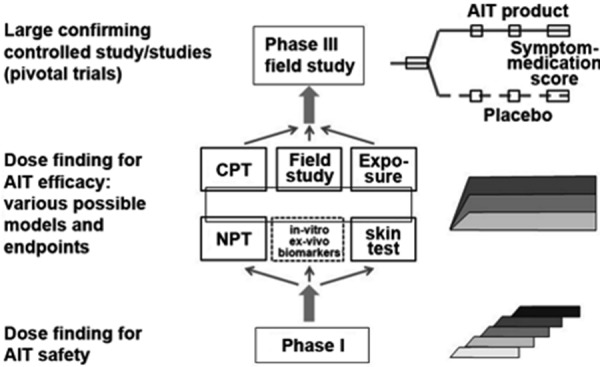
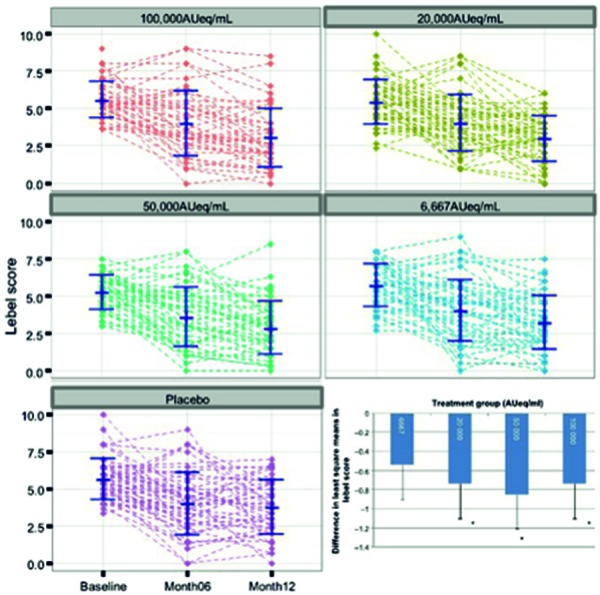
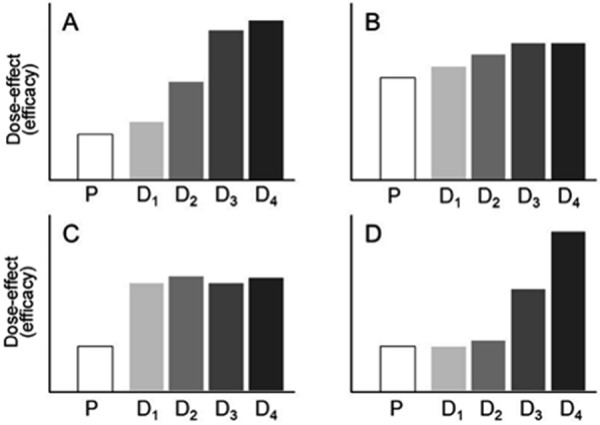
Phase II studies on allergen immunotherapy (AIT) should define the dose with the best balance between efficacy and safety ("optimal dose"). Their key role is based on dose selection for subsequent pivotal studies (phase III, field studies). Since products for AIT differ in composition and unit definitions, phase II trials are mandatory for new products and preparations being developed according to the German Therapy Allergen Ordinance ("Therapie-Allergeneverordnung", TAV) due to current EMA guidelines since 2009. The latter permit various in-vivo models and endpoints for phase II studies, e.g., AIT-induced changes in skin test, nasal, conjunctival or bronchial provocation, or in exposure chamber or field trials. Selection and graduation of the doses, minimization of placebo effects, and sufficient numbers of patients are a challenge. Effort, required time, and costs are important variables for the initiators of phase II trials. Risks are characterized by e.g., a) too small doses without relevant differences compared to placebo, b) missing true dose-response relationships, c) strong placebo effect and consequently small "therapeutic window", d) large heterogeneity and missing distinct differences (compared to placebo), e) too small effects in field studies due to low allergen exposure, f) missing dose-related increase (in case of too high doses). In the view of the Paul-Ehrlich-Institute, the unambiguous phase II trials with TAV products performed until today were not able to confirm the marketed doses for AIT. Regardless of the utilized model, more raw and single data should illustrate the individual outcome of AIT during phase II trials, facilitating an improved and more intuitive interpretation of the data (placebo effects? scattering?). In the medium term, evidence regarding AIT efficacy will considerably increase due to phase II trials as a prerequisite for subsequent phase III field studies. This affects all manufacturers offering AIT products in Germany and Europe.
变应原免疫疗法(AIT)的II期研究应确定在疗效和安全性之间达到最佳平衡的剂量(“最佳剂量”)。其关键作用基于为后续关键研究(III期、现场研究)选择剂量。由于AIT产品在成分和单位定义上存在差异,根据自2009年起实施的现行欧洲药品管理局(EMA)指南,对于按照德国《治疗变应原条例》(“Therapie-Allergeneverordnung”,TAV)研发的新产品和制剂,II期试验是必不可少的。后者允许在II期研究中采用各种体内模型和终点指标,例如,AIT引起的皮肤试验、鼻、结膜或支气管激发试验的变化,或在暴露室或现场试验中的变化。剂量的选择和分级、安慰剂效应的最小化以及足够数量的患者是一项挑战。努力程度、所需时间和成本是II期试验发起者的重要变量。风险表现为例如:a)剂量过小,与安慰剂相比无显著差异;b)缺乏真正的剂量反应关系;c)安慰剂效应强烈,因此“治疗窗”较小;d)异质性大且缺乏明显差异(与安慰剂相比);e)由于变应原暴露低,现场研究中的效果过小;f)剂量过高时缺乏剂量相关的增加。在保罗·埃利希研究所看来,迄今为止进行的明确的TAV产品II期试验未能证实AIT的上市剂量。无论采用何种模型,在II期试验期间,更多的原始和单一数据应能说明AIT的个体结果,便于对数据进行更好、更直观的解释(安慰剂效应?离散度?)。从中期来看,由于II期试验作为后续III期现场研究的前提条件,关于AIT疗效的证据将大幅增加。这影响到在德国和欧洲提供AIT产品的所有制造商。