Sheshadri Anoop, Kittiskulnam Piyawan, Lai Jennifer C, Johansen Kirsten L
Division of Nephrology, Department of Medicine, University of California, San Francisco, USA.
San Francisco Veterans Affairs Medical Center, San Francisco, California, USA.
BMC Nephrol. 2020 Mar 16;21(1):100. doi: 10.1186/s12882-020-01753-5.
A randomized trial of a pedometer-based intervention with weekly activity goals led to a modest increase in step count among dialysis patients. In a secondary analysis, we investigated the effect of this intervention on body composition.
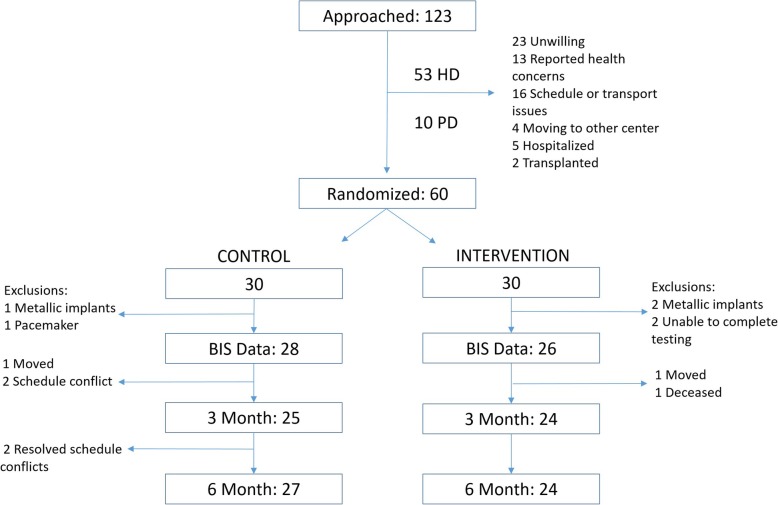
Sixty dialysis patients were randomized to standard care or a 6-month program consisting of 3 months of pedometers and weekly step count targets and 3 months of post-intervention follow-up. We obtained bioelectrical impedance spectroscopy (BIS) data on 54 of these patients (28 control, 26 intervention) and used linear mixed-modeling (adjusted for sex and dialysis modality) to estimate differences in change in total-body muscle mass (TBMM) adjusted for height, fat mass (kg), and body mass index (BMI) (kg/m) between control and intervention groups.
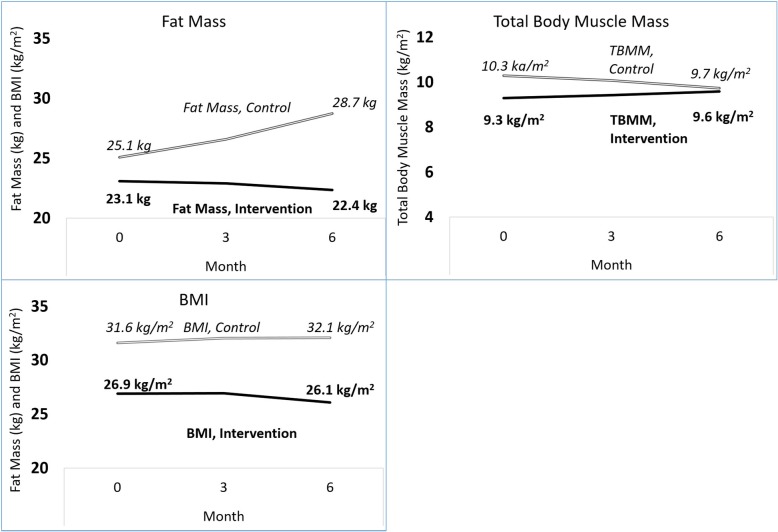
The median age of participants was 57.5 years (53-66), and 76% were men. At baseline, there was no significant difference between groups in age, BMI, race, or body composition, but there were more men in the intervention group. After 3 months, patients in the intervention group increased their average daily steps by 2414 (95% CI 1047, 3782) more than controls (p < 0.001), but there were no significant differences in body composition. However, at 6 months, participants in the intervention had a significantly greater increase from baseline in TBMM of 0.7 kg/m (95% CI 0.3, 1.13), decrease in fat mass (- 4.3 kg [95% CI -7.1, - 1.5]) and decrease in BMI (- 1.0 kg/m [95% CI -1.8, - 0.2]) relative to controls. In post-hoc analysis, each increase of 1000 steps from 0 to 3 months was associated with a 0.3 kg decrease in fat mass (95% CI 0.05, 0.5) from 0 to 6 months, but there was no dose-response relationship with TBMM/ht or BMI.
A pedometer-based intervention resulted in greater decreases in fat mass with relative preservation of muscle mass, leading to a greater decrease in BMI over time compared with patients not in the intervention. These differences were driven as much by worsening in the control group as by improvement in the intervention group. Step counts had a dose-response relationship with decrease in fat mass.
ClinicalTrials.gov (NCT02623348). 02 December 2015.
一项基于计步器的干预措施随机试验,设定每周活动目标,使透析患者的步数有适度增加。在一项二次分析中,我们研究了该干预措施对身体成分的影响。
60名透析患者被随机分为接受标准护理或参加一个为期6个月的项目,该项目包括3个月使用计步器及每周步数目标,以及3个月的干预后随访。我们获取了其中54名患者(28名对照组,26名干预组)的生物电阻抗光谱(BIS)数据,并使用线性混合模型(根据性别和透析方式进行调整)来估计对照组和干预组之间在根据身高、脂肪量(千克)和体重指数(BMI)(千克/米)调整后的全身肌肉量(TBMM)变化差异。
参与者的中位年龄为57.5岁(53 - 66岁),76%为男性。在基线时,两组在年龄、BMI、种族或身体成分方面无显著差异,但干预组男性更多。3个月后,干预组患者平均每日步数比对照组多增加2414步(95%可信区间1047, 3782)(p < 0.001),但身体成分无显著差异。然而,在6个月时,与对照组相比,干预组参与者的TBMM较基线显著增加0.7千克/米(95%可信区间0.3, 1.13),脂肪量减少(-4.3千克[95%可信区间-7.1, -1.5]),BMI降低(-1.0千克/米[95%可信区间-1.8, -0.2])。在事后分析中,从0到3个月每增加1000步与从0到6个月脂肪量减少0.3千克(95%可信区间0.05, 0.5)相关,但与TBMM/身高或BMI无剂量反应关系。
基于计步器的干预措施导致脂肪量有更大程度减少,同时肌肉量相对保持,与未参与干预的患者相比,随着时间推移BMI降低幅度更大。这些差异在对照组恶化和干预组改善方面起的作用相当。步数与脂肪量减少存在剂量反应关系。
ClinicalTrials.gov(NCT02623348)。2015年12月2日。