Aston-Deaville Sebastian, Carlsson Emil, Saleem Muhammad, Thistlethwaite Angela, Chan Hannah, Maharjan Sunil, Facchetti Alessandra, Feavers Ian M, Alistair Siebert C, Collins Richard F, Roseman Alan, Derrick Jeremy P
Lydia Becker Institute of Immunology and Inflammation, School of Biological Sciences, Faculty of Biology, Medicine and Health, Manchester Academic Health Science Centre, University of Manchester, Manchester M13 9PL, UK.
National Institute for Biological Standards and Control, Blanche Lane, South Mimms, Hertfordshire EN6 3QG, UK.
Vaccine. 2020 Apr 3;38(16):3201-3209. doi: 10.1016/j.vaccine.2020.03.001. Epub 2020 Mar 13.
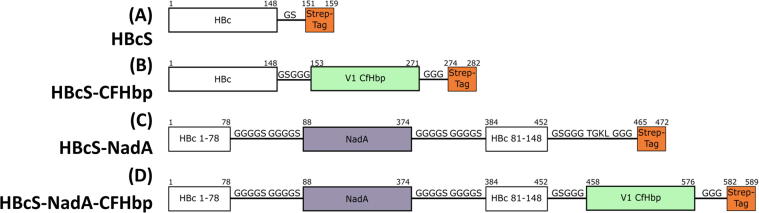
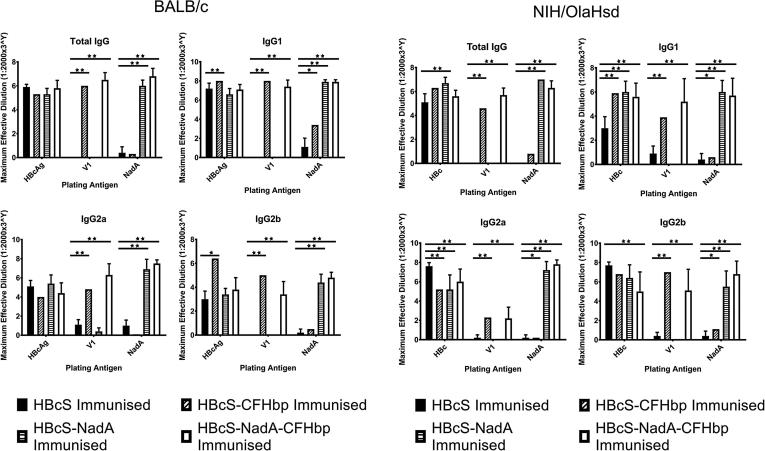
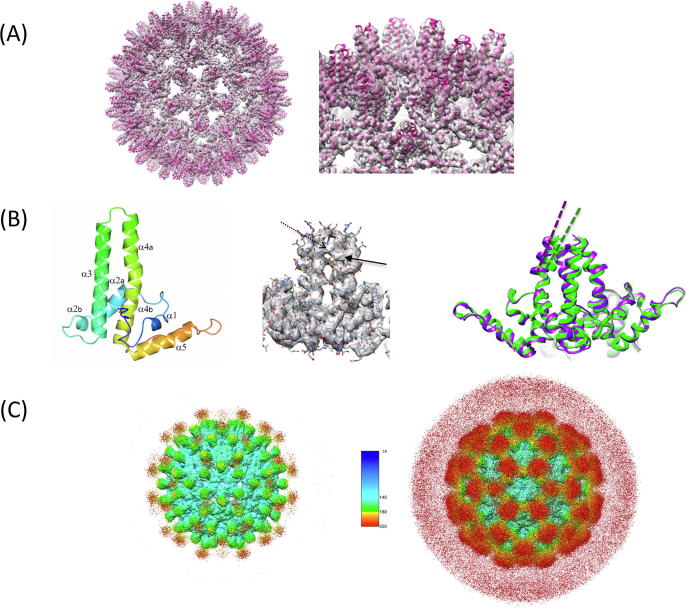
Neisseria meningitidis is the causative agent of meningococcal meningitis and sepsis and remains a significant public health problem in many countries. Efforts to develop a comprehensive vaccine against serogroup B meningococci have focused on the use of surface-exposed outer membrane proteins. Here we report the use of virus-like particles derived from the core protein of Hepatitis B Virus, HBc, to incorporate antigen domains derived from Factor H binding protein (FHbp) and the adhesin NadA. The extracellular domain of NadA was inserted into the major immunodominant region of HBc, and the C-terminal domain of FHbp at the C-terminus (CFHbp), creating a single polypeptide chain 3.7-fold larger than native HBc. Remarkably, cryoelectron microscopy revealed that the construct formed assemblies that were able to incorporate both antigens with minimal structural changes to native HBc. Electron density was weak for NadA and absent for CFHbp, partly attributable to domain flexibility. Following immunization of mice, three HBc fusions (CFHbp or NadA alone, NadA + CFHbp) were able to induce production of IgG1, IgG2a and IgG2b antibodies reactive against their respective antigens at dilutions in excess of 1:18,000. However, only HBc fusions containing NadA elicited the production of antibodies with serum bactericidal activity. It is hypothesized that this improved immune response is attributable to the adoption of a more native-like folding of crucial conformational epitopes of NadA within the chimeric VLP. This work demonstrates that HBc can incorporate insertions of large antigen domains but that maintenance of their three-dimensional structure is likely to be critical in obtaining a protective response.
脑膜炎奈瑟菌是脑膜炎球菌性脑膜炎和败血症的病原体,在许多国家仍然是一个重大的公共卫生问题。开发针对B群脑膜炎球菌的综合疫苗的努力主要集中在使用表面暴露的外膜蛋白。在此,我们报告了利用源自乙肝病毒核心蛋白(HBc)的病毒样颗粒,来整合源自因子H结合蛋白(FHbp)和黏附素NadA的抗原结构域。将NadA的胞外结构域插入HBc的主要免疫显性区域,并将FHbp的C末端结构域(CFHbp)置于C末端,从而产生一条比天然HBc大3.7倍的单多肽链。值得注意的是,冷冻电子显微镜显示该构建体形成的组装体能够整合两种抗原,且对天然HBc的结构改变最小。NadA的电子密度较弱,CFHbp则没有电子密度,部分原因是结构域的灵活性。对小鼠进行免疫后,三种HBc融合体(单独的CFHbp或NadA、NadA + CFHbp)能够诱导产生针对各自抗原的IgG1、IgG2a和IgG2b抗体,稀释度超过1:18,000。然而,只有含有NadA的HBc融合体能够引发具有血清杀菌活性的抗体产生。据推测,这种改善的免疫反应归因于嵌合病毒样颗粒内NadA关键构象表位采用了更接近天然的折叠方式。这项工作表明,HBc能够整合大抗原结构域的插入片段,但维持其三维结构可能对获得保护性反应至关重要。