Banerjee Arinjay, Zhang Xi, Yip Alyssa, Schulz Katharina S, Irving Aaron T, Bowdish Dawn, Golding Brian, Wang Lin-Fa, Mossman Karen
Michael DeGroote Institute for Infectious Disease Research, McMaster Immunology Research Centre, Department of Pathology and Molecular Medicine, McMaster University, Hamilton, ON L8S 4K1, Canada.
Department of Biology, McMaster University, Hamilton, ON L8S 4K1, Canada.
iScience. 2020 Mar 27;23(3):100958. doi: 10.1016/j.isci.2020.100958. Epub 2020 Mar 2.
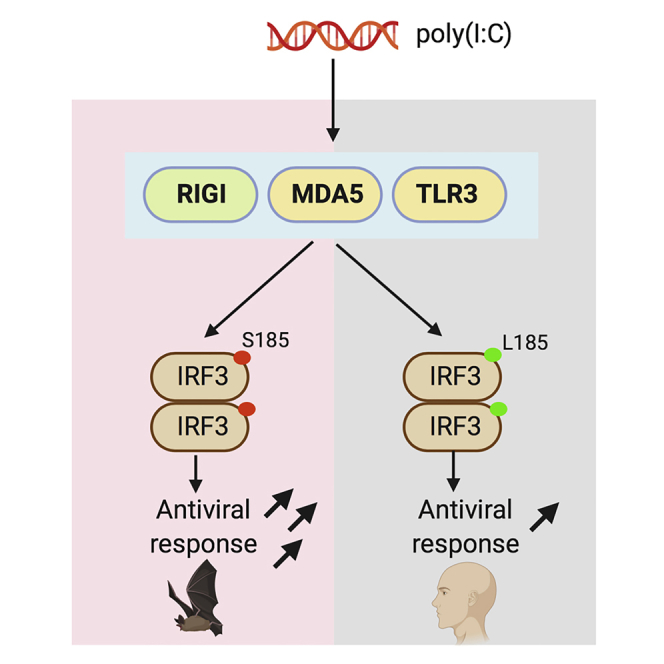
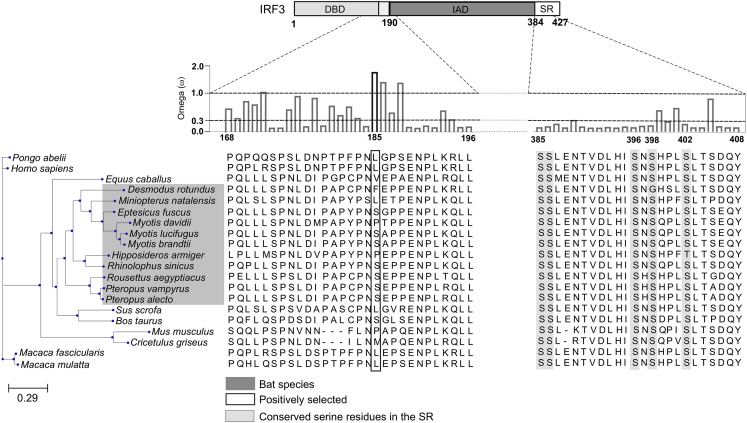
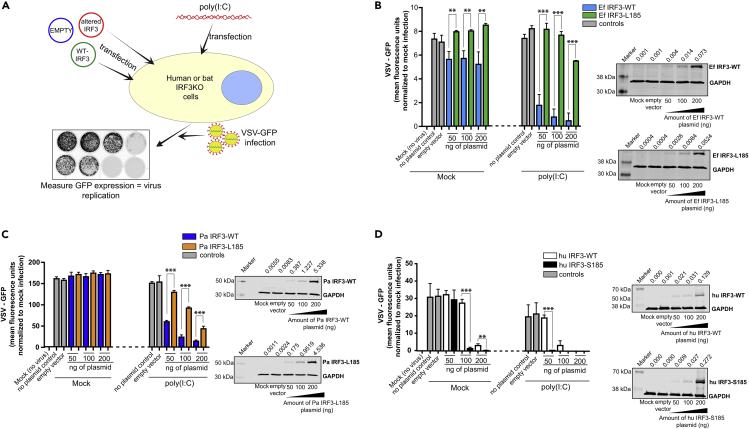
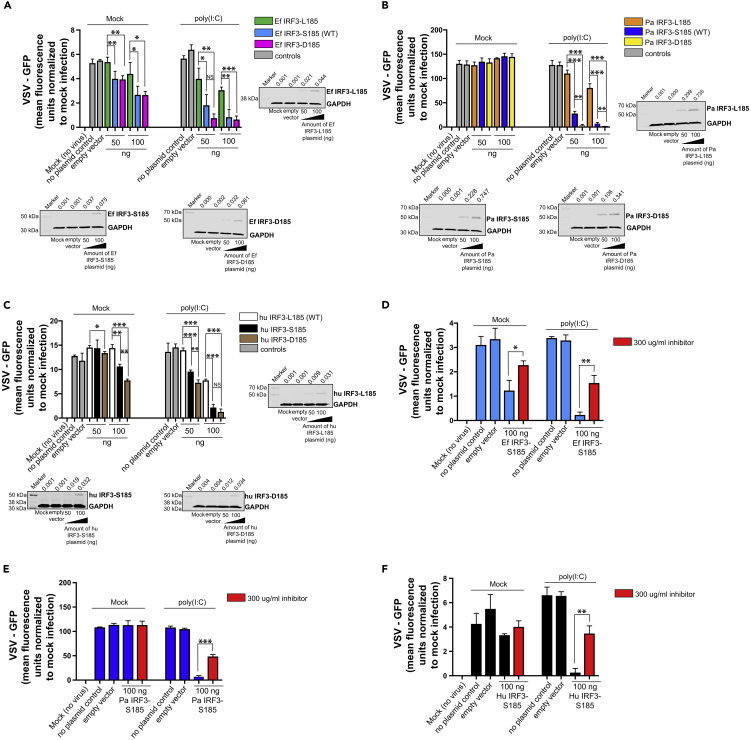
Compared with other mammals, bats harbor more zoonotic viruses per species and do not demonstrate signs of disease on infection with these viruses. To counteract infections with viruses, bats have evolved enhanced mechanisms to limit virus replication and immunopathology. However, molecular and cellular drivers of antiviral responses in bats largely remain an enigma. In this study, we demonstrate that a serine residue in IRF3 is positively selected for in multiple bat species. IRF3 is a central regulator of innate antiviral responses in mammals. Replacing the serine residue in bat IRF3 with the human leucine residue decreased antiviral protection in bat cells, whereas the addition of this serine residue in human IRF3 significantly enhanced antiviral protection in human cells. Our study provides genetic and functional evidence for enhanced IRF3-mediated antiviral responses in bats and adds support to speculations that bats have positively selected for multiple adaptations in their antiviral immune responses.
与其他哺乳动物相比,蝙蝠每个物种携带的人畜共患病毒更多,并且感染这些病毒后不会表现出疾病症状。为了对抗病毒感染,蝙蝠进化出了增强的机制来限制病毒复制和免疫病理反应。然而,蝙蝠抗病毒反应的分子和细胞驱动因素在很大程度上仍然是个谜。在这项研究中,我们证明IRF3中的一个丝氨酸残基在多个蝙蝠物种中受到正选择。IRF3是哺乳动物先天性抗病毒反应的核心调节因子。将蝙蝠IRF3中的丝氨酸残基替换为人的亮氨酸残基会降低蝙蝠细胞中的抗病毒保护作用,而在人IRF3中添加这个丝氨酸残基则显著增强了人细胞中的抗病毒保护作用。我们的研究为蝙蝠中增强的IRF3介导的抗病毒反应提供了遗传和功能证据,并支持了蝙蝠在其抗病毒免疫反应中经过正选择而产生多种适应性的推测。