Department of Medical Sciences, Uppsala University, Uppsala, Sweden.
Department of Pharmaceutical Biosciences, Uppsala University, Uppsala, Sweden.
Antimicrob Agents Chemother. 2020 May 21;64(6). doi: 10.1128/AAC.02111-19.
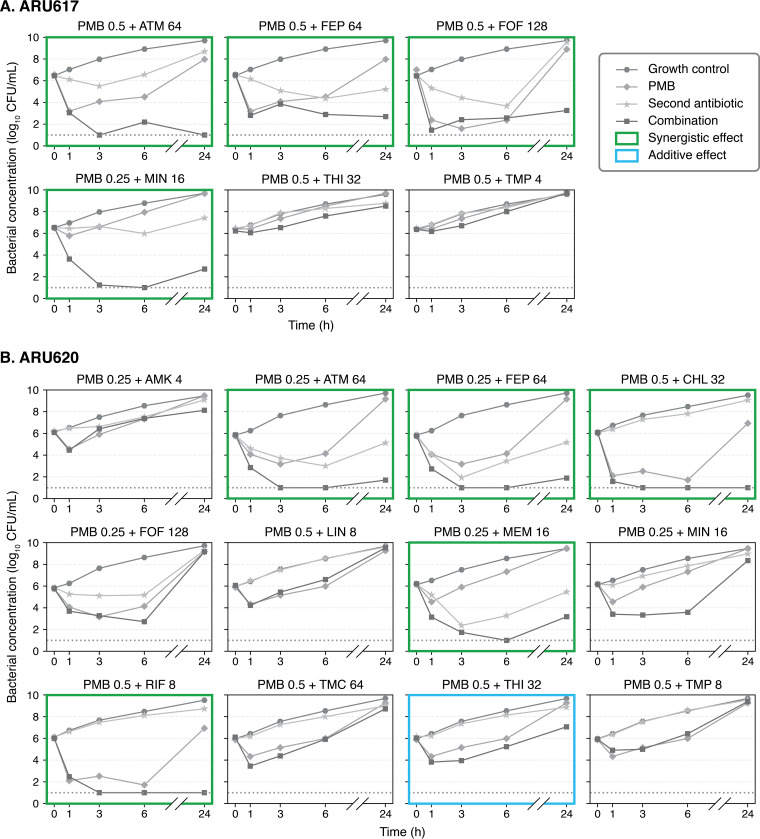
Antibiotic combination therapy is used for severe infections caused by multidrug-resistant (MDR) Gram-negative bacteria, yet data regarding which combinations are most effective are lacking. This study aimed to evaluate the efficacy of polymyxin B in combination with 13 other antibiotics against four clinical strains of MDR We evaluated the interactions of polymyxin B in combination with amikacin, aztreonam, cefepime, chloramphenicol, ciprofloxacin, fosfomycin, linezolid, meropenem, minocycline, rifampin, temocillin, thiamphenicol, or trimethoprim by automated time-lapse microscopy using predefined cutoff values indicating inhibition of growth (≤10 CFU/ml) at 24 h. Promising combinations were subsequently evaluated in static time-kill experiments. All strains were intermediate or resistant to polymyxin B, antipseudomonal β-lactams, ciprofloxacin, and amikacin. Genes encoding β-lactamases (e.g., and ) and mutations associated with permeability and efflux were detected in all strains. In the time-lapse microscopy experiments, positive interactions were found with 39 of 52 antibiotic combination/bacterial strain setups. Enhanced activity was found against all four strains with polymyxin B used in combination with aztreonam, cefepime, fosfomycin, minocycline, thiamphenicol, and trimethoprim. Time-kill experiments showed additive or synergistic activity with 27 of the 39 tested polymyxin B combinations, most frequently with aztreonam, cefepime, and meropenem. Positive interactions were frequently found with the tested combinations, against strains that harbored several resistance mechanisms to the single drugs, and with antibiotics that are normally not active against Further study is needed to explore the clinical utility of these combinations.
抗生素联合治疗用于治疗由多重耐药(MDR)革兰氏阴性菌引起的严重感染,但缺乏关于哪些组合最有效的数据。本研究旨在评估多粘菌素 B 联合 13 种其他抗生素对四种临床 MDR 菌株的疗效。我们通过自动时间 lapse 显微镜评估了多粘菌素 B 与阿米卡星、氨曲南、头孢吡肟、氯霉素、环丙沙星、磷霉素、利奈唑胺、美罗培南、米诺环素、利福平、替莫西林、噻苯达唑或甲氧苄啶联合使用时的相互作用,使用预定义的临界值(≤10 CFU/ml)在 24 小时内指示生长抑制。随后,在静态时间杀伤实验中评估了有前途的组合。所有菌株对多粘菌素 B、抗假单胞菌β-内酰胺类药物、环丙沙星和阿米卡星均呈中介或耐药。所有菌株均检测到编码β-内酰胺酶(如 和 )和与通透性和外排相关的突变的基因。在时间 lapse 显微镜实验中,在 52 种抗生素组合/细菌株设定中发现了 39 种具有阳性相互作用。在与氨曲南、头孢吡肟、磷霉素、米诺环素、噻苯达唑和甲氧苄啶联合使用时,发现对所有四种菌株均具有增强活性。时间杀伤实验显示,在 39 种测试的多粘菌素 B 组合中,有 27 种具有相加或协同活性,最常见的是与氨曲南、头孢吡肟和美罗培南联合使用。在测试组合中经常发现阳性相互作用,针对携带多种耐药机制的菌株,以及对抗生素通常对 无活性的抗生素,需要进一步研究以探讨这些组合的临床应用。