Huang Wendi, Zhou Yongjian, Tu Lin, Ba Zhisheng, Huang Juan, Huang Nanqu, Luo Yong
Department of Pediatrics, Guizhou Medical University, Guizhou, China.
School of Graduate Studies, Zunyi Medical University, Guizhou, China.
Front Mol Neurosci. 2020 Feb 28;13:26. doi: 10.3389/fnmol.2020.00026. eCollection 2020.
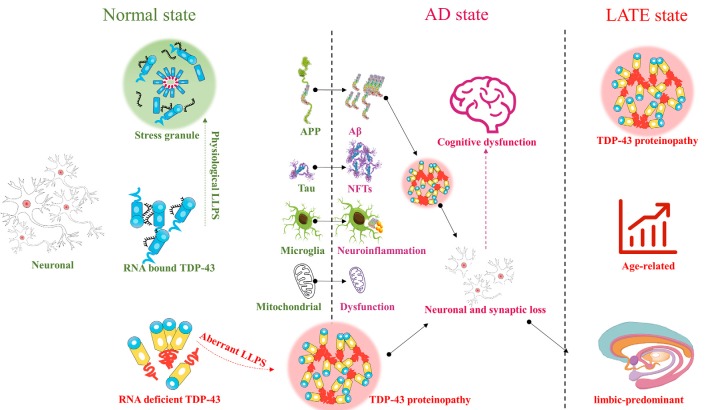
Since the discovery of TAR DNA-binding protein 43 (TDP-43) in 1995, our understanding of its role continues to expand as research progresses. In particular, its role in the pathogenesis of Alzheimer's disease (AD) has drawn increasing interest in recent years. TDP-43 may participate in various pathogenic mechanisms underlying AD, such as amyloid β deposition, tau hyperphosphorylation, mitochondrial dysfunction, and neuroinflammation. Because AD is complex and heterogeneous, and because of the distinct characteristics of TDP-43, mostly seen in the oldest-old and those with more severe clinical phenotype, subcategorization based on specific features or biomarkers may significantly improve diagnosis and treatment. AD-like cognitive dysfunction associated with TDP-43 pathology may therefore be a distinct encephalopathy, referred to as limbic-predominant age-related TDP-43 encephalopathy (LATE).
自1995年发现TAR DNA结合蛋白43(TDP - 43)以来,随着研究的进展,我们对其作用的理解不断扩展。特别是近年来,它在阿尔茨海默病(AD)发病机制中的作用引起了越来越多的关注。TDP - 43可能参与AD潜在的各种致病机制,如淀粉样β蛋白沉积、tau蛋白过度磷酸化、线粒体功能障碍和神经炎症。由于AD复杂且具有异质性,以及TDP - 43的独特特征(主要见于高龄老人和临床表型更严重的患者),基于特定特征或生物标志物进行亚分类可能会显著改善诊断和治疗。因此,与TDP - 43病理相关的类AD认知功能障碍可能是一种独特的脑病,称为边缘叶为主的年龄相关性TDP - 43脑病(LATE)。