Albohn Daniel N, Adams Reginald B
Department of Psychology, The Pennsylvania State University, University Park, PA, United States.
Front Psychol. 2020 Feb 28;11:264. doi: 10.3389/fpsyg.2020.00264. eCollection 2020.
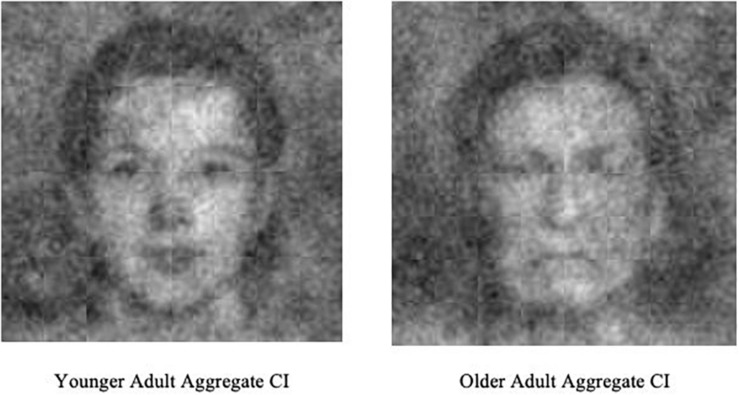
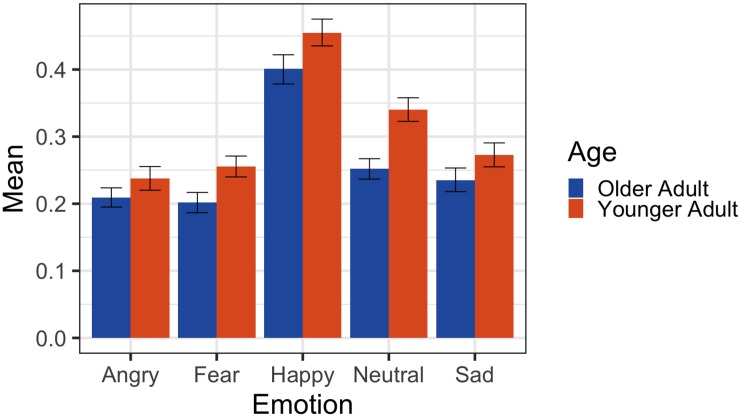
The evolution of the human brain and visual system is widely believed to have been shaped by the need to process and make sense out of expressive information, particularly via the face. We are so attuned to expressive information in the face that it informs even stable trait inferences (e.g., Knutson, 1996) through a process we refer to here as the (Albohn et al., 2019). We even derive highly consistent beliefs about the emotional lives of others based on emotion-resembling facial appearance (e.g., low versus high brows, big versus small eyes, etc.) in faces we know are completely devoid of overt expression (i.e., emotion overgeneralization effect: see Zebrowitz et al., 2010). The present studies extend these insights to better understand lay beliefs about older and younger adults' emotion dispositions and their impact on behavioral outcomes. In Study 1, we found that older versus younger faces objectively have more negative emotion-resembling cues in the face (using computer vision), and that raters likewise attribute more negative emotional dispositions to older versus younger adults based just on neutral facial appearance (see too Adams et al., 2016). In Study 2, we found that people appear to encode these negative emotional appearance cues in memory more so for older than younger adult faces. Finally, in Study 3 we exam downstream behavioral consequences of these negative attributions, showing that observers' avoidance of older versus younger faces is mediated by emotion-resembling facial appearance.
人们普遍认为,人类大脑和视觉系统的进化是由处理和理解表达性信息的需求所塑造的,尤其是通过面部来进行。我们对脸上的表达性信息非常敏感,以至于它甚至能通过我们在此称为(阿尔博恩等人,2019年)的过程来影响稳定的特质推断(例如,克努森,1996年)。我们甚至会根据我们知道完全没有明显表情的脸上类似情绪的面部特征(例如,低眉与高眉、大眼睛与小眼睛等),对他人的情感生活得出高度一致的看法(即情绪过度概括效应:见泽布罗维茨等人,2010年)。本研究扩展了这些见解,以更好地理解关于老年人和年轻人情绪倾向的外行信念及其对行为结果的影响。在研究1中,我们发现,客观上,老年人的脸与年轻人的脸相比,在脸上有更多类似负面情绪的线索(使用计算机视觉),并且评分者同样仅根据中性面部外观就将更多负面情绪倾向归因于老年人而非年轻人(另见亚当斯等人,2016年)。在研究2中,我们发现,与年轻人的脸相比,人们似乎在记忆中对老年人的脸更多地编码了这些负面情绪外观线索。最后,在研究3中,我们考察了这些负面归因的下游行为后果,表明观察者对老年人脸与年轻人脸的回避是由类似情绪的面部外观介导的。