Albohn Daniel N, Adams Reginald B
Department of Psychology, The Pennsylvania State University, University Park, PA, United States.
Front Psychol. 2021 Feb 25;12:612923. doi: 10.3389/fpsyg.2021.612923. eCollection 2021.
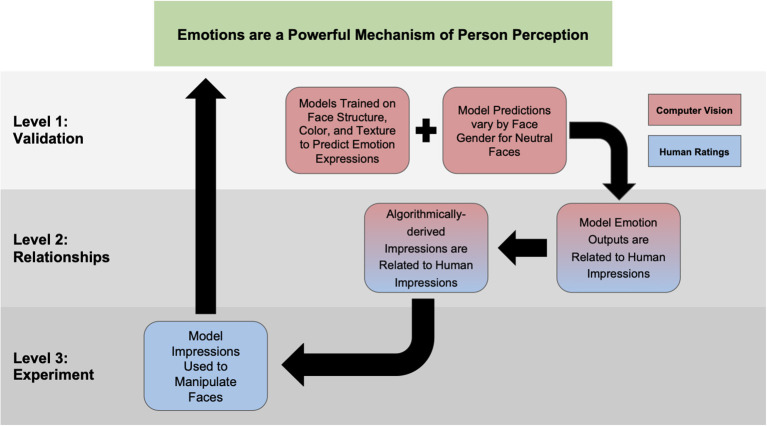
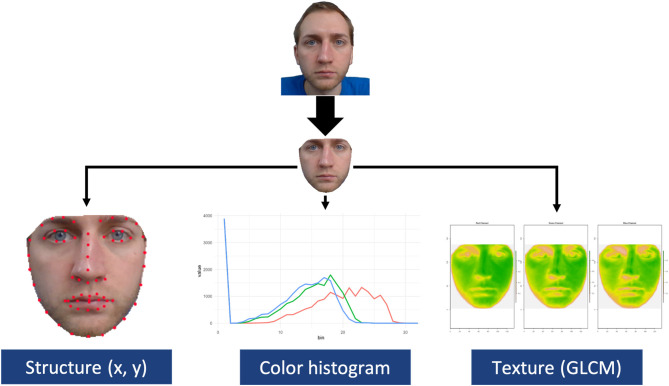
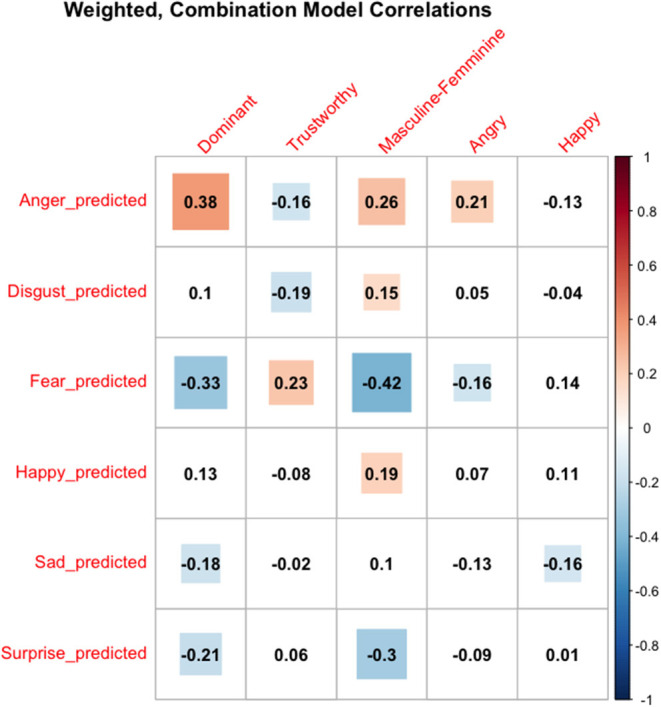
Previous research has demonstrated how emotion resembling cues in the face help shape impression formation (i. e., emotion overgeneralization). Perhaps most notable in the literature to date, has been work suggesting that gender-related appearance cues are visually confounded with certain stereotypic expressive cues (see Adams et al., 2015 for review). Only a couple studies to date have used computer vision to directly map out and test facial structural resemblance to emotion expressions using facial landmark coordinates to estimate face shape. In one study using a Bayesian network classifier trained to detect emotional expressions structural resemblance to a specific expression on a non-expressive (i.e., neutral) face was found to influence trait impressions of others (Said et al., 2009). In another study, a connectionist model trained to detect emotional expressions found different emotion-resembling cues in male vs. female faces (Zebrowitz et al., 2010). Despite this seminal work, direct evidence confirming the theoretical assertion that humans likewise utilize these emotion-resembling cues when forming impressions has been lacking. Across four studies, we replicate and extend these prior findings using new advances in computer vision to examine gender-related, emotion-resembling structure, color, and texture (as well as their weighted combination) and their impact on gender-stereotypic impression formation. We show that all three (plus their combination) are meaningfully related to human impressions of emotionally neutral faces. Further when applying the computer vision algorithms to experimentally manipulate faces, we show that humans derive similar impressions from them as did the computer.
先前的研究已经证明,面部类似情绪的线索如何有助于塑造印象形成(即情绪过度概括)。也许在迄今为止的文献中最值得注意的是,有研究表明与性别相关的外貌线索在视觉上与某些刻板的表达线索混淆在一起(见亚当斯等人,2015年的综述)。迄今为止,只有几项研究使用计算机视觉,通过面部标志坐标来估计面部形状,直接绘制并测试面部结构与情绪表达的相似性。在一项研究中,使用经过训练以检测情绪表达的贝叶斯网络分类器,发现非表达性(即中性)面部上与特定表达的结构相似性会影响对他人的特质印象(赛义德等人,2009年)。在另一项研究中,一个经过训练以检测情绪表达的联结主义模型在男性和女性面部发现了不同的类似情绪的线索(泽布罗维茨等人,2010年)。尽管有这项开创性的工作,但一直缺乏直接证据来证实人类在形成印象时同样会利用这些类似情绪的线索这一理论断言。在四项研究中,我们利用计算机视觉的新进展来复制和扩展这些先前的发现,以研究与性别相关的、类似情绪的结构、颜色和纹理(以及它们的加权组合)及其对性别刻板印象形成的影响。我们表明,所有这三者(加上它们的组合)都与人类对情绪中性面孔的印象有意义地相关。此外,当应用计算机视觉算法对人脸进行实验性操作时,我们表明人类从这些人脸中获得的印象与计算机获得的相似。