Liu Dun-Yi, Zhang Wei, Liu Yu-Min, Chen Xin-Ping, Zou Chun-Qin
Key Laboratory of Efficient Utilization of Soil and Fertilizer Resources, College of Resources and Environment, Southwest University, Chongqing, China.
Key Laboratory of Plant-Soil Interactions, Ministry of Education, Center for Resources, Environment and Food Security, China Agricultural University, Beijing, China.
Front Plant Sci. 2020 Feb 28;11:188. doi: 10.3389/fpls.2020.00188. eCollection 2020.
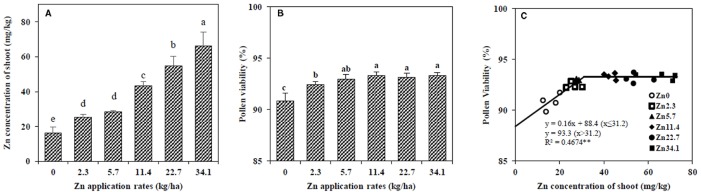
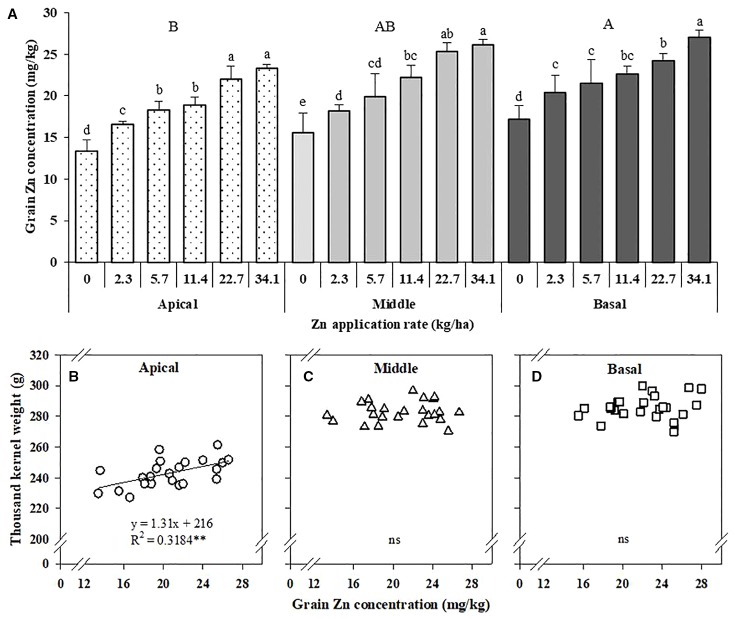
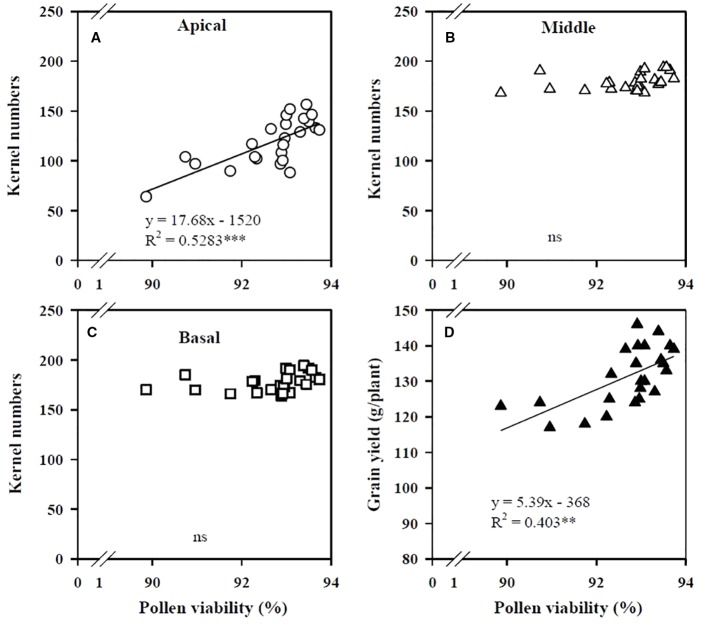
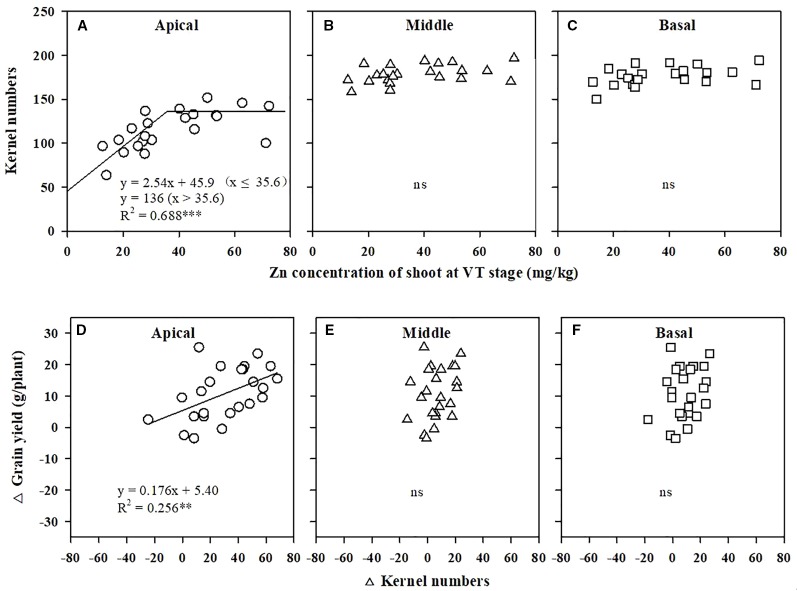
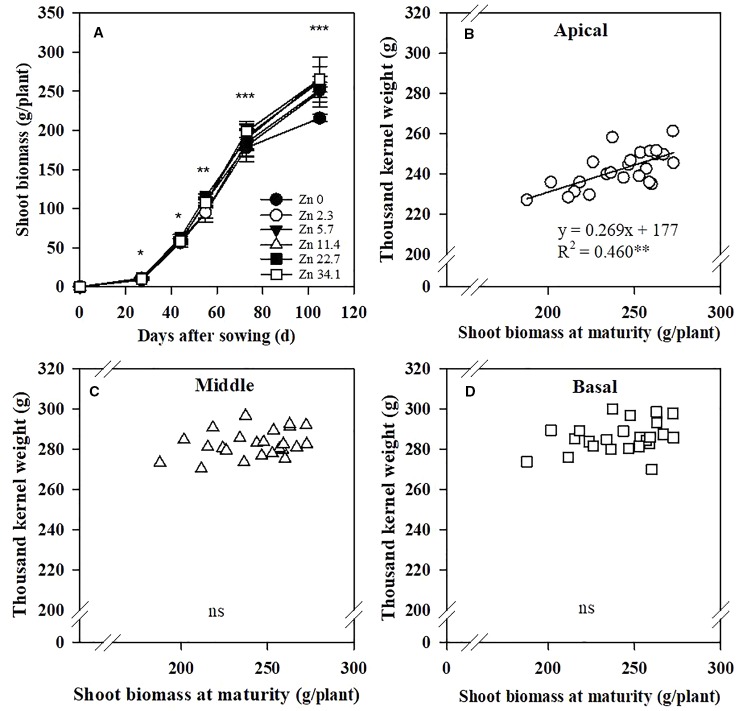
Improving the development of inferior grains is important for increasing maize yield under high-density conditions. However, the effect of micronutrients, especially zinc (Zn), on the development of inferior grains and maize yield under field conditions has not been evaluated to date. A field experiment with six Zn application rates (0, 2.3, 5.7, 11.4, 22.7, and 34.1 kg/ha) was conducted to investigate the effects of soil application of Zn fertilizer on the development of inferior grains. Pollen viability was measured at the tasseling stage. The maize spike was divided into apical (inferior grain), middle, and basal sections for further measurement at harvest. Results showed that soil application of Zn fertilizer increased maize yield by 4.2-16.7% due to increased kernel number and weight in the apical, but not in the middle and basal sections. Zn application also significantly increased pollen viability at the tasseling stage. The critical Zn concentrations in shoots at the tasseling stage for obtaining high pollen viability and high kernel numbers of inferior grains were 31.2 and 35.6 mg/kg, respectively. Zn application also increased the 1,000-kernel weight of inferior grain due to high biomass accumulation. Furthermore, the grain Zn concentration of inferior grain with Zn application increased by 24.3-74.9% compared with no Zn application. Thus, soil application of Zn fertilizer successfully increased grain yield of maize by improving pollen viability, kernel number, and kernel weight of inferior grains (apical section), also contributing to grain Zn biofortification.
改善弱势籽粒的发育对于在高密度条件下提高玉米产量至关重要。然而,迄今为止,尚未评估微量元素,尤其是锌(Zn)对田间条件下弱势籽粒发育和玉米产量的影响。进行了一项田间试验,设置了六个锌施用量水平(0、2.3、5.7、11.4、22.7和34.1千克/公顷),以研究土壤施用锌肥对弱势籽粒发育的影响。在抽雄期测定花粉活力。在收获时,将玉米果穗分为顶部(弱势籽粒)、中部和基部进行进一步测量。结果表明,土壤施用锌肥使玉米产量提高了4.2%-16.7%,这是由于顶部籽粒数量和重量增加,但中部和基部没有增加。施用锌肥还显著提高了抽雄期的花粉活力。抽雄期获得高花粉活力和高弱势籽粒粒数时,地上部锌的临界浓度分别为31.2和35.6毫克/千克。由于生物量积累高,施用锌肥还增加了弱势籽粒的千粒重。此外,与不施锌相比,施用锌肥的弱势籽粒的籽粒锌浓度提高了24.3%-74.9%。因此,土壤施用锌肥通过提高花粉活力、弱势籽粒(顶部)的粒数和粒重,成功提高了玉米的籽粒产量,也有助于籽粒锌生物强化。