Zare Javid Ahmad, Aminzadeh Majid, Haghighi-Zadeh Mohammad Hosein, Jamalvandi Mona
Nutrition and Metabolic Diseases Research Center, Ahvaz Jundishapur University of Medical Sciences, Ahvaz, Iran.
Department of Nutrition, School of Allied Medical Sciences, Ahvaz Jundishapur University of Medical Sciences, Ahvaz, Iran.
Diabetes Metab Syndr Obes. 2020 Mar 2;13:607-617. doi: 10.2147/DMSO.S238867. eCollection 2020.
The aim of the present study was to evaluate the effects of synbiotic on glycemic status, lipid profile, and biomarkers of oxidative stress in type 1 diabetes mellitus (T1DM) patients.
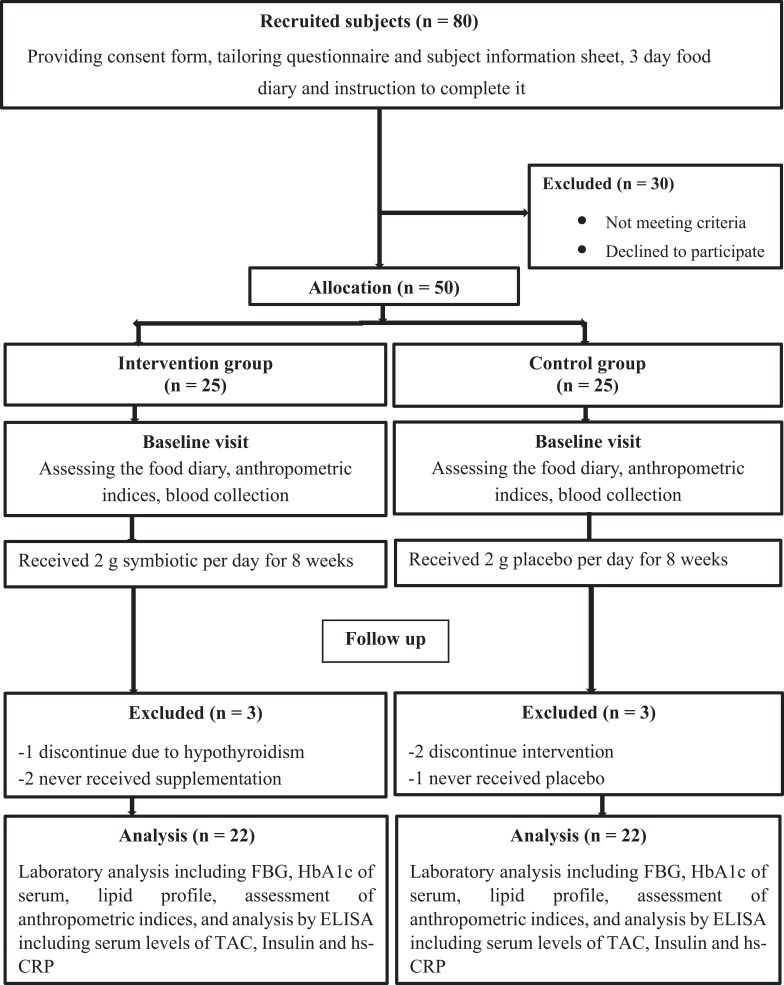
In this double-blind clinical trial, 50 T1DM patients were randomly allocated to intervention (n = 25) and control (n = 25) groups and received either synbiotic powder ( GBI-30 (probiotic), maltodextrin and fructooligosaccharide (prebiotic)) or placebo 2 g per day for 8 weeks. Fasting blood samples were collected before and after the intervention to measure fasting blood glucose (FBG), insulin concentration, hemoglobin A1c (HbA1c), lipid profile, and biomarkers of oxidative stress such as total antioxidant capacity (TAC) and hs-C-reactive protein (hs-CRP).
Supplementation with synbiotic resulted in a significant decrease in the mean serum levels of HbA1c and hs-CRP ( = 0.01 and = 0.004, respectively), and marginally significant decrease in FBG ( = 0.05) in the intervention group post- intervention. Also, the mean changes of FBG and hs-CRP were significantly lower in the intervention group compared with the control group ( = 0.03 and = 0.005, respectively). There were no significant changes found in lipid profile in intervention group post-intervention (≥ 0.05). The mean serum levels of insulin and TAC were significantly increased in the intervention group post-intervention ( = 0.001). There was a significant increase in the mean changes of TAC ( = 0.005) in the intervention group compared with the control group.
The 8-week synbiotic supplementation in T1DM patients may be effective in improvement of FBG, HbA1c, insulin, hs-CRP, and TAC.
本研究旨在评估合生元对1型糖尿病(T1DM)患者血糖状态、血脂谱及氧化应激生物标志物的影响。
在这项双盲临床试验中,50例T1DM患者被随机分为干预组(n = 25)和对照组(n = 25),分别接受合生元粉(GBI - 30(益生菌)、麦芽糊精和低聚果糖(益生元))或安慰剂,每天2克,持续8周。在干预前后采集空腹血样,以测量空腹血糖(FBG)、胰岛素浓度、糖化血红蛋白(HbA1c)、血脂谱以及氧化应激生物标志物,如总抗氧化能力(TAC)和高敏C反应蛋白(hs - CRP)。
干预组干预后,补充合生元导致HbA1c和hs - CRP的平均血清水平显著降低(分别为P = 0.01和P = 0.004),FBG略有显著降低(P = 0.05)。此外,干预组的FBG和hs - CRP平均变化与对照组相比显著更低(分别为P = 0.03和P = 0.005)。干预组干预后血脂谱无显著变化(P≥0.05)。干预组干预后胰岛素和TAC的平均血清水平显著升高(P = 0.001)。与对照组相比,干预组TAC的平均变化显著增加(P = 0.005)。
T1DM患者补充8周合生元可能有效改善FBG、HbA1c、胰岛素、hs - CRP和TAC。