Tyszkiewicz-Nwafor Marta, Rybakowski Filip, Dmitrzak-Weglarz Monika, Skibinska Maria, Paszynska Elżbieta, Dutkiewicz Agata, Słopien Agnieszka
Department of Child and Adolescent Psychiatry, Poznan University of Medical Sciences, Poznan, Poland.
Department Psychiatry, Poznan University of Medical Sciences, Poznan, Poland.
Front Psychiatry. 2020 Feb 28;10:1032. doi: 10.3389/fpsyt.2019.01032. eCollection 2019.
Brain-derived neurotrophic factor (BDNF), as well as oxytocin (OXY), are centrally secreted neuropeptides regulating a range of physiological processes, including food intake and metabolism. Moreover, numerous reports suggest their role in affective and cognitive symptoms of various psychiatric disorders. Thus, the study aimed to measure the serum level of BDNF and its receptor-tropomyosin-related kinase B (TrkB) and OXY in the malnourished anorexia nervosa patients and following partial weight-recovery. The correlations between levels of these proteins with the primary symptoms of the anorexia nervosa (AN) were also analyzed.
Eighty-four adolescent AN patients were recruited into the study, but only forty-two AN patients completed it. The control group comprises of thirty age- and height-matched girls (CG). Serum BDNF, TrkB, and OXY levels were measured in AN group in two time-points-at the beginning of the hospitalization in malnourished patients (AN-T1) and again after partial weight normalization, on the day of discharge (AN-T2). The severity of eating disorders, as well as depressive and obsessive-compulsive symptoms, were assessed at the same two-time points.
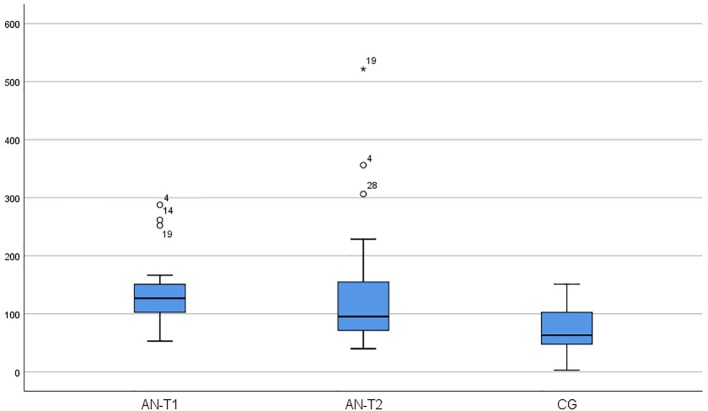
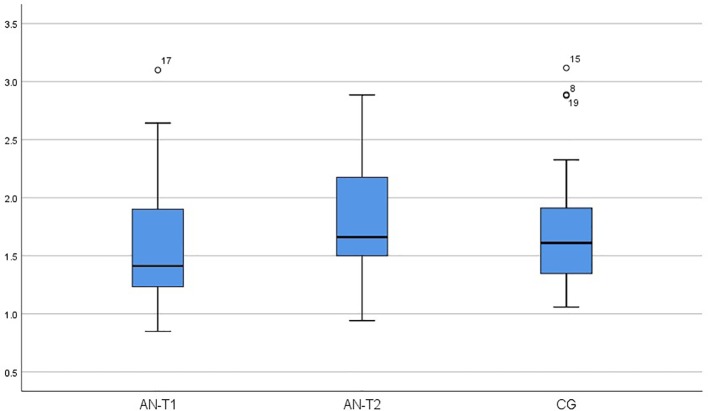
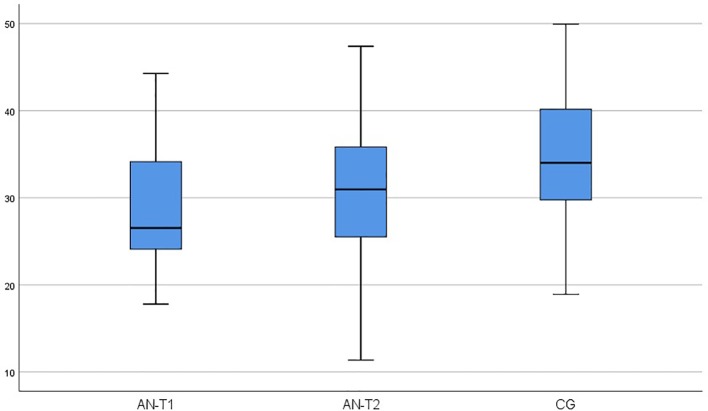
Body mass index (BMI) differed significantly between the AN-T1, AN-T2, and CG. BDNF levels for the AN-T2 increased significantly in comparison to the AN-T1, but at two-time points were significantly lower than in the CG. The OXY level did not change with weight gain and in both groups AN-T1 and AN-T2 were statistically significantly higher than in the CG. Statistically significant negative correlations between BDNF and the severity of eating disorders symptoms were found. Depressive and obsessive-compulsive symptoms did not show significant correlations with levels of studied proteins for either malnourished or partially weight recovered AN patients.
BDNF serum levels were decreased in the malnourished AN patients and tended to normalize with partial weight recovery. OXY serum levels were found to be increased in the malnourished AN patients and did not normalize with partial weight recovery, confirming previous reports about its role in the etiopathogenesis of AN. BDNF can be related to aberrant eating behaviors occurring in AN. Our results do not support the role of serum levels of BDNF, TrkB, or OXY in the modulation of depressive or obsessive-compulsive symptoms.
脑源性神经营养因子(BDNF)以及催产素(OXY)是中枢分泌的神经肽,可调节一系列生理过程,包括食物摄入和新陈代谢。此外,大量报告表明它们在各种精神疾病的情感和认知症状中发挥作用。因此,本研究旨在测量营养不良的神经性厌食症患者及其部分体重恢复后的血清BDNF及其受体——原肌球蛋白相关激酶B(TrkB)和OXY的水平。还分析了这些蛋白质水平与神经性厌食症(AN)主要症状之间的相关性。
84名青少年AN患者被纳入研究,但只有42名AN患者完成了研究。对照组由30名年龄和身高匹配的女孩组成(CG)。在AN组的两个时间点测量血清BDNF、TrkB和OXY水平——营养不良患者住院开始时(AN-T1),以及出院当天部分体重恢复正常后(AN-T2)。在相同的两个时间点评估饮食失调的严重程度以及抑郁和强迫症状。
AN-T1、AN-T2和CG之间的体重指数(BMI)存在显著差异。与AN-T1相比,AN-T2的BDNF水平显著升高,但在两个时间点均显著低于CG组。OXY水平并未随体重增加而变化,AN-T1和AN-T2两组均在统计学上显著高于CG组。发现BDNF与饮食失调症状的严重程度之间存在统计学上的显著负相关。对于营养不良或部分体重恢复的AN患者,抑郁和强迫症状与所研究蛋白质的水平均未显示出显著相关性。
营养不良的AN患者血清BDNF水平降低,部分体重恢复后趋于正常。发现营养不良的AN患者血清OXY水平升高,且部分体重恢复后未恢复正常,这证实了先前关于其在AN发病机制中作用的报道。BDNF可能与AN中出现的异常饮食行为有关。我们的结果不支持血清BDNF、TrkB或OXY水平在调节抑郁或强迫症状中的作用。